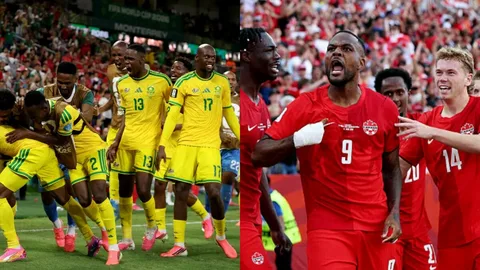
If you’d told most football analysts before the tournament that South Africa and Canada would both be standing in the Round of 32, a few eyebrows would have been raised. But here they are two nations that have consistently punched above their weight throughout the group stage now facing each other with a quarterfinal spot on the line.
This is exactly the kind of match that World Cups are made for. No overwhelming favorite, no foregone conclusion, just two teams with different footballing identities and equal determination to keep their tournament alive.
South Africa: Defense First, Everything Else Second
Bafana Bafana’s run to the knockout stage hasn’t been pretty. It hasn’t needed to be.South Africa have essentially played the same way in every group match sit deep, stay compact, frustrate the opposition, and then hit them on the counter before they’ve had time to reset. It’s disciplined, occasionally unglamorous, and remarkably effective.
Their defensive unit has been the story of their tournament. The goalkeeper has been commanding, the central defenders have marshalled their lines with composure that belies the pressure they’ve been under, and the midfield has put in the kind of thankless defensive work that wins matches without ever making highlight reels.
What’s impressed observers most is the mentality. South Africa have faced moments in every match where the pressure mounted and a lesser side would have buckled. They haven’t. They’ve absorbed it, reorganized, and waited for their moment.
Canada: Fast, Exciting, and Slightly Vulnerable at the Back
Canada’s journey to the Round of 32 has looked completely different. Where South Africa have defended and countered, Canada have pressed, attacked, and created.
The midfield has been the engine controlling possession, moving quickly, creating combinations that have consistently opened up opposition defenses. Their wide players have been a genuine threat throughout the group stage, and the forwards have benefited from being well-supplied.
The concern is the other end. Canada’s defensive transitions have been vulnerable at times. When possession is lost in advanced positions, there’s occasionally a gap behind the full-backs that quicker teams have been able to exploit. Against South Africa who are specifically built to exploit exactly that kind of space that vulnerability becomes a genuine tactical problem.
How This Match Gets Won
The tactical story essentially writes itself: Canada will want to dominate the ball and create overloads in wide areas. South Africa will want to let them have it, stay organized, and spring forward the moment the opportunity arrives.
The question is which approach holds under knockout pressure.
If Canada’s front players hit their stride early and convert one of their first clear chances, the match opens up in their favor. South Africa chasing a game isn’t their natural habitat it forces them to take risks they’d rather not take.
But if South Africa stay compact for the first half-hour, weather Canada’s early pressure, and keep the score level then the match becomes a test of nerve more than quality. And in those situations, South Africa have already shown this tournament that they know exactly what they’re doing.
Set pieces could be decisive. South Africa have been dangerous from dead balls and solid when defending them. In a match where open-play goals might be hard to come by, a corner or free kick at the right moment could be the difference.
Key Battles to Watch
Canada’s wide players vs South Africa’s full-backs This is where Canada want to create their chances. If they can get their wingers isolated and running at South Africa’s defensive line, they’ll generate opportunities. South Africa’s full-backs will need their best performance.
South Africa’s counter-attack vs Canada’s holding midfielder Whenever Canada lose possession in midfield or higher up, South Africa’s forwards will look to spring immediately. Canada’s defensive midfielder has to be alert throughout one lapse could be extremely costly.
Goalkeepers under pressure Both keepers have been reliable so far. In a tightly contested match that could go to extra time or penalties, shot-stopping and handling under pressure might end up being the most important contributions on the pitch.
The Prediction
Canada edges this one but narrowly, and nothing is certain until the final whistle.
South Africa 1 – 2 Canada
Canada’s attacking quality should prove the difference, but expect South Africa to make every minute difficult. If the match stays level past 70 minutes, the momentum could easily shift. South Africa have already defied expectations several times this tournament, and they won’t be going quietly.
Why This Match Matters Beyond the Result
Both of these teams representing what’s happening in world football right now a genuine broadening of the sport’s competitive landscape.
A decade ago, South Africa reaching the Round of 32 at a World Cup would have been a significant surprise. Canada reaching the same stage with the kind of performances they’ve put in would have been almost unthinkable. Now both are here, and neither feels like they don’t deserve to be.
For African football, South Africa’s tournament run reinforces a growing confidence that the continent’s teams can compete with anyone when organized and motivated. For North American football ahead of what promises to be enormous domestic interest in this World Cup, Canada’s performances have given the sport a genuine boost at exactly the right moment.
Whoever advances on the day, the match itself is a demonstration of why expanding the World Cup to 48 teams was always going to produce moments like this.
FAQs
Who’s the favorite to win the whole tournament?
Several traditional powers remain in contention the usual suspects from Europe and South America — but this World Cup has already produced enough surprises that making confident predictions feels risky. Teams that combine defensive solidity, squad depth, and clinical attacking football tend to go deepest. The brackets have opened up in interesting ways that give multiple contenders a realistic path.
Why are South Africa and Canada playing each other specifically?
Both came through their respective groups successfully, and the Round of 32 bracket paired them based on FIFA’s knockout format seeding. That’s the straightforward answer. The slightly more interesting answer is that both teams earned their way here by outperforming expectations which makes for a more compelling match than the bracket might have suggested on paper.
Is the Round of 32 winner-take-all?
Yes, completely. Lose and you go home. If it’s level after 90 minutes, there’s extra time. If it’s still level after that, penalties. One team advances, one doesn’t. That elimination pressure is exactly what makes knockout football different from the group stage and why teams that manage nerves and composure often outperform those with superior technical quality on paper.