
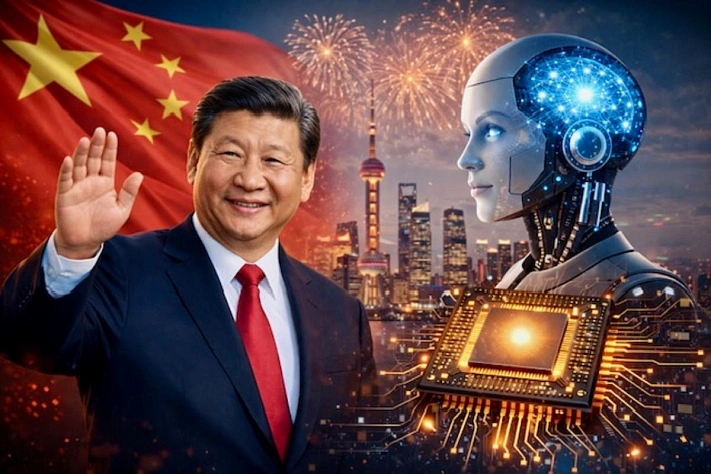
Chinese President Xi Jinping used the opening of the World Artificial Intelligence Conference in Shanghai to position Beijing as a leading voice in global AI governance, directly challenging US dominance over the sector. The speech marks one of the clearest signals yet of China AI strategy shifting from catching up technically to shaping the rules the rest of the world follows.
Background
China’s AI development has moved in stages since the government’s original national plan was released in 2017, with the goal of making the country a global AI leader by 2030. Momentum built further through the China AI strategy 2021 and China AI strategy 2022 phases, when Beijing poured state investment into chips, data infrastructure, and domestic AI research amid tightening US export controls on advanced semiconductors.
Those export restrictions were designed to slow China’s progress on cutting-edge chips. Instead, Chinese firms leaned harder into software efficiency and China open-source AI development, releasing models that required less computing power while still competing with top US systems. This approach has become a defining feature of China AI development over the past two years.
By 2026, the strategy had visibly matured. Xi’s appearance at this year’s World Artificial Intelligence Conference was itself notable, since previous editions were opened by Premier Li Qiang rather than Xi himself, a change that signals how central AI has become to China’s broader global ambitions.
Details
Speaking Friday in Shanghai, Xi told an audience that included UN Secretary-General Antonio Guterres and several regional leaders that artificial intelligence should not be dominated by a single country, calling for greater international cooperation on AI development and governance. The remarks were widely read as a direct challenge to Washington’s influence over global AI standards.
Alongside the speech, China unveiled a new body called WAICO, described as a rival AI governance organization aimed at courting Global South nations. If enough countries join, the body would establish a separate set of AI norms outside the frameworks built by the EU, the OECD, and the G7, effectively splitting global AI governance into two competing systems.
This comes as the China vs U.S. AI race has narrowed considerably. Stanford’s 2026 AI Index found the leading American model held just a 2.7-percentage-point performance advantage over the best Chinese model on Arena Leaderboard benchmarks as of March 2026, a gap that has shrunk sharply from previous years.
China AI adoption globally has also accelerated. Chinese firms accounted for 20 of the daily top 50 AI models on OpenRouter in May, up from only five at the start of 2025, according to analysis cited by CNN. Separately, Bloomberg reported that Chinese models’ share of US firms’ AI usage on OpenRouter is nearing a record 60%, underscoring how far China open-source AI offerings have spread even among American companies.
New product announcements reinforced the momentum. Beijing-based startup Moonshot AI released its Kimi K3 model at the conference, alongside MiniMax’s M3 model and Huawei’s Atlas 950 AI computing architecture, all positioned as evidence that China is running multiple ai races simultaneously across model development, hardware, and applied robotics.
Quotes
Xi framed China’s approach in cooperative rather than competitive terms during his keynote, saying “AI development should not be a solo performance by a single country, but a symphony of international cooperation.” He added a pointed warning about how AI security concerns are being used politically, stating countries should “jointly oppose overstretching the national security concept in the field of AI or placing one country’s security over that of others.”
In a separate portion of his address, Xi emphasized safety alongside ambition, telling attendees, “With AI advancing at a staggering speed, we must ensure its development is for positive, for good, and for humanity.” He called for oversight mechanisms robust enough to prevent what he described as a loss of control over the technology.
Analysts covering the event noted the political undertone. Bloomberg’s coverage framed the speech as Xi leveraging China’s AI progress to push for a bigger role in setting global rules, even as concerns about the technology’s power grow in both capitals.
Impact
The push for a parallel AI governance body carries real global consequences. A bifurcated system, one built around Western frameworks and another centered on Beijing, would give China outsized influence over AI norms in developing economies that join its bloc, similar to how the Shanghai Cooperation Organization functions in the security domain.
For the China vs U.S. AI race, the growing adoption of Chinese open-source models by companies outside China, including in the US, suggests the competition is no longer purely about raw model performance. Cost and accessibility have become just as important, and Chinese firms have leaned into that advantage aggressively.
The announcement also lands at a politically sensitive moment, with President Trump separately accusing Beijing of exploiting US election data around the same time Xi was positioning China as a responsible global tech leader. That contrast highlights how AI policy has become entangled with broader US-China tensions well beyond the technology sector itself.
For governments and businesses tracking China AI strategy, the conference signals that Beijing intends to compete on governance and standard-setting, not just on chips and model benchmarks, a shift that could reshape how AI rules are written across large parts of the world in the years ahead.
Conclusion
With WAICO now formally introduced and Chinese models continuing to close the performance gap with US rivals, the coming months will show how many countries are willing to align with Beijing’s alternative governance framework. Analysts expect further product launches and diplomatic outreach tied to China AI development as Beijing works to convert technical progress into lasting global influence.
Whether this adds up to real parity with Washington, or just a louder seat at the table, depends on how far Chinese firms can stretch their open-source lead, and how many nations end up picking a side in an AI governance landscape that’s now visibly splitting in two.
Frequently Asked Questions
Is China leading in AI technology?
China is not clearly ahead of the United States overall, but the gap has narrowed significantly. Recent benchmark data shows the top American model holds only a small performance advantage over the best Chinese model, and Chinese firms have gained substantial ground in specific areas like open-source model development and cost-efficient AI systems. Where China has arguably taken a lead is in adoption and accessibility, with Chinese open-source models spreading rapidly among international users and even among companies based in the US, partly because they tend to be cheaper to run than comparable American systems.
Is Chinese AI better than ChatGPT?
It depends on the specific task and model being compared. Some Chinese models, including newer releases like Moonshot AI’s Kimi K3 and MiniMax’s M3, have been reported to rival top-tier US offerings including those from OpenAI on certain benchmarks, though independent, task-by-task comparisons vary widely and no single model consistently outperforms every rival across the board. What has become clear is that the performance difference between the best Chinese and American models has shrunk considerably compared to just a couple of years ago, making direct comparisons far closer than they once were.
What is the AI model of China?
China does not have one single official national AI model; instead, multiple Chinese companies develop and release their own competing systems. Notable examples showcased recently include Moonshot AI’s Kimi K3, MiniMax’s M3, and models developed by companies like Alibaba, DeepSeek, and Huawei, which also unveiled its Atlas 950 AI computing architecture. Many of these are released as open-source models, which has been a deliberate strategic choice by Chinese developers to encourage widespread global adoption and build influence over how AI tools are used internationally.