
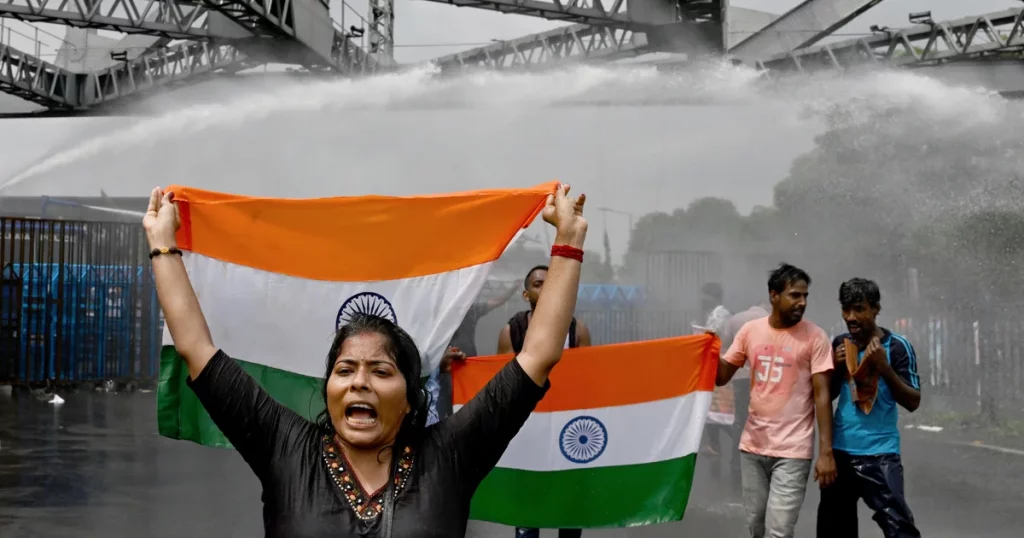
India’s democracy is facing one of its most talked-about political crises in recent years. The dramatic events unfolding in West Bengal have sparked a global debate is India truly a democracy, or is it drifting toward something else?
What Happened in West Bengal?
India’s ruling Bharatiya Janata Party (BJP), led by Prime Minister Narendra Modi, swept West Bengal’s state elections, securing more than two-thirds of the 294 seats when votes were counted. The BJP defeated Chief Minister Mamata Banerjee’s Trinamool Congress (TMC), which had governed the state since 2011.
The BJP has never previously ruled West Bengal, a populous eastern state bordering Bangladesh, making this victory a significant political milestone the party now controls nearly all states in eastern India.
This is not just an election result. It is a moment that is forcing people across South Asia to ask serious questions about the democracy of India, the political crisis meaning in real governance terms, and what happens when democratic institutions are tested.
Mamata Banerjee Refuses to Go The Political Crisis Deepens
The TMC’s seat tally collapsed from 215 to just 80, and Banerjee herself lost her own constituency seat. Yet in an unprecedented move, she refused to step down.
Banerjee declared that she “did not lose” and would not resign, claiming that around 100 seats were “forcibly taken” from her party and accusing the Election Commission of being biased though she offered no evidence to support these allegations.
This is the very definition of a political crisis. Political crisis meaning, in simple terms, is a situation where political authority breaks down or is openly contested, creating instability in governance. West Bengal is now living through exactly that.
West Bengal’s Chief Electoral Officer Manoj Kumar Agarwal dismissed the allegations as “baseless,” while BJP’s Suvendu Adhikari, who defeated Banerjee directly, pointed to the constitution as the guiding framework.
What Does the Indian Constitution Say?
Under the Indian constitution, the state’s governor can demand Banerjee’s resignation or simply wait for her term to expire, after which newly elected lawmakers would be sworn in and the process of forming a new government would begin. Banerjee’s term was set to end on Thursday.
This constitutional mechanism is one of the strongest arguments for those who say India remains a democracy. The democracy of India, as a system, has legal procedures and institutional safeguards even when individual leaders refuse to accept results.
A defeated candidate in an Indian state election can challenge the result in court on grounds including corrupt practices, improper acceptance or rejection of nominations, candidate disqualification, or non-compliance with election laws that affected the outcome.
Is India a Democracy or Autocracy?
This is perhaps the most searched question today in the context of this recent political crisis. The answer is not black and white.
India holds regular elections, has an independent judiciary, and a functioning press. In that sense, it is a democracy. The democracy of India is one of the oldest and largest in the world, rooted in a constitution adopted in 1950. Democracy in India notes from political scholars consistently highlight its federal structure, universal adult franchise, and multiparty system as core strengths.
However, critics including international democracy watchdogs have raised concerns in recent years. They point to the centralization of power under BJP’s national leadership, pressure on opposition-governed states, and questions about the independence of institutions like the Election Commission. These are the factors that fuel the “is India a democracy or autocracy” debate.
This West Bengal episode adds more fuel to that fire. When a ruling party wins an overwhelming majority and the opposition accuses the Election Commission of bias without evidence, it raises questions on both sides. Were elections free and fair? And if so, is the losing party respecting democratic norms by refusing to resign?
The Punjab Political Crisis A Parallel Story
The West Bengal drama is not happening in isolation. The Punjab political crisis both in Indian Punjab and in broader regional terms reflects a similar tension between democratic processes and political power struggles.
In Indian Punjab, political realignments, factional disputes, and shifting alliances have repeatedly destabilized governance. The Punjab political crisis, much like West Bengal’s, reveals how India’s democracy of India is stress-tested at the state level far more intensely than national elections show.
Both situations share a common theme: elected leaders and institutions clashing over legitimacy, authority, and the rules of democratic transition.
Hinglaj Mata Temple Democracy and Minority Rights
A seemingly unrelated topic Hinglaj Mata temple recently seen in news connects to the broader conversation about democracy of India and minority rights. Hinglaj Mata temple is located in Balochistan, Pakistan, near Lasbela. It is the largest Hindu pilgrimage site in Pakistan and a symbol of religious coexistence.
When discussing is India a democracy or autocracy, the treatment of minorities both within India and across the subcontinent often becomes a key reference point. Democracy in India notes from scholars highlight that true democracy requires not just elections but protection of minority communities, freedom of worship, and equal rights. Hinglaj Mata temple’s continued significance for Hindu pilgrims in Pakistan, and similar sacred sites within India, are markers of how religious plurality survives or struggles within South Asian democracies.
Essay on Democracy in India
India is the world’s largest democracy, built on universal suffrage, constitutional rights, and federal governance. Since independence in 1947, the democracy of India has survived wars, economic crises, and political upheavals. Regular elections, a free press, and an independent judiciary remain its pillars.
However, recent years have seen a political crisis of democratic norms. State-level conflicts, institutional pressure, and a polarized political climate challenge the system. The West Bengal political crisis of 2026 where a defeated Chief Minister refused to resign is a recent example of how democratic transitions can become contested.
Democracy in India notes remind us that democracy is not just about winning elections. It is about respecting results, protecting rights, and ensuring institutions remain impartial. India remains a democracy, but one that must constantly defend itself from within. Its future depends on whether its leaders uphold the constitution not just when they win, but especially when they lose.
Expert Opinion and Context
Political analysts who study democracy of India argue that what makes Indian democracy resilient is not any single leader or party it is the constitutional framework. Even in this current political crisis, the governor’s power, the judiciary’s role, and the Election Commission’s authority all remain intact as checks and balances.
Newspaper articles on democracy in India from major outlets like The Hindu, Indian Express, and Dawn have all highlighted a common concern: the erosion of democratic culture the willingness to accept outcomes is more dangerous than any single election result.
The political crisis meaning goes beyond just one state. It is a signal. When powerful leaders reject election results without evidence, it normalizes behavior that, repeated often enough, can hollow out even the strongest democracy.
Regional and Global Impact
The situation in West Bengal is being closely watched across South Asia. Neighboring countries including Pakistan, Bangladesh, and Sri Lanka are observing how India’s institutions respond. The democracy of India has long been held up as a model for developing nations. A political crisis that is managed well strengthens that model. One that is mishandled weakens it globally.
International observers note that the BJP’s consolidation of power across Indian states raises questions about political pluralism. At the same time, the TMC’s refusal to accept defeat raises questions about democratic maturity. Both sides, in their own way, are testing the democracy of India.
What Happens Next?
The governor of West Bengal is expected to act in accordance with the constitution. A new government led by the BJP will likely be sworn in. Mamata Banerjee may challenge results in court, which is her legal right under the democracy of India’s judicial framework.
The Punjab political crisis, ongoing debates about institutions, and cases like the Hinglaj Mata temple highlight that democracy across South Asia is a living, contested process not a settled fact. Democracy in India notes from historians remind us that every democratic system faces moments of crisis. What defines a democracy is not the absence of crisis, but how it is resolved.
India’s democracy has survived before. The question now is whether its leaders winners and losers alike will let the constitution do its job.
FAQs
What are the political issues in India?
India faces several political issues including centralization of power, state vs. federal government tensions, election integrity concerns, minority rights debates, and regional political crises such as the recent West Bengal and Punjab political situations. The democracy of India is tested by these recurring conflicts between institutions and political leaders.
What is the biggest problem in India right now?
As of May 2026, the biggest political problem in India is the constitutional standoff in West Bengal, where Chief Minister Mamata Banerjee refused to resign after her party’s election defeat. This has sparked a nationwide debate about democratic norms, the role of the Election Commission, and the meaning of political crisis in a functioning democracy.
What kind of crisis is India facing?
India is facing a political crisis rooted in contested election results and institutional trust. The West Bengal political crisis is the most visible example, but deeper issues including debates over whether India is a democracy or autocracy, the Punjab political crisis, and questions about democratic culture point to a broader stress on India’s democratic institutions.