

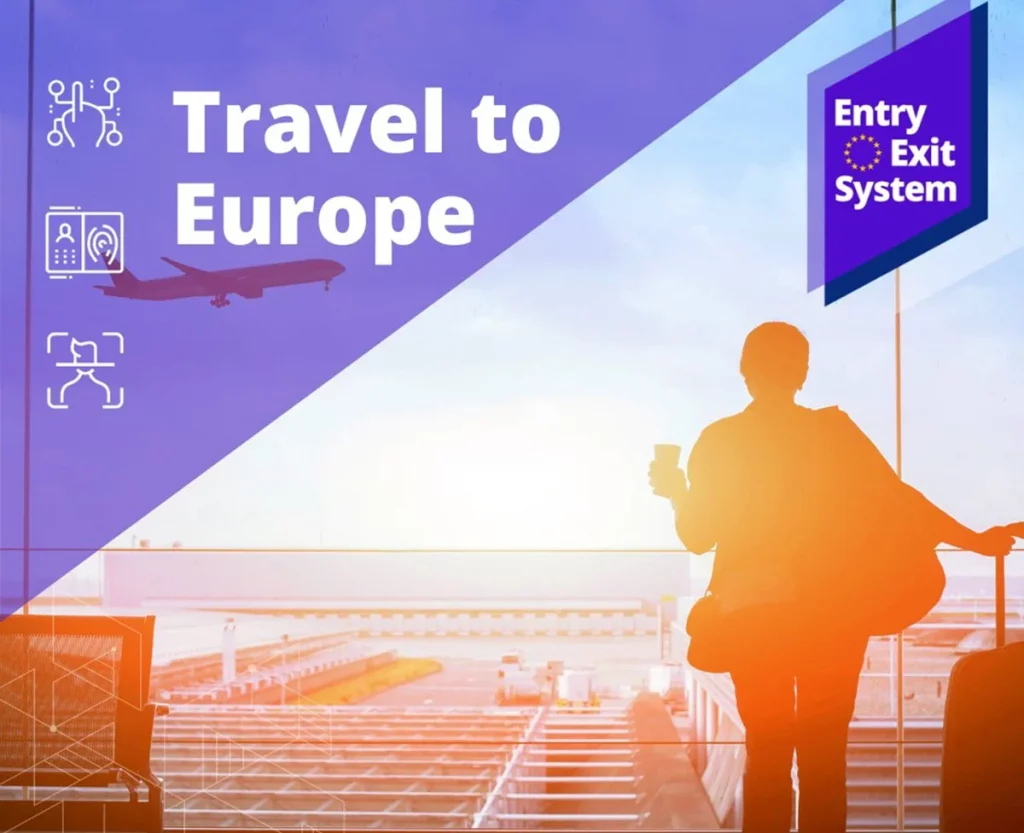
If you’ve flown into Europe recently and had your fingerprints and photo taken at the border instead of getting a passport stamp, that’s the EU’s new Entry/Exit System (EES) and it’s no longer a “coming soon” story. EES began rolling out on October 12, 2025, and became fully operational across all Schengen external borders on April 10, 2026. As of this summer, it’s logged more than 60 million border crossings and flagged around 32,000 people for overstaying their allowed time.
The system replaces manual passport stamping with biometric registration facial images and fingerprints for non-EU travelers, including anyone visiting from the UK, US, Canada, or Australia. If you’re planning a trip to Europe now, this is what’s actually waiting for you at the border, not what might happen eventually.
Why the EU Built This System
For decades, passport stamps were the only real record of when non-EU travelers entered or left the Schengen Area a system that made it genuinely hard to catch overstays or track patterns with any precision. EES fixes that by creating a digital record every time someone crosses an external Schengen border, automatically tracking how many of their allotted 90 days (within any rolling 180-day window) they’ve used.
It’s explicitly designed as the foundation for ETIAS, the pre-travel authorization system that’s still on the way (more on that below) the idea being a fully digital, two-layer border system: apply for clearance before you travel, then verify biometrically when you arrive.
How It Actually Works at the Border
On your first entry after EES activation at a given border point, you’ll have your passport scanned and provide a facial image and fingerprints a one-time registration that then gets checked automatically on every subsequent entry and exit. In practice, that’s meant longer processing times for first-timers and noticeably faster ones on repeat visits, at least where the system is functioning smoothly.
“Smoothly” is doing some work in that sentence, though. Rollout hasn’t been uniform. Lisbon Airport actually suspended EES checks in December 2025 after repeated gate malfunctions forced staff back to manual passport stamping, and Portugal had to bring in dozens of extra border officers to manage the fallout. In France, the Parafe e-gates that rely on facial recognition still weren’t processing UK or US passports properly as of late 2025, with full compatibility not expected until the end of March 2026. Travelers passing through Spain and Switzerland have also reported inconsistent application of biometric checks sometimes skipped, sometimes repeated unnecessarily on return trips.
The European Commission has acknowledged as much, building in flexibility for member states to temporarily pause EES checks for up to 90 days (with a possible 60-day extension) specifically to manage congestion during peak summer travel which is worth knowing if you’re flying into a busy hub this July or August and hit a manual stamping line instead of a biometric kiosk.
What This Means for British Travelers Specifically
Since Brexit, UK citizens have been treated as non-EU travelers at Schengen borders, which puts them squarely inside EES’s scope. In practice, that means UK travelers now go through biometric registration on arrival rather than a simple passport stamp a bigger process shift for British travelers than for most other nationalities, given how routine EU travel used to be pre-Brexit.
If you’re heading to Europe from the UK and this will be your first trip since EES went fully live, budget extra time at the airport arriving a few hours earlier than you normally would for an international flight is reasonable advice, particularly at busier airports still working through implementation kinks.
EES vs. ETIAS: Two Different Systems
These two get confused constantly, so it’s worth being precise: EES is the at-the-border registration system, live now. ETIAS is a separate, still-unlaunched pre-travel authorization similar in concept to the US ESTA or UK ETA that will require visa-exempt travelers to apply online before their trip, not at the border itself.
ETIAS is currently expected to launch in the last quarter of 2026, though the European Commission hasn’t locked in an exact date yet. When it does arrive, it’ll cost €20, stay valid for three years across multiple trips, and apply to travelers from more than 60 visa-exempt countries Americans, Brits, Canadians, and others who currently enter Schengen countries without needing a visa. Once both systems are live, that means two separate steps: apply for ETIAS clearance before you travel, then complete EES biometric verification when you actually arrive.
One important warning here: ETIAS is not accepting applications yet, despite what some websites claim. If a site is asking you to pay for an ETIAS authorization right now, it’s not legitimate the only official channel will be travel-europe.europa.eu, and it isn’t live for applications as of this writing.
The Practical Impact on Travelers and Tourism
For millions of annual visitors, this is a real shift in how European travel works not a hypothetical one anymore. Airports handling high volumes of international arrivals have had to scale up both staffing and infrastructure to keep processing times reasonable, and it’s been a genuinely uneven rollout across the 29 Schengen countries, with some hubs handling it far better than others.
Airlines and travel companies have been updating guidance accordingly, and there’s also a Europe-specific mobile app the “Travel to Europe” app that lets travelers pre-register their passport data and facial image up to 72 hours before reaching an EES border point. It’s optional, and availability still varies by country (it launched first at specific Swedish border crossings), so don’t assume it’ll work everywhere yet.
The practical advice hasn’t changed much from before full rollout: check current entry requirements before you fly, keep your documents valid and accessible, and build extra buffer time into airport arrivals especially for a first EES registration.
Common Questions About Traveling to Europe Right Now
Is Europe still safe to visit?
Yes EES is a border-management change, not a signal about safety. General travel advice still applies: check destination-specific guidance, stay aware of local conditions, and prepare your documents properly.
Have any European countries closed their borders?
No, not in any broad sense. The Schengen Area continues operating under its normal framework. Some countries do apply temporary internal border controls around specific events or security situations, but that’s not the same as a border closure, and it’s usually limited in scope and duration.
Can you still travel freely between Schengen countries?
Yes EES applies specifically to entry and exit through external Schengen borders. Once you’re legally inside the Schengen Area, movement between member countries generally doesn’t involve routine passport checks, the same as before.
Conclusion
The EES rollout is done, not pending full operation since April 2026, tens of millions of crossings already logged, and real (if uneven) implementation across Europe’s external borders. For travelers, especially from the UK, that means budgeting extra time at the border, particularly on a first trip since the system went live, and staying alert to the fact that some airports are still working through technical growing pains.
ETIAS is the next major piece, expected in the final quarter of 2026, and it’ll add a pre-travel application step on top of EES’s at-the-border checks. Until then, the best move for anyone planning a European trip is the same as always: check official sources close to your travel date, since implementation details are still shifting airport by airport.