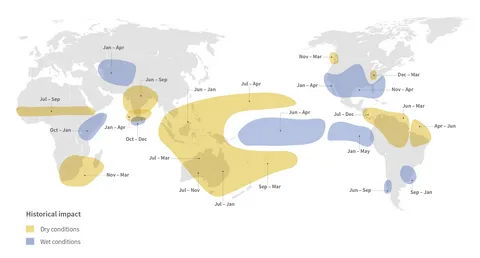
El Niño agriculture impact in Pakistan is expected to become a major concern as climate models indicate stronger warming patterns in the Pacific.The possibility of Super El Niño 2026 has raised alarms among meteorologists and agricultural experts.This climate event could significantly disturb rainfall, crop cycles, and water availability across Pakistan.
Background
El Niño is a natural climate phenomenon linked to warming of sea surface temperatures in the central and eastern Pacific Ocean. It directly affects global weather patterns, including monsoon systems that are vital for Pakistan’s agriculture. Historically, El Niño has been associated with weaker monsoons and increased drought conditions in South Asia.
Pakistan’s agriculture sector, which depends heavily on seasonal rainfall and irrigation, becomes highly vulnerable during such climate shifts.
Details
The El Niño agriculture impact in Pakistan is expected to influence wheat, rice, cotton, and sugarcane production.
Reduced rainfall and higher temperatures may lead to water shortages in key farming regions like Punjab and Sindh. Farmers could face delayed sowing seasons and reduced crop yields due to unpredictable weather patterns.
Climate scientists warn that the upcoming El Niño 2026 predictions suggest a moderate to strong event. If it intensifies into a Super El Niño 2026, Pakistan may experience extended dry spells and heatwaves. This could also affect groundwater levels, increasing pressure on already strained irrigation systems.
Agricultural experts believe that small farmers will be the most affected group. They often lack access to advanced irrigation systems or climate-resilient seeds, making them vulnerable to crop losse.Food inflation may rise if production drops significantly across major crops.
Quotes
Meteorologists have noted that “El Niño events tend to weaken the South Asian monsoon, leading to uneven rainfall distribution.” Agricultural analysts also suggest that “Pakistan must invest in climate-smart farming to reduce long-term risks from El Niño cycles.” Experts emphasize early warning systems and better water management as key solutions.
Impact
The El Niño agriculture impact in Pakistan extends beyond farming and directly affects food security.Lower crop production can increase dependency on imports, putting pressure on foreign reserves.
Rural economies may suffer as farmers face financial losses and reduced productivity.Regionally, South Asia could experience similar agricultural stress, especially in India and Bangladesh.Global food supply chains may also be affected if multiple major producing regions face climate disruptions simultaneously.Water scarcity and heat stress could further worsen living conditions in vulnerable rural areas.
Conclusion
The coming years, especially Super El Niño 2026, may bring significant challenges for Pakistan’s agriculture sector.While the severity is still uncertain, early planning and climate adaptation strategies are essential.Strengthening irrigation systems, improving forecasting, and supporting farmers can help reduce potential damage.
The El Niño agriculture impact in Pakistan remains a critical issue for policymakers and climate experts.
FAQs
What is an El Niño?
El Niño is a climate phenomenon caused by unusual warming of ocean surface temperatures in the Pacific Ocean.This warming disrupts normal weather patterns globally, affecting rainfall, storms, and temperature.In South Asia, it often leads to weaker monsoons and dry conditions, which can impact agriculture and water supply systems.
Will there be an El Niño in 2026?
Climate models suggest a possibility of El Niño conditions developing around 2026, though intensity may vary. Some forecasts indicate a moderate to strong phase, while others warn of a potential Super El Niño scenario. However, exact predictions depend on ocean temperature trends and atmospheric conditions closer to the period.
What is the effect of El Niño in India in 2026?
In India, El Niño can reduce monsoon rainfall, leading to drought-like conditions in several agricultural regions. This can impact crop production, especially rice and wheat, and increase dependence on irrigation. It may also lead to higher food prices and economic stress in rural farming communities.