

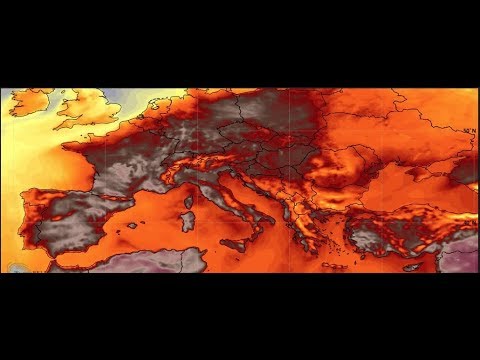
Western Europe has just lived through its hottest June on record, and a fresh heatwave is already building across the region this week. New data released on Thursday confirmed that the Western Europe heatwave causes behind last month’s extreme heat were tied to a stubborn “heat dome” that trapped hot air over the continent for weeks.
Summary
Western Europe’s average temperature reached 20.74C in June 2026, more than three degrees above the 1991-2020 norm, according to the <cite index=”3-1″>European Union’s Copernicus Climate Change Service</cite>. The reading broke the previous record set only a year earlier, in June 2025. A new heatwave is already forming over Spain, Portugal and France this week, raising fresh fears about the Western Europe heatwave forecast for the rest of July.
Background
Europe has faced a punishing run of heat since spring. <cite index=”1-1″>Several severe heatwaves affected the continent starting in late May 2026, with temperature records broken in Austria, Belgium, Czechia, Denmark, France, Germany, Hungary, Italy, the Netherlands, Poland, Romania, Spain, and the United Kingdom</cite>.
<cite index=”1-1″>The first heatwave began on 24 May, bringing higher than normal temperatures and several heat-related deaths, with May turning out to be the hottest ever recorded for that month</cite>. Western Europe bore the brunt of it, and the pattern only intensified from there.
<cite index=”1-1″>A second and far more severe heatwave began on 17 June, just days before the summer solstice</cite>. That spell became the defining event behind the Western Europe heatwave map that meteorologists have been tracking ever since.
Details
The scale of last month’s heat is difficult to overstate. <cite index=”3-1″>The average temperature in Western Europe reached 20.74C, driven by a heatwave in the second half of June that broke records across several countries</cite>. Globally, <cite index=”3-1″>June 2026 was 0.56C above the 1991-2020 average and 1.39C warmer than the estimated pre-industrial average for the period 1850 to 1900</cite>.
France recorded some of the most extreme readings on the continent. <cite index=”1-1″>Météo-France declared 23 June the country’s hottest day since measurements began in 1947, with temperatures reaching 44.3C in Pissos, 42.1C in Bordeaux, and a June record of 40.9C in Paris</cite>. In the United Kingdom, <cite index=”1-1″>temperatures peaked at 37.7C</cite> during the same spell.
Central Europe was not spared either. <cite index=”7-1″>The Czech Republic recorded its hottest day on record on 27 June with 40.9C in the town of Doksany, only for the record to fall again the very next day when 41.9C was measured at the same station</cite>. <cite index=”7-1″>Denmark’s all-time temperature record was also broken on 27 June, with 36.6C recorded north of Odense, a benchmark that had stood since record-keeping began in 1874</cite>.
The human toll of the Western Europe heatwave causes has been severe. <cite index=”3-1″>Thousands of deaths were linked to the heatwave, mostly in France, Spain and Belgium</cite>. <cite index=”3-1″>More than two-thirds of Europeans, roughly 410 million people, endured temperatures topping 35C during the June heatwave, according to an analysis by AFP</cite>.
Humidity made the crisis worse rather than easing it. <cite index=”3-1″>High humidity levels meant people did not get relief overnight, resulting in a number of tropical nights in a row</cite>, according to climate officials tracking the event.
Marine temperatures also broke records during the same window. <cite index=”6-1″>June 2026 recorded the highest June sea surface temperatures ever observed for the world’s ice-free oceans, narrowly exceeding the previous record set in 2024</cite>. <cite index=”3-1″>The Mediterranean experienced its own record-breaking marine heatwave, with the Atlantic coasts also hit by hot spells that put ecosystems at risk</cite>.
Dry conditions have compounded the danger. <cite index=”3-1″>Dry conditions in southwestern Europe raised drought risks and contributed to wildfire activity in the Iberian Peninsula and southern France</cite>. In France specifically, <cite index=”2-1″>wildfires in the south of the country had burned through more than 11,000 acres and forced roughly 10,000 evacuations</cite>, according to the country’s interior minister.
Quotes
Climate officials say the pattern reflects a system that is steadily absorbing more heat. <cite index=”2-1″>Samantha Burgess, a climate expert at the European Centre for Medium-Range Weather Forecasts, said June’s conditions “underscored how profoundly the climate is changing”</cite> when the new figures were released.
She added that the consequences extend well beyond a single hot month. <cite index=”2-1″>”Together, these records reflect a climate system continuing to accumulate heat. The result is increasingly intense heatwaves, a persistently warm ocean, and growing risks for people, ecosystems and infrastructure across Europe and beyond,”</cite> Burgess said.
Researchers studying the event independently reached a similar conclusion about its severity. <cite index=”7-1″>World Weather Attribution concluded it was the most severe heatwave ever recorded over the region studied, and that it was “virtually impossible” to explain its intensity without accounting for climate change</cite>.
Officials have also warned that more such extremes should be expected. <cite index=”5-1″>”We will see more heatwaves in a warmer world,”</cite> Burgess said as the June report was published this week.
Impact
The regional and global impact of the Western Europe heatwave causes goes far beyond uncomfortable weather. Health systems across France, Spain and Belgium have faced added strain from heat-related illness and mortality, while emergency services have been stretched thin by wildfires and water rescues linked to people trying to cool off.
Agriculture and water supplies are also under pressure. <cite index=”6-1″>The impacts extended beyond high temperatures, with dry conditions across much of Europe, particularly the Iberian Peninsula, southern France, and parts of eastern Europe, increasing wildfire activity, reducing river flows, and intensifying drought risk that undermines food production</cite>.
Infrastructure has buckled under the strain in several countries. Rail lines have warped, schools have closed, and power supplies have been disrupted in multiple nations during the peak of the June heat dome, according to reporting on the event.
Globally, the event fits into a broader pattern that scientists have been tracking for years. Europe remains the fastest-warming continent on Earth, and researchers say the current El Niño conditions in the Pacific are adding further upward pressure on already elevated global temperatures.
Western Europe Heatwave Forecast
The relief many hoped for after June has not materialised. <cite index=”8-1″>Near-surface temperature anomalies are already extreme across Spain and Portugal this week, surging northward into France and the rest of Western Europe in the coming days, before spreading east towards Italy and the Alpine region</cite>.
Forecasters warn the new spell could rival or exceed the intensity of June’s event. <cite index=”8-1″>Temperatures are expected to run 12-16C above normal for mid-July, with daily highs reaching the upper 30s to low 40s in some regions and pushing into the mid-40s from Spain to western France</cite>.
The outlook suggests little respite through the rest of the month. <cite index=”8-1″>The overall heatwave effect is likely to persist through mid-July, worsening drought conditions and supporting additional dangerous wildfires as soil moisture remains exceptionally low</cite>.
Conclusion
The confirmation that June 2026 was Western Europe’s hottest on record adds to a growing body of evidence that extreme heat is becoming a defining feature of European summers rather than a rare exception. With a fresh heat dome already forming over the Iberian Peninsula and France, authorities are bracing for another difficult stretch through mid-July.
Governments across the region are expected to keep heat-health warnings, wildfire monitoring and water-safety advisories active in the coming weeks. Scientists say further reports are likely to track whether July 2026 will add yet another entry to Europe’s expanding list of temperature records.
FAQs
What is the hottest country in Europe right now?
As of early July 2026, Spain, Portugal and southern France are recording the highest temperatures on the continent, with forecasts showing daytime highs pushing into the low-to-mid 40s Celsius in parts of the Iberian Peninsula and western France. Southern Italy and the Balkans are also expected to see intense heat as the current heat dome expands eastward through mid-July, meaning the title of hottest country in Europe is likely to shift between these nations depending on the day and the exact movement of the high-pressure system driving the heat.
What is the #1 hottest country?
Globally, the countries that consistently record the highest air temperatures are located in the Middle East and North Africa, such as Kuwait, Iraq, Saudi Arabia and Libya, where summer highs regularly exceed 50C. Within Europe specifically, southern Spain and parts of Greece and Cyprus tend to register the continent’s most extreme readings during major heatwaves, and Spain’s Ebro Valley and Guadalquivir Valley have both been flagged by meteorologists as among the hottest spots on the continent during the current 2026 heat events.
Will 2026 be the hottest year?
It is too early to say definitively whether 2026 will surpass previous record years globally, but the trend so far is concerning. June 2026 was the second-hottest June ever recorded worldwide and the hottest on record for Western Europe specifically, while sea surface temperatures also hit record highs for the month. With El Niño conditions strengthening in the Pacific and a new heatwave already building across Europe in July, climate scientists say 2026 has a strong chance of ranking among the warmest years on record, though final confirmation will depend on temperature data collected through the rest of the year.