
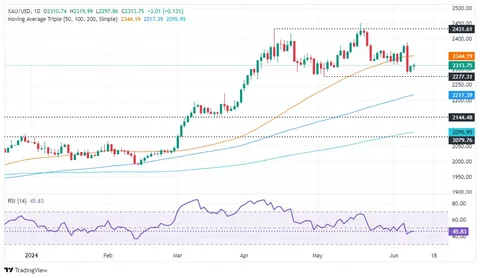
Gold price falls inflation data has pushed the precious metal to its lowest point in 4 months — with spot gold diving to a level not seen since late 2025 as stronger than expected inflation readings in the United States have reignited Federal Reserve interest rate hike expectations that are the single most powerful short-term driver of gold price direction.
Gold price falls inflation dynamic reflects the classic inverse relationship between gold and real interest rates — with rising inflation expectations that were previously supporting gold as an inflation hedge now being overwhelmed by the concurrent rise in rate hike probability that makes yield-bearing assets more attractive relative to non-yielding gold and drives the dollar strength that makes gold more expensive for international buyers.
Silver price today has followed gold lower in the precious metals selloff — with the gold price falls inflation dynamic dragging silver down alongside gold in a broad precious metals retreat that reflects repositioning by institutional investors who had built significant long positions during the Iran war oil price shock period and are now reducing exposure as the inflation and rate outlook shifts.
Background: Gold and Inflation — A Complex Relationship
Gold Price Falls Inflation — Understanding the Paradox
Gold price falls inflation scenario appears paradoxical to many investors who think of gold primarily as an inflation hedge — with the intuitive assumption being that rising inflation should push gold prices higher rather than lower. Understanding why gold price falls inflation dynamics produce the current selloff requires understanding the distinction between inflation itself and the policy response to inflation that actually determines gold’s short-term price direction.
Gold price falls inflation paradox resolves when you distinguish between 2 simultaneous effects of inflation on gold. The first effect is inflationary — inflation erodes the purchasing power of paper currency which should increase demand for gold as a store of value. The second effect is the rate response — when inflation rises central banks raise interest rates which increases the opportunity cost of holding non-yielding gold and strengthens the dollar making gold more expensive in other currencies and reducing international demand.
Gold price falls inflation in the current scenario because the second effect — rate hike expectations — is currently overpowering the first effect — direct inflation hedge demand. The Federal Reserve’s credibility as an inflation fighter means that every inflation data point above expectations is interpreted by markets not primarily as a reason to buy gold for inflation protection but as a reason to expect higher interest rates that will hurt gold through the rate and dollar channels.
Gold price falls inflation dynamic is therefore most acute when inflation surprises to the upside — because upside inflation surprises simultaneously increase rate hike probability and strengthen the dollar in ways that mechanically pressure gold regardless of the inflation hedge rationale that long-term gold bulls cite.
Historical Gold Price Falls Inflation Context
Gold price falls inflation precedent is well-established in financial market history — with the most dramatic historical example being the 1980 to 1982 period when gold fell from approximately $850 per ounce to approximately $300 per ounce as Fed Chair Paul Volcker raised interest rates aggressively to defeat the inflation that had driven gold to its then-record high.
Gold price falls inflation 2022 episode provides the most recent historical precedent for the current situation — with gold having fallen approximately 20 percent during the Fed’s most aggressive rate hiking cycle since the Volcker era despite elevated inflation throughout the period. The 2022 gold price falls inflation episode established the template that markets are now following — higher inflation leads to higher rates which leads to lower gold despite the intuitive inflation hedge argument.
Gold Price Falls Inflation — What Triggered the Drop
The Inflation Data That Moved Gold
Gold price falls inflation current episode was triggered by a US Consumer Price Index reading that came in significantly above market consensus expectations — with core inflation — the measure that excludes food and energy and that the Federal Reserve focuses on most closely — rising at a rate that suggested the progress toward the Fed’s 2 percent inflation target had stalled or reversed.
Gold price falls inflation CPI trigger reflected several components of the inflation basket that had been expected to moderate but instead accelerated — including services inflation which the Fed considers the most persistent and hardest-to-control component of the inflation complex and which has been the primary driver of the above-target inflation that has prevented the Fed from cutting rates as aggressively as markets had previously hoped.
Gold price falls inflation oil price dimension adds a specific complication to the current episode — with the Iran war-driven oil price surge past $100 per barrel having created an energy inflation shock that is feeding through to transportation logistics and manufacturing costs across the economy in ways that are sustaining goods inflation even as the Fed has raised rates to reduce demand.
Gold price falls inflation Fed response probability has shifted dramatically — with futures markets now pricing in significantly higher probability of a Fed rate hike at the next Federal Open Market Committee meeting than was priced before the CPI print. This probability shift in rate hike expectations produced the immediate gold selloff as algorithmic traders and institutional investors repositioned from long gold to dollar-denominated rate-sensitive assets.
Technical Dimension of Gold Price Falls Inflation
Gold price falls inflation technical dimension involves the breach of key chart support levels that has accelerated selling by technically oriented traders — with gold’s break below its 200-day moving average triggering algorithmic selling programs that added momentum to the fundamentally driven selloff.
Gold price falls inflation technical breakdown through the 4-month low has brought gold to a price level where technical analysts identify the next significant support zone — with gold needing to hold at this level to prevent a more extended selloff toward the 6-month lows that bearish analysts are now targeting.
Silver Price Today — Parallel Market Movement
Silver Price Today — Following Gold Lower
Silver price today reflects the gold price falls inflation selloff in precious metals — with silver having declined proportionally more than gold in percentage terms given silver’s higher beta to gold price movements and its additional industrial metal dimension that makes it more sensitive to the growth slowdown implications of higher interest rates.
Silver price today decline reflects silver’s dual identity as both a precious metal that tracks gold and an industrial metal whose demand depends on economic growth. Gold price falls inflation rate hike implications that are bad for gold are doubly bad for silver — because higher rates hurt both the precious metal component through the same gold price falls inflation dynamic and the industrial component through the growth slowdown that higher rates typically produce.
Silver price today technical picture mirrors the gold price falls inflation technical breakdown — with silver having breached its own key support levels in a selloff that technical analysts describe as confirming the broader precious metals downtrend that the gold price falls inflation episode has initiated.
Silver price today gold silver ratio — the number of ounces of silver required to buy one ounce of gold — has widened significantly during the gold price falls inflation selloff — reflecting silver’s proportionally larger decline and historically suggesting that silver is undervalued relative to gold at current levels. Whether the ratio mean-reverts through silver outperformance or gold underperformance depends on whether the gold price falls inflation selloff continues or reverses.
Will Gold Price Increase — Analyst Forecasts
Will Gold Price Increase — Bullish Case
Will gold price increase is the question that gold investors globally are asking in the wake of the gold price falls inflation selloff — with the answer depending critically on which of 3 competing scenarios for US monetary policy and global risk sentiment prevails over the coming months.
Will gold price increase bullish scenario rests on the argument that the gold price falls inflation selloff is a temporary dislocation driven by short-term rate hike expectations that will ultimately prove transitory — with the longer-term structural case for gold including central bank buying de-dollarisation of global reserves geopolitical risk from the ongoing Iran war and the eventual Fed pivot toward rate cuts all remaining intact.
Will gold price increase central bank demand argument is particularly powerful — with central banks globally having been net buyers of gold for 13 consecutive years and the pace of central bank gold accumulation having accelerated as geopolitical tensions and concerns about dollar-denominated asset vulnerability have increased. Central bank gold demand does not respond to short-term rate hike expectations in the same way that financial market demand does — providing a structural floor under gold prices that limits the downside from gold price falls inflation episodes.
Will gold price increase Iran war risk argument remains relevant — with the unresolved geopolitical conflict in the Middle East providing ongoing safe haven demand for gold that would intensify dramatically if the conflict escalates further or if diplomatic resolution fails to materialise in the near term.
Will Gold Price Increase — Bearish Case
Will gold price increase bearish scenario argues that the gold price falls inflation dynamic represents the beginning of a more sustained correction rather than a temporary dislocation — with the Fed’s credibility on inflation and the dollar’s ongoing strength creating a multi-month headwind for gold that the structural arguments cannot overcome in the near term.
Will gold price increase bearish argument notes that gold’s recent rally to record highs had already priced in significant geopolitical risk premium that would deflate if the Iran war moves toward ceasefire — with the diplomatic signals from Guterres end war US Israel Iran initiative and the Strait of Hormuz ships Iran partial opening potentially reducing the risk premium that had supported gold at elevated levels.
Will gold price increase timing depends critically on when the Fed pivots from rate hike to rate cut mode — with gold historically performing strongly in the 6 to 12 months preceding the first Fed rate cut as markets anticipate the reduced opportunity cost of holding non-yielding gold that lower rates will produce.
Gold Price in India — Domestic Impact
Gold Price in India — Why It Matters
Gold price in India context gives the current gold price falls inflation episode its most human and most culturally significant dimension — with India being the world’s second largest gold consumer and a country where gold is not merely an investment asset but a culturally embedded store of wealth savings mechanism wedding gift tradition and jewellery that touches virtually every Indian household.
Gold price in India domestic level reflects the combination of international spot gold prices and the Indian rupee dollar exchange rate — with gold price falls inflation in dollar terms being either amplified or mitigated for Indian buyers depending on whether the rupee is simultaneously strengthening or weakening against the dollar.
Gold price in India 2026 context includes both the international gold price falls inflation dynamic and the specific domestic factors of Indian gold demand — with the festive season and wedding season calendar creating specific periods of elevated Indian gold demand that can partially offset international price pressure and with the Indian government’s import duty on gold affecting the domestic price premium over international benchmarks.
Gold price in India retail market response to the gold price falls inflation episode has been mixed — with price-sensitive buyers welcoming the reduced cost as a buying opportunity while investors who purchased at higher levels are experiencing mark-to-market losses that are tempering sentiment in India’s significant retail gold investment market.
Gold Price in India — Import and RBI Dimensions
Gold price in India RBI policy dimension involves the Reserve Bank of India’s own gold reserves — which the RBI has been increasing as part of India’s broader reserve diversification strategy that mirrors the global central bank gold accumulation trend. Gold price falls inflation episodes that reduce the market value of RBI gold holdings create accounting losses on the reserve portfolio that are noted in financial commentary but do not affect the RBI’s strategic rationale for holding gold.
Rate Hike Bets — The Fed Connection
How Rate Hike Bets Drive Gold Price Falls Inflation
Rate hike bets — the market’s probabilistic assessment of whether the Federal Reserve will raise interest rates at upcoming FOMC meetings — are the most direct mechanical driver of the gold price falls inflation dynamic in the current episode.
Rate hike bets operate on gold through 2 simultaneous channels. The first is the real interest rate channel — with higher nominal rates and stable inflation expectations producing higher real rates that increase the opportunity cost of holding non-yielding gold relative to yield-bearing alternatives. The second is the dollar channel — with rate hike expectations strengthening the dollar as international capital flows into dollar-denominated assets to capture the higher yields US rate hikes produce making gold more expensive in non-dollar currencies and reducing international demand.
Rate hike bets shift in response to every major US economic data release — with inflation employment and growth data all capable of moving rate hike probability in ways that immediately translate into gold price movements. Gold price falls inflation episodes are therefore most acute in the hours and days following major inflation data releases when rate hike probability shifts are most sudden and most dramatic.
Rate hike bets current level following the above-consensus CPI print that triggered the gold price falls inflation episode now implies a materially higher probability of a Fed rate hike than was priced before the data — with the futures market’s repricing of the terminal Fed funds rate having been the primary mechanical driver of the gold selloff.
Quotes on Gold Price Falls Inflation
Goldman Sachs commodity strategist Sabine Schels stated that the gold price falls inflation dynamic reflected the market’s rational response to above-consensus inflation data — adding that gold would find support at current levels from central bank demand and geopolitical risk but that the near-term path for gold remained challenging while rate hike expectations were elevated.
JPMorgan precious metals analyst Gregory Shearer described the gold price falls inflation selloff as a buying opportunity for long-term investors — stating that the structural case for gold including central bank accumulation de-dollarisation and eventual Fed pivot remained intact and that the current gold price falls inflation episode was likely a temporary interruption rather than a trend reversal.
Federal Reserve Governor Christopher Waller stated in a speech that the Fed remained committed to returning inflation to its 2 percent target — adding that recent inflation data had been disappointing and that the Fed would not hesitate to raise rates further if inflation progress stalled. This statement reinforced rate hike bets and added further pressure to the gold price falls inflation dynamic.
World Gold Council chief market strategist John Reade described the gold price falls inflation episode as illustrating the tension between gold’s long-term inflation hedge properties and its short-term sensitivity to real interest rate movements — stating that investors with a 12-month or longer time horizon should use gold price falls inflation dips as accumulation opportunities given the structural tailwinds that remain in place.
A senior fund manager at a major London-based commodities hedge fund stated that the gold price falls inflation selloff had created the most attractive gold entry point since late 2025 — adding that the fund was using the dip to increase its gold allocation given the continued uncertainty from the Iran war geopolitical risk and the eventual Fed rate cut cycle that remained on the medium-term horizon.
Impact: What Gold Price Falls Inflation Means
For Global Investment Markets
Gold price falls inflation episode has rippled through global investment markets beyond precious metals — with the higher rate hike expectations that triggered the gold selloff also weighing on equity markets bond prices and other rate-sensitive assets in a broad risk-off repositioning.
Gold price falls inflation real interest rate rise implications are negative for long-duration assets generally — with technology stocks growth stocks and long-maturity bonds all facing similar headwinds from the rate hike probability repricing that has driven the gold price falls inflation selloff.
For Emerging Market Economies
Gold price falls inflation dollar strength implications are particularly damaging for emerging market economies — with the stronger dollar that rate hike expectations produce increasing the cost of dollar-denominated debt service for countries like Pakistan India Turkey and Argentina whose external debt is largely dollar-denominated.
Gold price falls inflation Pakistan specific impact involves the compounding of an already challenging external financing environment — with higher US rates attracting capital away from emerging markets reducing the available financing for Pakistan’s current account deficit and adding to the rupee pressure that affects gold price in Pakistan alongside the international price movement.
For Central Bank Reserve Strategy
Gold price falls inflation central bank reserve strategy impact is paradoxical — with the episode simultaneously reducing the short-term value of existing central bank gold holdings while potentially increasing the attractiveness of gold accumulation at lower prices for central banks with long-term strategic accumulation mandates.
Frequently Asked Questions
Why Has the Gold Price Dropped?
Gold price falls inflation in the current episode because stronger than expected US inflation data has reignited Federal Reserve interest rate hike expectations — and rising rate hike expectations are negative for gold through 2 simultaneous channels. First higher interest rates increase the opportunity cost of holding non-yielding gold relative to bonds and deposits that pay interest — making yield-bearing alternatives more attractive. Second rate hike expectations strengthen the US dollar which makes gold more expensive for buyers using non-dollar currencies and reduces international demand. The gold price falls inflation paradox — where higher inflation leads to lower gold prices — resolves when you understand that what matters for gold in the short term is not inflation itself but the Fed’s policy response to inflation. When inflation surprises upside the immediate market reaction is to price in more rate hikes which hurts gold regardless of gold’s long-term inflation hedge properties.
How High Will Gold Go in 2026?
Will gold price increase in 2026 is contested among analysts — with forecasts ranging from modest recovery to new record highs depending on assumptions about US monetary policy geopolitical risk and central bank demand. The bullish will gold price increase case rests on the eventual Federal Reserve pivot toward rate cuts expected later in 2026 or in 2027 which would reduce the opportunity cost of holding gold and weaken the dollar in ways that historically produce strong gold price appreciation. Central bank gold demand continuing at its recent elevated pace provides structural support. The Iran war geopolitical risk premium remaining elevated provides an additional tailwind. Bullish forecasts for will gold price increase in 2026 from institutions including Goldman Sachs JPMorgan and the World Gold Council have ranged from $2,800 to $3,200 per ounce on a 12-month view. Bearish forecasts citing persistent Fed hawkishness and dollar strength suggest gold could remain range-bound or decline further toward $2,200 to $2,400. The actual outcome depends primarily on US inflation trajectory and the timing of the Fed’s first rate cut.
What Happens to Gold If Inflation Goes Down?
What happens to gold if inflation goes down depends on whether falling inflation is accompanied by Fed rate cuts or whether inflation falls while rates remain elevated. If inflation falls because the Fed’s rate hikes have successfully reduced demand then gold faces a mixed environment — with lower inflation reducing gold’s inflation hedge appeal but the eventual rate cut cycle supporting gold through reduced opportunity cost and dollar weakness. Historically gold price falls inflation episodes that lead to eventual Fed rate cuts have been followed by strong gold appreciation as the rate cut cycle begins — with gold having significantly outperformed in the 6 to 18 months following the start of Fed rate cut cycles across multiple historical cycles. If inflation falls without Fed rate cuts — a scenario sometimes called a soft landing — gold typically performs moderately as the reduced inflation premium is only partially offset by the stable rather than declining real interest rate environment. The current gold price falls inflation episode is therefore potentially setting up the buying opportunity that historically precedes strong gold performance once the Fed rate cut cycle begins.
Conclusion
Gold price falls inflation to a 4-month low tells a story that is simultaneously about monetary economics geopolitics and the complex relationship between inflation and the assets that are supposed to protect against it.
The gold price falls inflation dynamic is real and rational — driven by the Federal Reserve’s credibility as an inflation fighter and the mechanical pressure that rate hike expectations apply to non-yielding assets. But it is also temporary in the sense that the structural case for gold — central bank demand de-dollarisation geopolitical risk and the eventual Fed pivot — remains entirely intact beneath the short-term noise.
Silver price today has followed gold lower. Will gold price increase depends on inflation trajectory and Fed policy timing. Gold price in India reflects both the global selloff and the rupee dimension of a domestic market where gold is embedded in culture as well as portfolios.
The investors who understand that gold price falls inflation episodes have historically provided the best entry points for gold’s next bull phase are the ones most likely to be rewarded when the Fed pivots and the structural tailwinds reassert themselves over the short-term rate hike pressure that is currently driving the selloff.