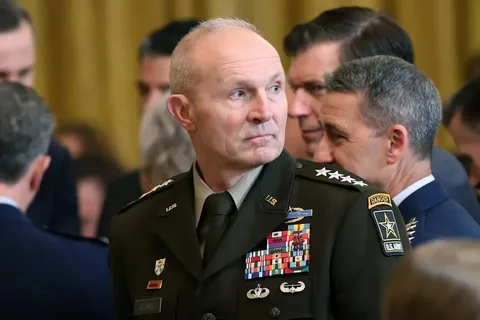

In one of the most dramatic military shake-ups in recent American history, Defense Secretary Pete Hegseth has fired the U.S. Army’s top general and ordered billions of dollars in Pentagon cuts all while U.S. forces remain actively engaged in a war against Iran. The move has sent shockwaves through Washington, raised urgent questions about military readiness, and reignited a fierce national debate about loyalty, leadership, and the politicization of America’s armed forces.
Background
U.S. Army Chief of Staff Gen. Randy George was fired on Thursday by Defense Secretary Pete Hegseth, according to three U.S. defense officials, in the latest purge among the Pentagon’s most senior ranks.The removal is extraordinary by any historical measure. Even as Hegseth, a former Fox News host, has moved quickly to reshape the department, firing a general during wartime is nearly without precedent.This is not Hegseth’s first such action. Since taking office as part of President Trump’s second administration, he has systematically dismantled the existing military leadership structure. Hegseth has fired more than a dozen senior military officers, including Chairman of the Joint Chiefs of Staff Gen. C.Q. Brown, Chief of Naval Operations Adm. Lisa Franchetti, the Air Force Vice Chief of Staff Gen. James Slife, and the head of the Defense Intelligence Agency Lt. Gen. Jeffrey Kruse.
Details: The Firing of Gen. Randy George
Defense Secretary Pete Hegseth asked Army Chief of Staff Gen. Randy George, the service’s top uniformed officer, to step down from his position and retire immediately. “General Randy A. George will be retiring from his position as the 41st Chief of Staff of the Army effective immediately,” Pentagon spokesman Sean Parnell confirmed.
The Army’s chief of staff typically serves a four-year term, cutting George’s tenure short by more than a year.George had been nominated to the role in 2023 by then-President Biden and was expected to serve until 2027.
Beyond George, the shake-up extended further down the command structure. Hegseth also fired two other Army general the chief of chaplains, Maj. Gen. William Green Jr., and the commander of Army Transformation and Training Command, Gen. David Hodne.Gen. Christopher LaNeve, the current vice chief of staff of the Army, will serve as acting Army chief of staff. He is a former commanding general of the 82nd Airborne Division and was once Hegseth’s own military aide. Critics have noted the optics of replacing an independent-minded general with a former personal aide as deeply troubling.
The New York Times was among the first outlets to report on the real reason behind the firing. According to the Times, George was ousted because he and Army Secretary Daniel P. Driscoll refused to remove two Black and two female officers from a list of military members to be promoted to become one-star generals. George and Driscoll defied Hegseth and cited the long and exemplary service of the four officers as justification for their being on the list for promotion.Military officials told the Times that Hegseth refused a request from George for a meeting two weeks ago to discuss the four officers pinpointed to be removed from the promotion list.
Pentagon Cuts: Hegseth’s Budget Revolution
The firing of senior generals is only one part of a wider transformation Hegseth is driving inside the Pentagon. Earlier in his tenure, Defense Secretary Pete Hegseth ordered military officials to find $50 billion in budget cuts for fiscal year 2026 to be redirected to align with President Trump’s priorities for the department.
Hegseth has directed the Pentagon to cut 8% from the defense budget in each of the next five years. Acting Deputy Secretary of Defense Robert Salesses confirmed that the department seeks cuts totaling about $50 billion, targeting “so-called ‘climate change’ and other woke programs, as well as excessive bureaucracy.”The priorities for redirected funds include border security, the construction of an American “Iron Dome” missile defense shield, and the complete elimination of DEI programs throughout the military. By redirecting funds from DEI programs and climate initiatives, Hegseth aims to reinforce the military’s combat effectiveness and overall readiness.
“The Defense Department is not in the business of climate change, solving the global thermostat. We’re in the business of deterring and winning wars,” Hegseth said.However, these Pentagon cuts have drawn sharp criticism from across the political spectrum. New York Times columnist David French wrote on X: “This is totally absurd. We’re at the onset of a second Cold War that could go hot over Taiwan, and Hegseth wants to gut the defense budget. 8 percent cuts per year would decimate the military, exactly when China is rising.”
Quotes: Officials and Experts Respond
A senior Defense Department official told CBS News: “We are grateful for his service, but it was time for a leadership change in the Army.”
Hegseth has been a vocal proponent of ending “wokeness” and Diversity, Equity, and Inclusion programs at the Pentagon. Speaking previously, Hegseth said, “I think the single dumbest phrase in military history is ‘our diversity is our strength.'”
Despite Hegseth’s stated focus to “revive the warrior ethos,” some defense officials responsible for drafting lists of civilian Pentagon employees to be fired are voicing concerns that the summary firings could break the law and harm U.S. military readiness.
Democratic Representative Seth Moulton of Massachusetts told CNN’s Anderson Cooper: “Well, look, I’ve been a critic of Pentagon spending for a long time and I think the Pentagon could spend its money more efficiently.”He stopped short, however, of endorsing Hegseth’s approach
Impact: What This Means for America and the World
The strategic consequences of this shake-up are already being felt globally. Hegseth’s move to fire Gen. George comes a day after President Donald Trump’s address to the nation on the Iran war, in which Trump signaled the U.S. will intensify strikes on Iran, after earlier suggesting the U.S. could be done with the war within two to three weeks.
At least 348 U.S. military personnel have been wounded in the Iran war as of March 31, according to U.S. Central Command.Replacing senior military commanders during active combat operations is a significant risk one that military historians and defense analysts describe as highly unusual, if not destabilizing.
The Pentagon cuts also threaten long-term readiness. The proposed cuts to the Pentagon’s approximately $850 billion budget would amount to the largest reduction in the Defense Department budget since sequestration in 2013. The proposal is certain to meet with resistance from Congressional Republicans, many of whom have called for increasing the defense budget and derided the Biden administration for only modest hikes in defense spending.
For America’s allies and adversaries alike, the message is mixed: a United States that is simultaneously intensifying a war in the Middle East while cutting its defense budget and firing its most experienced military leaders raises genuine questions about strategic coherence.
Conclusion: A Military in Transition or in Turmoil?
Pete Hegseth came to the Pentagon with a clear ideological mission: strip out what he sees as political “wokeness,” cut bureaucratic fat, and rebuild a leaner, more aggressive military loyal to President Trump’s vision. The firing of Gen. Randy George is the most visible and dramatic expression of that mission to date.
But critics warn that speed and loyalty are not substitutes for institutional knowledge and military expertise especially in wartime. The simultaneous pursuit of Pentagon cuts, leadership purges, and an active war against Iran is an experiment with enormous stakes. Whether it strengthens or fractures American military power will become clear in the months ahead.
Frequently Asked Questions (FAQs)
What exactly did the Pentagon Papers reveal?
The Pentagon Papers were a classified Defense Department study leaked by Daniel Ellsberg in 1971. They revealed that multiple U.S. administrations from Truman through Nixon had systematically misled Congress and the American public about the scope and prospects of U.S. involvement in the Vietnam War. The papers showed that officials privately doubted the war could be won even while publicly projecting confidence. The Supreme Court ruled the press had the right to publish the documents, in a landmark First Amendment victory.
What did Pete Hegseth actually do in the military?
Pete Hegseth is a U.S. Army National Guard veteran who served in Iraq and Guantanamo Bay. He reached the rank of Major and was awarded the Combat Infantryman Badge. Before becoming Defense Secretary, he was best known as a Fox News host and conservative media personality. His lack of experience at the Pentagon’s senior leadership level made his confirmation controversial, though the Senate confirmed him in a narrow vote.
Was JD Vance in the military?
Yes. Vice President JD Vance served in the U.S. Marine Corps from 2003 to 2007. He worked as a public affairs officer and served in Iraq, though not in a combat role. After his military service, he attended Ohio State University and then Yale Law School, later writing his bestselling memoir Hillbilly Elegy.