
When Will the Global Economy’s Funeral Take Place and How Will the Legacy Be Distributed
Mian Iftikhar Ahmed
The reserve currency’s short story, the journey from 71 percent to 57 percent and the hidden wars behind it, the 40 trillion burden, American debt and its global impact has become an indisputable reality. America’s debt will reach 63.8 trillion dollars by 2036, will this be the global economy’s funeral?
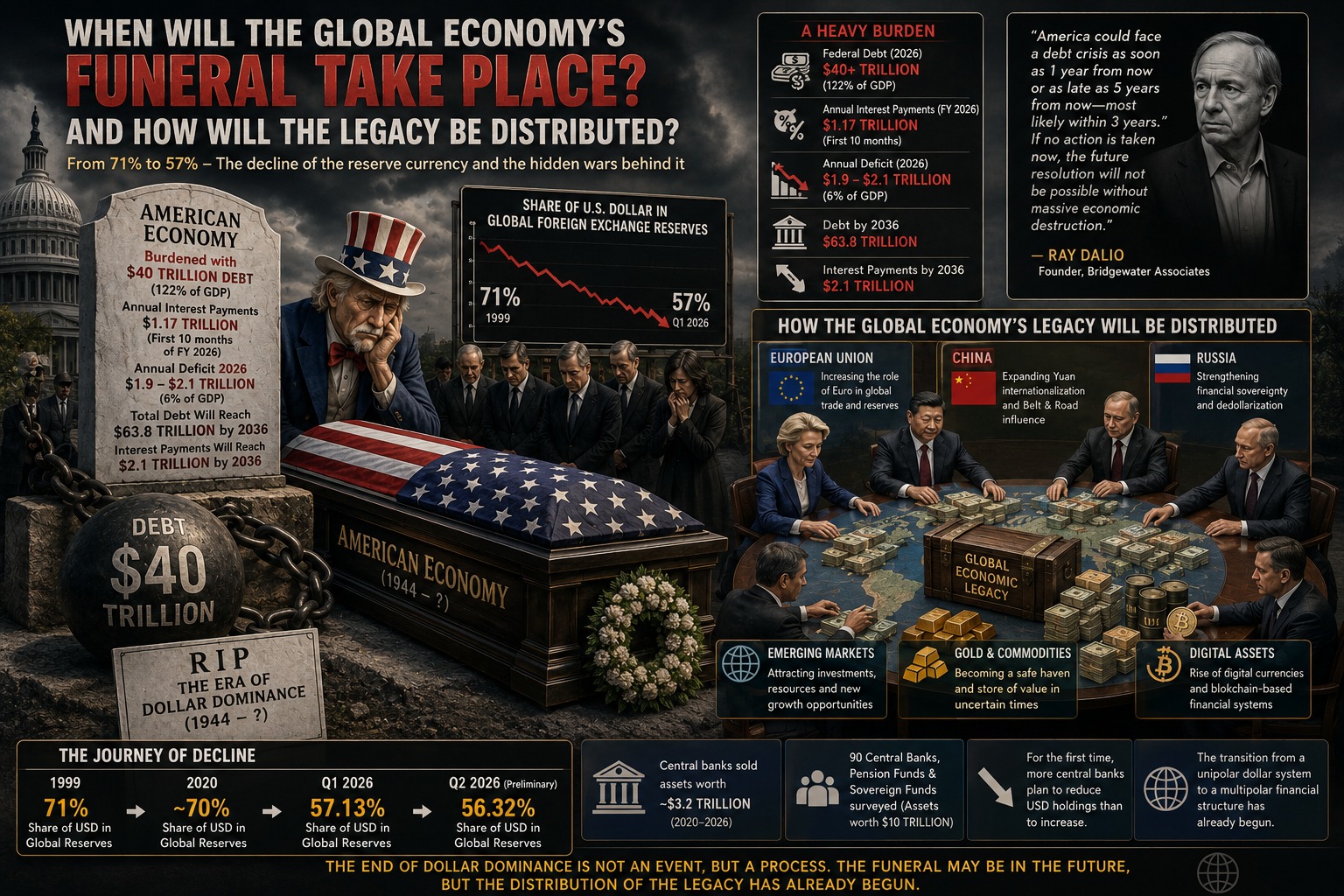
And after the funeral, this question of how the global economy’s legacy will be distributed is the most important financial question of our era and to find its answer we must closely examine research reports published by international financial institutions, central banks, and renowned international think tanks, all these analyses reveal a clear reality that the global economy’s legacy is transitioning from a unipolar US dollar system to a multipolar financial structure, and during this transition this legacy will be distributed through various channels and pathways, in this context we must first understand the current financial condition of the American economy because this is the fundamental driver that has initiated the global decline in confidence in the dollar, the latest data published by the US Treasury Department shows that the US federal debt has surpassed 40 trillion dollars which equals 122 percent of the country’s total economic output and is double the safe limit set by the World Bank, according to the Congressional Budget Office report net interest payments from October 2025 to July 2026 amounted to 963 billion dollars averaging 3.18 billion dollars per day and this burden continues to rise, according to the US Treasury Department interest costs reached 1.17 trillion dollars in the first ten months of the current fiscal year which is 15 percent higher than the previous year and these interest payments have now become the third largest expenditure in the federal budget, according to Congressional Budget Office projections the federal deficit for 2026 will be between 1.9 and 2.1 trillion dollars which is six percent of GDP and double the internationally recognized safe limit of three percent, according to these same projections by 2036 this deficit will reach 3.1 trillion dollars and total federal debt will reach 63.8 trillion dollars while interest payments will reach 2.1 trillion dollars, in this situation the defense budget is also continuously increasing and for 2026 it is approximately one trillion dollars while the Pentagon has requested an additional 80 billion dollars for the Iran war and the proposed defense budget for 2027 is 1.5 trillion dollars which is 42 percent higher than 2026 and will be the largest defense spending increase since World War II, Bridgewater Associates founder Ray Dalio has clearly warned that America could face a debt crisis and this crisis could come as soon as one year from now or as late as five years from now and most likely within three years, he stated that the US government’s financial condition is at a critical turning point and if no action is taken now then its resolution in the future will not be possible without massive economic destruction, in light of all these facts global investors and central banks are reassessing their strategies and this is the starting point from which the practical process of distributing the global economy’s legacy has already begun, according to the latest data released by the International Monetary Fund the US dollar’s share in global foreign exchange reserves was 57.13 percent in the first quarter of 2026 compared to 56.42 percent in the fourth quarter of 2025, but the IMF’s own historical data also shows that where the dollar’s share was 71 percent in 1999 it had fallen to 56 percent by 2026 and between 2020 and 2026 the dollar’s share decreased by approximately 14 percentage points meaning that central banks sold approximately 3.2 trillion dollars worth of assets, according to the IMF’s preliminary second quarter 2026 report the dollar’s share further declined to 56.32 percent although most of this decline was due to exchange rate movements rather than deliberate selling by central banks, according to a February 2026 report from the Brookings Institution this rapid and severe decline in the dollar is unusual and has sparked debate about whether America is losing its reserve currency status, Brookings analysis also reveals that reserve managers have maintained the dollar despite significant policy fluctuations largely because there is no clear alternative to the dollar, in this context the 2026 Global Public Investor Report from the London-based independent research institute Official Monetary and Financial Institutions Forum is extremely important, which included responses from 90 central banks, public pension funds, and sovereign funds managing a total of 10 trillion dollars in assets, according to this report for the first time the number of central banks intending to reduce their dollar holdings in the coming decade exceeds those wishing to increase their dollar holdings, according to OMFIF Head of Research Andrea Corea the dollar has remained at 58 percent of central bank allocations over the past five years but now the trend of gradual de-dollarization is increasing with central banks moving toward the euro and the Chinese currency, this report also stated that almost all central banks believe the Chinese currency provides diversification while two-thirds said the euro has become more attractive in global trade rising from 43 percent last year to 66 percent now, 29 percent of respondents expressed a desire to increase euro allocations in the long term compared to 22 percent last year and according to the report 79 percent of central banks and 60 percent of public funds believe the global financial system is moving toward a multipolar world, in this transition gold has assumed a central role and according to the World Gold Council’s 2026 Central Bank Gold Reserves Survey central banks have accumulated an average of 1000 tons of gold over the past four years which is significantly higher than the 500 ton average of the previous decade, this survey included participation from 76 central banks which is the highest number in the history of this survey and 89 percent of respondents believe global central bank gold reserves will increase in the next 12 months and a record 45 percent of respondents expect to increase their own gold reserves, 82 percent of central banks currently hold physical gold compared to 71 percent last year and a net 30 percent of respondents intend to increase their gold allocations in the next one to two years, according to the OMFIF report gold has come to the center of reserve management strategy and 51 percent of central banks cited geopolitical risk protection as an important reason for holding gold which was 11 percent higher than in 2024, according to the World Gold Council survey 74 percent of respondents expect a slight or significant decline in the dollar’s share of global reserves over the next five years while they believe the euro and the Chinese currency will maintain their share and gold reserves will increase, according to a June 2026 report from the European Central Bank by the end of 2025 gold had become approximately 27 percent of global official reserves surpassing the euro’s 15 percent and US Treasury securities’ 22 percent, however the ECB clearly warns that this conclusion may be misleading because gold prices rose approximately 60 percent in 2025 and a further 30 percent in 2024 which mechanically increased gold’s share of reserves, if gold is valued at end of 2023 prices then gold and the euro would each represent approximately 16 percent of global reserves while US official securities would remain the largest reserve asset representing approximately 26 percent, the ECB is therefore explaining not the demise of the dollar but the effects of gold’s remarkable revaluation, according to ECB data the dollar dominates the global financial system with a 57 percent share of global foreign exchange reserves which is almost unchanged from the previous year, the euro is near the 20 percent mark while the Chinese currency remains stagnant at around 2 percent, due to this stability the report’s authors conclude that reserve managers avoid sudden portfolio changes even in a rapidly escalating geopolitical environment, consequently the ECB does not indicate a rapid process of moving away from the dollar but rather cautious diversification of reserve holdings, the ECB report emphasizes that wars have brought gold back into focus and central bank gold purchases remained near 850 tons in 2025 which is lower than the record levels between 2022 and 2024 but still well above historical averages, the ECB observes that the countries purchasing the largest amounts of gold tend to be those located in regions facing increasing external conflict risks, since Russia’s invasion of Ukraine in 2022 China has purchased over 350 tons of gold, Poland approximately 320 tons, Turkey approximately 220 tons, and India approximately 130 tons of gold, the authors conclude that gold is increasingly being used not merely as a diversification asset but as a hedge against geopolitical risks, according to HSBC’s 2026 Reserve Management Trends Report conducted in partnership with Central Banking Publications which included responses from 101 central banks managing a total of 9.5 trillion dollars in reserves, 70 percent of central banks identified geopolitical tension as the most important risk they face in 2026, according to the HSBC report 80 percent of central banks still consider the dollar a safe haven currency, however many of them agree that its status is being challenged, 68 percent of respondents say the euro has become more attractive as a reserve currency over the past 12 months, sentiment toward the Chinese currency has also seen a slight positive increase and on average respondents expect the Chinese currency to represent 7.2 percent of global foreign exchange reserves by 2035 which is higher than the 6.5 percent forecast in last year’s survey, the HSBC report also stated that 39 percent of respondents intend to increase their gold reserves in 2026 and 73 percent of respondents invest in gold which is higher than last year’s 69 percent, according to UBS’s 2026 Annual Reserve Managers Survey which included responses from approximately 30 major central banks, 82 percent of respondents listed persistent inflation or uncontrolled long-term yield increases as their biggest global aggregate risk and 52 percent of respondents identified stagflation as the most likely scenario for the next five years compared to 39 percent last year, according to the UBS survey 81 percent of reserve managers have changed their strategic asset allocation in the past year compared to 59 percent last year, the 2026 Global Justice Report from the Paris School of Economics’ World Inequality Lab published on 4 June 2026 presented a long-term scenario according to which by 2100 all countries could converge toward a monthly income of 5,000 euros per capita while staying within planetary boundaries, according to this report 89 percent of the world’s population would see their incomes double by 2100 and more than half of the world’s poorest population’s share of wealth could increase from the current 2 percent to 30 percent while the billionaire class’s share would decrease from 6 percent to just 0.05 percent, new institutional structures are also emerging for this financial transition, the BRICS countries are developing their alternative payment system BRICS Pay whose business-to-business cross-border payment system is being prepared for launch in the second half of 2026 with settlement possible in 23 currencies, the consumer-to-business payment system of BRICS Pay was launched in the first quarter of 2026, according to a recent report approximately 65 percent of trade between BRICS countries is now conducted in local currencies, similarly the mBridge project under the supervision of the Bank for International Settlements, a multi-central bank digital currency cross-border payment platform, is approaching commercial launch, the BIS announced in 2024 that mBridge had reached the minimum viable product stage and this platform’s fees are half of traditional systems, new multilateral financial institutions such as the Asian Infrastructure Investment Bank are also playing a role in reshaping the global financial architecture, this bank has over 110 members and its authorized capital is 100 billion dollars and it has approved over 70 billion dollars in more than 360 projects since its inception in 2016, this bank has also recently launched a 10 billion dollar crisis facility for countries affected by the Middle East conflict, according to SWIFT data the Chinese currency’s share in global payments increased to 3.1 percent in June 2026 compared to 2.75 percent in May, according to SWIFT data 81 percent of payments for goods and services in April 2026 were in dollars, 8 percent in the Chinese currency, and 5 percent in euros, from all these reports a common conclusion emerges that the global financial

system is passing through a long, gradual, and multi-dimensional transition, IMF data shows that the dollar’s share has fallen from 71 percent in 1999 to 57 percent in 2026, the OMFIF report indicates that for the first time central banks intending to reduce dollar holdings outnumber those wanting to increase them and 79 percent of central banks acknowledge the transition toward a multipolar system, according to the World Gold Council survey 74 percent of central banks expect a decline in dollar reserves over the next five years and 89 percent believe global gold reserves will increase, SWIFT data shows that the Chinese currency’s share in global payments has increased to 3.1 percent and 65 percent of trade between BRICS countries is now conducted in local currencies, this transition is not happening in the form of a single event or funeral but is a structural transformation that will span several decades, as OMFIF Senior Economist Yara Aziz wrote in the report that the old assumption that public investors can wait for the environment to normalize increasingly appears unrealistic, the global financial system’s legacy is being distributed into a system where the dollar will still be the largest currency but its unipolar dominance will end, gold and new digital currencies will play key roles, regional financial blocs will emerge, and alternative payment systems like BRICS Pay and mBridge will challenge SWIFT’s monopoly, whether this legacy distribution process will be peaceful and gradual or violent and chaotic depends on whether the current financial powers accept this change or resist it, the most important factor in distributing the global financial system’s legacy will be America’s approach to dealing with its financial crisis, if America succeeds in controlling its debt and deficit then the dollar’s decline will be slow and orderly, but if America moves toward default or confidence in its financial policies is completely lost then this legacy distribution could be sudden and chaotic resulting in severe volatility in global financial markets, massive capital migration, and potentially the beginning of regional financial wars, according to the ECB report if the dollar loses its reserve currency status then the euro and the Chinese currency could fill this gap but this transition will span decades and during this period the global economy will face uncertainty and instability, the trend toward gold clearly indicates that central banks and major investors are losing confidence in the long-term stability of the US dollar and are seeking safe havens, according to the World Gold Council survey central banks’ shift toward gold is not merely a temporary measure but a long-term strategy that will continue in the coming decades, similarly the BRICS countries’ development of their own alternative payment system is evidence that they want to reduce their dependence on the Western financial system and are moving toward a more balanced global financial system, these changes are gradual and still in their early stages but their pace is accelerating and in the coming years they will determine the fundamental forms of the global economy’s legacy distribution, finally it can be said that the distribution of the global economy’s legacy will depend on three key factors, first America’s ability to deal with its financial crisis, second the pace of increase in the international status of the Chinese currency and the euro, and third the intensity of the global trend toward alternative assets such as gold and digital currencies, these three factors together will determine the new shape of the global financial system and will distribute this legacy that has been centered around the US dollar for decades, this is a historic transformation whose effects will be felt for generations to come and for which there is no simple or immediate solution, the global community must manage this transition wisely and with foresight so that this process can be completed in a peaceful and orderly manner and a major economic catastrophe can be avoided in the meantime.