
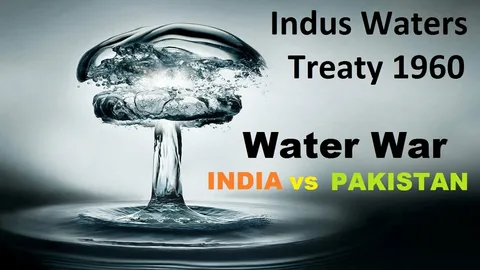
The Indus Water Treaty 1960 between India and Pakistan is one of the world’s most enduring water-sharing agreements but it is now under severe pressure. India has threatened to suspend it, while inside Pakistan, Indus river water sharing remains a bitter conflict between Sindh and Punjab. Understanding the Indus Water Treaty main points is no longer just an academic exercise it is a matter of survival for millions.
What Is the Indus Water Treaty 1960?
The Indus Water Treaty 1960 between India and Pakistan is a landmark bilateral agreement brokered by the World Bank. It governs how the waters of the Indus river system one of the largest river networks in Asia are shared between the two nations.
The treaty was the result of years of negotiations following the partition of British India in 1947. At partition, the Indus river water sharing arrangement collapsed overnight, as rivers that had irrigated undivided Punjab were now split between two hostile states.
The Indus Water Treaty 1960 was signed on September 19, 1960, in Karachi. It brought a structured, permanent legal framework to Indus river water sharing, dividing the rivers between India and Pakistan based on a geographic and hydrological formula.
Indus Water Treaty Who Signed It?
The Indus Water Treaty signed by officials included Pakistan’s President Ayub Khan and India’s Prime Minister Jawaharlal Nehru. The World Bank President W.A.B. Illiff also signed the treaty as a guarantor and mediator. This makes the Indus Water Treaty unique it is one of the few international water agreements with a third-party guarantor from a multilateral institution.
The Indus Water Treaty signed by these leaders on September 19, 1960, ended nearly a decade of disputes over Indus river water sharing that had begun at partition. It remains in force to this day, though India’s recent threats to suspend it have put its future in serious doubt.
Indus Water Treaty Main Points How Are Rivers Divided?
The Indus Water Treaty main points revolve around a clear division of the six rivers of the Indus system. According to the Indus Water Treaty main points, the three eastern rivers Ravi, Beas, and Sutlej were allocated to India. The three western rivers Indus, Jhelum, and Chenab were allocated to Pakistan.
This Indus river water sharing formula gave India approximately 20% of the total water flow and Pakistan approximately 80%. While this seems generous to Pakistan, the practical reality of Indus river water sharing is more complicated. India was allowed to use the western rivers for limited non-consumptive purposes such as navigation, power generation, and small-scale irrigation.
One of the critical Indus Water Treaty main points is the establishment of the Permanent Indus Water Commission. This body is tasked with implementing the treaty, exchanging data, and resolving disputes before they escalate. The Indus Water Commission has held regular meetings since 1960, even during periods of war between India and Pakistan.
Indus Water Commission The Peacekeeping Body
The Indus Water Commission is the operational backbone of the Indus Water Treaty 1960 between India and Pakistan. It consists of two Commissioners one from each country who meet at least once a year to review data, inspect sites, and discuss implementation.
The Indus Water Commission has been credited with keeping the treaty alive through three wars, multiple military standoffs, and decades of political hostility. Even when diplomatic relations between India and Pakistan collapsed entirely, the Indus Water Commission continued to function.
However, the Indus Water Commission faces a serious test today. India has served a notice of modification of the Indus Water Treaty, citing disputes over Pakistani hydropower projects and security concerns. If India withdraws from or fundamentally alters the treaty, the Indus Water Commission would lose its legal foundation, putting all Indus river water sharing arrangements at risk.
India’s Threat to Suspend the Treaty A Crisis Point
India’s threat to suspend the Indus Water Treaty 1960 between India and Pakistan has sent alarm bells ringing across Pakistan. The threat emerged in the context of cross-border tensions and was reinforced by India’s objections to Pakistani hydropower projects on the western rivers.
For Pakistan, the Indus river water sharing arrangement is not just a political matter it is existential. Agriculture accounts for nearly a quarter of Pakistan’s GDP and the livelihoods of over 60% of its rural population depend on Indus river water. Any disruption to Indus river water sharing would be catastrophic.
Pakistan has consistently maintained that the Indus Water Treaty 1960 is a permanent international agreement that cannot be unilaterally suspended. Pakistan’s position, as outlined in every Indus Water Treaty PDF submitted to international bodies, is that the World Bank and international law must ensure the treaty’s enforcement.
Those studying Indus Water Treaty UPSC-related material will note that this dispute is now a live geopolitical flashpoint not just a historical case study in international water law.
Indus River Water Sharing Inside Pakistan Sindh Versus Punjab
While the international dimension of Indus river water sharing dominates headlines, there is an equally urgent domestic crisis. Inside Pakistan, Sindh and Punjab have been locked in a prolonged conflict over Indus river water sharing from the country’s own allocation.
As the swollen eastern rivers raged through Punjab towards downstream Sindh, there was uncertainty about the total inflows at Guddu Barrage in Sindh, with different numbers circulated in the media, causing confusion.
This confusion is not accidental. It reflects deep institutional mistrust between the two provinces over Indus river water sharing data. Sindh irrigation officials attributed the confusion about flows to discrepancies in Punjab’s data.
A Sindh irrigation official shared a gauge reading of 11.3ft, in comparison with Punjab’s reading of 11.7ft during monitoring. These may seem like small numbers, but at barrage scale, a difference of 0.4ft can represent tens of thousands of cusecs of water water that Sindh’s farmers desperately need.
Data Disputes at the Heart of Pakistan’s Water Crisis
The technical disputes over Indus river water sharing within Pakistan go deeper than simple measurement errors. A federal government official observed that the rating tables at concerned barrages were not calibrated to measure water volumes over 600,000 cusecs, since such high flows had not been seen in quite a while.
This points to a systemic failure in Pakistan’s water management infrastructure. The Indus Water Commission at the international level tracks data between India and Pakistan, but domestically, Pakistan’s own inter-provincial Indus river water sharing monitoring is broken.
Punjab officials rejected Sindh’s claims, saying their automated and manual systems were accurate and there were no discrepancies recorded at Panjnad. Punjab’s Additional Secretary for Irrigation questioned why Sindh had not put its concerns in writing, suggesting the disputes were more political than technical.
This back-and-forth is not new. It is the permanent state of Indus river water sharing politics within Pakistan a crisis that the Indus Water Treaty 1960 between India and Pakistan was never designed to solve, since it only governs the international boundary, not domestic allocations.
The Indus River Water Sharing Map Understanding the Geography
The Indus river water sharing map tells a story of geography and power. The Indus originates in Tibet, flows through Indian-controlled Ladakh, enters Pakistan near Attock, and travels south through Punjab and Sindh before emptying into the Arabian Sea near Karachi.
On the Indus river water sharing map, the three western rivers Indus, Jhelum, Chenab are Pakistan’s lifeline. They feed the world’s largest contiguous irrigation system, covering over 16 million hectares of farmland. Without these rivers, Pakistan’s agricultural economy would collapse.
The Indus river water sharing map also reveals a dangerous vulnerability: most of the rivers’ headwaters lie in territory controlled by India or disputed between India and Pakistan. This geographic reality gives India enormous leverage over Indus river water sharing leverage that India is increasingly willing to use as a political tool.
Indus Water Treaty PDF What the Documents Say
Every Indus Water Treaty PDF published by the World Bank, Pakistan’s Ministry of Water Resources, or Indian government bodies confirms the same basic structure: the treaty divides rivers, establishes the Indus Water Commission, and creates dispute resolution mechanisms including neutral expert review and international arbitration.
The Indus Water Treaty PDF documents also show that Pakistan has filed multiple complaints through the Indus Water Commission over Indian hydropower projects including the Baglihar Dam and the Kishanganga project. Pakistan argued these projects violated Indus Water Treaty main points by affecting water flows and storage capacity on rivers allocated to Pakistan.
For students studying Indus Water Treaty UPSC topics, these case studies are essential. The Indus Water Treaty UPSC syllabus covers the treaty under international relations, water diplomacy, and South Asian geopolitics and the current crisis makes it more relevant than ever.
Global and Regional Impact Why the World Is Watching
The Indus Water Treaty 1960 between India and Pakistan has been called a model for international water diplomacy. If India successfully suspends or renegotiates it under political pressure, it will set a dangerous global precedent that water treaties can be weaponized during geopolitical disputes.
For the 300 million people who depend on Indus river water sharing for drinking, farming, and survival, the stakes could not be higher. Climate change is already reducing glacial meltwater that feeds the Indus system. Add to that political interference with Indus river water sharing, and you have a humanitarian disaster in the making.
The Indus Water Commission, the World Bank, and the United Nations have all been called upon to intervene. Pakistan’s position is clear: the Indus Water Treaty 1960 must be upheld in full. India’s position that the treaty needs renegotiation is reshaping South Asia’s water politics in real time.
Conclusion Protecting the Indus Is a Matter of Survival
The Indus Water Treaty 1960 between India and Pakistan has survived wars, terrorism, and decades of hostility. But it has never faced a threat as serious as the current combination of Indian political pressure, climate change, and domestic mismanagement of Indus river water sharing within Pakistan.
The Indus Water Commission must be strengthened. The Indus river water sharing map must be updated to reflect new climate realities. The Indus Water Treaty main points must be protected through international law. And within Pakistan, Sindh and Punjab must resolve their data disputes before they erode the country’s ability to manage its own water allocation.
A nation that cannot manage its water cannot manage its future. For Pakistan, the Indus is not just a river it is the foundation of civilization itself.
FAQs
What happened on 19 September 1960?
On September 19, 1960, the Indus Water Treaty 1960 between India and Pakistan was formally signed in Karachi. The treaty was the Indus Water Treaty signed by Pakistan’s President Ayub Khan, India’s Prime Minister Jawaharlal Nehru, and World Bank President W.A.B. Illiff. The signing ended nearly a decade of negotiations over Indus river water sharing that had been disrupted by the partition of British India in 1947. The Indus Water Treaty 1960 established permanent rules for Indus river water sharing and created the Indus Water Commission to manage implementation.
Which countries share the Indus River?
The Indus River is primarily shared between Pakistan and India, with the headwaters originating in Tibet (China) and the river flowing through Indian-administered Ladakh before entering Pakistan. The Indus Water Treaty 1960 between India and Pakistan governs formal Indus river water sharing between the two countries. Afghanistan also uses some water from Indus tributaries in its eastern regions. The Indus river water sharing map shows that Pakistan receives the vast majority of the river’s water under the treaty, as the Indus is the primary artery of the country’s entire agricultural system.
Who is the owner of the Indus Water Treaty?
The Indus Water Treaty 1960 is jointly owned by India and Pakistan, with the World Bank serving as guarantor. The treaty was the Indus Water Treaty signed by the leaders of both nations on an equal and bilateral basis. Neither country can unilaterally claim ownership or cancel the treaty without going through the dispute resolution mechanisms outlined in the Indus Water Treaty main points, which include the Indus Water Commission, neutral expert review, and international arbitration at the Permanent Court of Arbitration at The Hague. Every Indus Water Treaty PDF confirms this shared legal ownership structure.