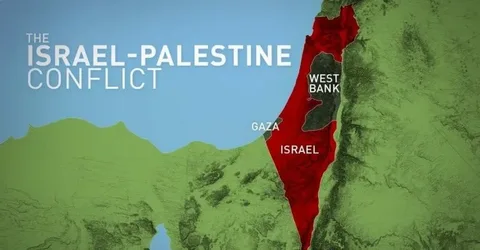

The Israel-Palestine conflict remains the world’s most debated, documented, and devastating unresolved dispute. With over 72,000 Palestinians killed since October 2023, a fragile ceasefire riddled with violations, and a UN refugee agency under systematic attack, the question millions ask on Reddit threads, news sites, and classrooms globally is the same: who is right?
The Israel-Palestine conflict, which has roots stretching back more than a century, reached a catastrophic new phase when Hamas launched a surprise attack on Israel on October 7, 2023, killing 1,195 Israelis and taking 251 hostage. Israel’s military response has since killed over 72,000 Palestinians in Gaza. As of April 1, 2026, confirmed deaths stand at at least 72,289 people, including 20,179 children, according to the Palestinian Ministry of Health. A ceasefire brokered by the United States came into effect on October 10, 2025 but it has been violated repeatedly, keeping the Israel-Palestine conflict at the forefront of global concern today.
Background: How Did the Israel-Palestine Conflict Start?
The Israel-Palestine conflict start can be traced to the late 19th century, when the Zionist movement began advocating for a Jewish homeland in Ottoman-controlled Palestine a land where Arab Palestinians had lived for generations. Following World War I, Britain controlled the region under the Balfour Declaration of 1917, which expressed support for a Jewish homeland while promising not to prejudice the rights of existing non-Jewish communities.
The modern Israel-Palestine conflict history accelerated dramatically in 1948 when Israel declared independence, triggering the first Arab-Israeli war. Roughly 700,000 Palestinians were displaced in what they call the “Nakba” Arabic for “catastrophe.” Israel calls this its War of Independence. The 1967 Six-Day War saw Israel capture the West Bank, Gaza Strip, Sinai Peninsula, and the Golan Heights, beginning a military occupation of Palestinian territories that international law widely considers illegal.
Decades of failed peace negotiations, two Palestinian intifadas (uprisings), the Oslo Accords, and the rise of Hamas in Gaza have all shaped the Israel-Palestine conflict history into what it is today: a conflict over land, sovereignty, identity, and survival with deeply opposing narratives on both sides.
Israel-Palestine Conflict: Who Is Right?
This is the question that dominates Israel-Palestine conflict Reddit discussions, academic debates, and UN Security Council chambers alike. The honest journalistic answer is: both sides present arguments rooted in genuine historical claims, religious identity, and legal frameworks and both sides have committed acts condemned by international bodies.
Israel’s position centers on its right to exist as a sovereign state within internationally recognized borders, its right to self-defense following the October 7, 2023 Hamas attack, and its stated goal of eliminating Hamas as a militant threat. Israel and the United States reject international characterizations of its military campaign as genocide.
Palestinian advocates argue that Palestinian people have an inalienable right to self-determination over land they inhabited for centuries before 1948, that the ongoing military occupation of the West Bank and the siege of Gaza constitute violations of international law, and that the scale of civilian casualties reflects deliberate targeting rather than collateral damage.
A report issued in September 2025 by the UN Commission of Inquiry found that Israel committed genocide in Gaza, underscoring a growing consensus among human rights organizations and experts around the atrocities in Israel’s campaign in Gaza. Israel strongly rejects this characterization.
The debate over who is right in the Israel-Palestine conflict ultimately collides with questions of proportionality, occupation law, civilian protection, and the right to resist issues on which international opinion is deeply divided.
The UNRWA Crisis: A Conflict Within the Conflict
Central to the Israel-Palestine conflict today is the systematic campaign against UNRWA the United Nations Relief and Works Agency for Palestine Refugees. UNRWA was founded specifically to serve Palestinian refugees after the creation of Israel in 1948, and its programs span primary health, community mental health, education, relief and social services, and refugee camp improvement.
UNRWA’s extensive and recently digitized archive contains property deeds and proof of land ownership, which can assist Palestinians in securing compensation and the right of return something many Israelis see as an existential threat to the Jewish state.Critics argue that Israel’s targeting of UNRWA is not incidental but strategic. The UN Deputy Special Coordinator for the Middle East Peace Process noted Israeli forces conducted “forcible entry with bulldozers and demolitions” at UNRWA’s headquarters in occupied East Jerusalem, alongside what he called “abhorrent calls for the annihilation of UNRWA staff” by Israeli officials.
An October 2025 ICJ advisory opinion found that Israel’s claim that UNRWA lacks impartiality is unfounded, and that its obstruction of the agency’s critical work is at odds with international law.
Israel-Palestine Conflict Ceasefire: A Peace That Isn’t Peace
The Israel-Palestine conflict ceasefire, which took effect on October 10, 2025, was hailed as a breakthrough. Under the first phase, all living hostages were to be released in exchange for 2,000 Palestinian prisoners, including 250 serving life sentences, within 72 hours of the withdrawal of Israeli forces to pre-designated lines within the Gaza Strip.But the Israel-Palestine conflict ceasefire has proven deeply fragile. Israel violated the ceasefire agreement at least 2,073 times from October 10, 2025 to March 18, 2026, through air attacks, artillery shelling, and direct shootings. Israeli forces shot at civilians 750 times, bombed and shelled Gaza 973 times, and demolished properties on 263 occasions.On the humanitarian front, only 38,358 trucks entered Gaza out of 94,800 allocated just 40 percent while Israel blocked essential food items including meat, dairy, and vegetables.Israeli Prime Minister Benjamin Netanyahu stated that the next phase of the ceasefire will be “disarming Hamas and demilitarising the Gaza Strip,” adding that “the next phase is not reconstruction.”Palestinian leadership took a starkly different view. The State of Palestine’s letter to the UN Security Council noted that since the ceasefire came into effect, Israel killed at least 509 Palestinians and wounded over 1,405 others, with the total death toll exceeding 72,000.
Israel-Palestine Conflict Today: Regional Escalation in April 2026
The Israel-Palestine conflict today exists within a dramatically changed Middle East. In April 2026, joint Israeli-US strikes on Iran that began on February 28 have triggered Iranian retaliation across the region. Israel and the US targeted Iran’s nuclear infrastructure, ballistic missile facilities, and naval assets, killing several top Iranian officials including Supreme Leader Ali Khamenei. Iran retaliated by striking Israel and US bases, and effectively closing the Strait of Hormuz.
This regional escalation has injected additional uncertainty into international efforts to advance the US-proposed peace framework, known as the “Comprehensive Plan to End the Gaza Conflict,” which the UN Security Council endorsed through resolution 2803 in November 2025.
Meanwhile, the West Bank situation continues to deteriorate. Israeli officials driving settlement expansion, including far-right Finance Minister Bezalel Smotrich, have been explicit that the moves are meant to block the establishment of a Palestinian state.Combined with a deepening economic crisis and overwhelming dissatisfaction with the Palestinian Authority, Palestinians in the West Bank are desperate for new leadership and a new political vision.
Expert and Official Voices
Christopher Gunness, Director of the Myanmar Accountability Project and former UNRWA spokesperson, argued in Al Jazeera on April 5, 2026, that UNRWA’s very existence, as a reminder of Palestinians’ entitlement to a full range of inalienable rights including the right to self-determination, has always made the physical and political destruction of the agency an imperative for successive Israeli governments.Israel’s representative to the UN stated that Hamas remains heavily armed, “holding thousands of rockets and anti-tank missiles,” and that “Hamas must now be dismantled completely, Gaza must be demilitarized and deradicalized.”The Palestinian Permanent Observer to the UN stated that for a ceasefire to succeed, “Israel must cease dictating the future of Gaza and fully withdraw from the territory,” adding that “Palestine must be central to, and fully represented in, any process that determines its future.”
Global Impact
The Israel-Palestine conflict today carries consequences far beyond the Middle East. The European Commission proposed a suspension of the trade pillar of the EU-Israel Association Agreement following a review that found Israel in violation of the agreement’s human rights clause. The UK suspended free-trade negotiations with Israel, and several states issued sanctions against violent settlers and halted arms transfers.In September 2025, the UN General Assembly adopted the New York Declaration on a two-state solution, spearheaded by France and Saudi Arabia.
The Israel-Palestine conflict has also reshaped Reddit communities, social media discourse, university campuses, and public squares globally, with millions of people demanding governments take clearer positions on international law, arms sales, and humanitarian access.
Conclusion: What Comes Next?
The key pillars of the ceasefire plan, as well as hopes for broader regional stability, will fail without a political vision and a credible pathway for Palestinian self-determination,according to Chatham House analysts. The UN Security Council’s April 2026 open debate on the Palestinian question, convened by Bahrain as a high-level signature event, takes place against the backdrop of escalating Middle East hostilities and an uncertain peace framework.
The Israel-Palestine conflict start may be more than a century old, but its resolution remains as distant as ever. What is clear is that without accountability, humanitarian access, and a genuine political horizon for Palestinian self-determination, no ceasefire however negotiated will hold.
FAQs
Who is the real owner of Palestine land?
This question sits at the heart of the Israel-Palestine conflict. Palestinians assert historical and continuous residency on the land for centuries, backed by international law recognizing the illegality of Israel’s occupation of Palestinian territories captured in 1967. Israel grounds its claim in religious history, the 1948 declaration of statehood recognized by the UN, and subsequent legal agreements. Most international legal frameworks recognize that Palestinians have rights to a sovereign state in the West Bank, Gaza, and East Jerusalem though no final agreement has ever been reached.
Who is older Israel or Palestine?
As a modern nation-state, Israel was formally established in 1948. However, the Arab Palestinian people and their presence on the land predate this by centuries. The name “Palestine” itself has ancient roots, used in various forms since antiquity. The modern Palestinian national identity crystallized in the 20th century, partly in response to the Zionist movement and later the creation of Israel. Neither claim to antiquity is simple or one-dimensional.
What started the Palestine and Israeli conflict?
The Israel-Palestine conflict start is most commonly traced to the late 1800s when Jewish immigration to Ottoman Palestine increased under the Zionist movement. It escalated through British rule, the 1947 UN Partition Plan (which Palestinians rejected), Israel’s declaration of independence in 1948, and the displacement of approximately 700,000 Palestinians. The 1967 war and subsequent military occupation of Palestinian territories deepened and entrenched the conflict into what the world witnesses today.