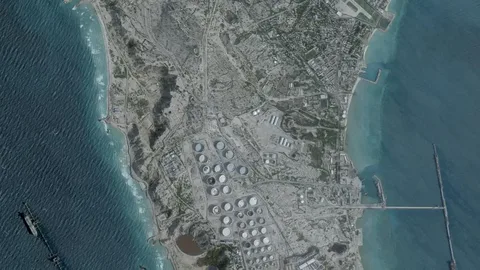
Kharg Island has become the single most consequential piece of territory in the Iran war — a five-mile coral outcrop in the Persian Gulf that handles 90 percent of Iran’s crude oil exports and that the Trump administration is actively weighing whether to seize by force.
President Donald Trump has been weighing whether to use ground forces to seize Iran’s strategic oil hub of Kharg Island — an operation analysts say could be achieved relatively quickly, but one that would leave US troops in great peril and prolong rather than shorten the war.
The Kharg Island battlefield has been prepared for exactly this scenario. Iran has been laying mines on shorelines, moving MANPADs and anti-aircraft systems to the island, and positioning thousands of additional military personnel in anticipation of an American amphibious assault — turning what was already a heavily fortified installation into what military experts describe as a potential trap.
Background
Kharg Island — Why This Island Matters More Than Any Other
Kharg Island is a five-mile stretch of land off the Iranian coast, around a third of the size of Manhattan. Its long jetties jut into waters that are deep enough to accommodate oil supertankers, making the island a critical site for oil distribution. A declassified CIA document from 1984 described the facilities as the most vital in Iran’s oil system, and their continued operation is essential to Iran’s economic well-being.
Often referred to as Iran’s oil lifeline, Kharg Island is a coral island located about 15 miles off the coast of mainland Iran. It is estimated that around 90 percent of the country’s crude exports pass through it before tankers then travel through the Strait of Hormuz.
Trump himself has had Kharg Island in his sights for nearly four decades. Trump told The Guardian in a 1988 interview that should he ever become US president, he would be harsh on Iran. He said one bullet shot at one of our men or ships and he would do a number on Kharg Island — he would go in and take it.
That 1988 instinct has now become a live operational debate inside the Trump administration, the Pentagon, and allied capitals — with the Kharg Island battlefield becoming the defining strategic question of the war’s fourth week.
Details
Kharg Island Bombing — What Has Already Happened
Before the ground operation debate, the Kharg Island bombing campaign had already taken place.
The US military had already targeted Kharg Island with strikes. Central Command said that 90 targets had been hit on the island, including naval mine storage facilities, missile storage bunkers, and multiple other military sites. Trump had announced the attack by saying that US forces had avoided hitting oil infrastructure on the island for reasons of decency.
Video posted to Truth Social and geolocated showed US strikes on the island’s airport facilities, with large explosions and black smoke visible throughout the footage. The Kharg Island bombing degraded some of its air and sea defences, including HAWK surface-to-air missiles and Oerlikon anti-aircraft guns.
Earlier this month, Israeli opposition leader Yair Lapid said destroying the terminal would cripple Iran’s economy and topple the regime. He declared that Israel must destroy all of Iran’s oil fields and energy industry on Kharg Island.
The Kharg Island bombing therefore represents the first phase of a potential two-phase operation — airstrikes to degrade defences, followed by a potential ground assault to physically seize and hold the island.
Iran’s Preparation of the Kharg Island Battlefield
Iran has not waited passively while the Kharg Island bombing campaign proceeded. It has been fortifying the island intensively — turning an already difficult target into what experts are calling a layered defensive nightmare.
Iran has been laying traps and moving additional military personnel and air defenses to Kharg Island in recent weeks in preparation for a possible US operation to take control of the island, according to multiple people familiar with US intelligence reporting. The island already has layered defenses, and the Iranians have moved additional shoulder-fired, surface-to-air guided missile systems known as MANPADs there in recent weeks. Iran has also been laying traps including anti-personnel and anti-armor mines around the island, including on the shoreline.
Reports indicate that anti-ship missiles, mines, drones and attack craft are being kept in underground tunnels across the island — a hardened defensive architecture that the Kharg Island bombing campaign would struggle to fully neutralise before any ground assault.
Iranian parliament speaker Mohammad Bagher Qalibaf issued an explicit public warning. He wrote on X that based on intelligence reports, Iran’s enemies are preparing to occupy one of the Iranian islands with support from one of the regional states. He said Iranian forces are monitoring all enemy movements and that if any step is taken, all the vital infrastructure of that regional state will be targeted with relentless, unceasing attacks.
The Kharg Island battlefield is therefore a prepared battlefield — not a target that the US would approach with surprise but one that Iran has had weeks to fortify, mine, and position for maximum defensive impact.
The Military Risks — Layer by Layer
Before any ground operation, US forces would have to pass through the Strait of Hormuz and to the northern part of the Gulf, contending with Iranian drones, ballistic missiles and mines in the waterway. Once in position off Kharg, the Marines would need ironclad air and sea superiority over at least 100 miles around the island.
Sitting roughly 20 miles off the coast of Iran at the western end of the Persian Gulf and over 350 miles past the Strait of Hormuz, Kharg Island would leave US forces vulnerable to numerous threats. Despite the effectiveness of US and Israeli strikes at degrading Iran’s missile and long-range drone capabilities, the regime still retains some capacity to conduct missile and drone attacks and will likely continue to do so for some time. The proximity of Kharg Island to the mainland would also leave US forces within range of Iranian multiple launch rocket systems and potentially even cannon artillery firing rocket-assisted projectiles.
US troops would be exposed to missile and drone attacks, including potentially small but lethal camera-wielding first-person view drones that are already used by the millions in Ukraine. Upon any successful strikes, the Iranian regime would be expected to release videos of those attacks online, using the graphic deaths of American service members as propaganda.
Even if the US did capture the island, holding the position would be extremely challenging, with resupply operations exposed to persistent drone, missile and artillery fire. It would be an absolutely disastrous decision that would ensure the conflict lasted many months.
Why the Navy Is Already Stretched
The US Navy would need to contribute heavily to the Kharg Island battlefield force protection effort. Already strained across several missions, destroyers would likely be required to provide ballistic and cruise missile defence not only for forces on the island, but also for the Amphibious Ready Groups needed to get troops there and the support craft needed to sustain them. These naval assets would then be unavailable for other tasks, such as convoying oil tankers through the Strait of Hormuz. Given that the Navy has yet to begin conducting convoy operations, a mission to seize Kharg Island would almost certainly delay its ability to do so.
The Strategic Gamble — Does Seizing Kharg Actually Work
Even setting aside the military risks, analysts question whether seizing Kharg Island would achieve the strategic objective Trump is pursuing — forcing Iran to reopen the Strait of Hormuz.
Tehran could opt to lay more mines to target shipping, including floating mines deployed from the coast, which would make the region even more hazardous for shipping and make the Strait of Hormuz even harder to reopen even if Kharg Island was taken.
A seizure and occupation of Kharg Island is more likely to expand and extend the war than it is to deliver any sort of decisive victory. A seizure could make things worse by emboldening Iran to escalate its attacks on Gulf states and tanker traffic, setting back negotiations and putting US troops in harm’s way with no clear exit strategy.
Trump would be gambling that the remaining Iranian leadership, faced with the loss of tens of billions in annual revenue, would capitulate.That gamble assumes a rational Iranian response to economic pressure — an assumption that four weeks of a war in which Iran has refused to back down despite devastating strikes makes difficult to sustain.
The Alternative — Blockade Without Invasion
One possible way to pressure the Iranians without a ground assault is to consider an offshore blockade of Kharg, making it impossible to export the oil. This could be done without actually putting troops ashore.
The blockade option would deny Iran its primary revenue source without placing US troops on a Kharg Island battlefield exposed to drone, missile, mine, and artillery fire from a coast 16 miles away. Gulf allies are privately backing this approach.
Gulf allies are privately urging the Trump administration against prolonging the war by putting boots on the ground to occupy Kharg Island. The concern is that occupying the island with US troops would result in high casualties, likely triggering Iranian retaliation against Gulf countries’ infrastructure and prolonging the conflict.
The Kharg Island Population
The Kharg Island population question matters in any discussion of a military seizure. Kharg Island is described by US officials as the nexus for all Iranian oil supply — its infrastructure includes long jetties extending into waters deep enough for supertankers, oil storage and loading facilities, and extensive military installations.The island has a small civilian population of Iranian workers and their families associated with the oil facility operations — civilians who would be caught in any Kharg Island battlefield scenario between US assault forces and Iranian defenders.
Quotes
“I’d go in and take it.” — Donald Trump, 1988 interview with The Guardian, on what he would do with Kharg Island as president
“Once in position off Kharg, the Marines would need ironclad air and sea superiority over at least 100 miles around the island.” — James Stavridis, former NATO Supreme Allied Commander
“I would be very worried about this. Iranians are clever and ruthless.” — Admiral James Stavridis, on the Kharg Island ground operation risk
“A seizure and occupation of Kharg Island is more likely to expand and extend the war than it is to deliver any sort of decisive victory.” — Ryan Brobst and Cameron McMillan, Foundation for Defense of Democracies
“Seizing Kharg Island is technically feasible but escalatory, given its centrality to Iran’s oil exports.” — Military Analyst, on the Kharg Island battlefield risk
“It would be an absolutely disastrous decision that would ensure the conflict lasted many months.” — Christian Emery, Associate Professor of US-Iran Relations, University College London
“Our forces are monitoring all enemy movements, and if they take any step, all the vital infrastructure of that regional state will be targeted with relentless, unceasing attacks.” — Mohammad Bagher Qalibaf, Iranian Parliament Speaker
“If an enemy makes a mistake, it will receive a decisive response there.” — IRGC Navy Chief Alireza Tangsiri, on Iran’s fortified Gulf islands
Impact
For US military planning, the Kharg Island battlefield debate represents the most consequential decision the Trump administration has not yet made. Two Marine Expeditionary Units and thousands of 82nd Airborne paratroopers are now in the region. The Marines are travelling on the USS Tripoli, an assault ship that could play a key role in a potential attack on Kharg Island.Every day of inaction increases Iranian defensive preparation. Every day of escalation increases the political cost of a ground operation that polls show is deeply unpopular with the American public.
For global energy markets, the Kharg Island question sits at the centre of the most consequential energy supply disruption in history. Alternative export routes that bypass the Strait of Hormuz exist but are limited and have not been robustly tested on a large scale, according to the IEA.If the US seizes Kharg Island and Iran responds by mining the strait more aggressively, global oil supply could deteriorate further rather than recover — the opposite of what the operation would be intended to achieve.
For the Gulf states, the Kharg Island battlefield scenario carries direct escalation risk. Iran has explicitly threatened to strike the vital infrastructure of any regional state that supports a US operation. Saudi Aramco facilities, UAE desalination plants, and Qatari LNG infrastructure would all be within range of Iranian retaliation triggered by a Kharg Island seizure.
For diplomatic negotiations, the Kharg Island bombing campaign and the threatened ground assault are simultaneously Trump’s pressure lever and his risk. Iran’s five-condition war termination demand already includes international recognition of its sovereignty over the Strait of Hormuz. Adding a US military seizure of its primary oil export hub to the negotiating context makes those five conditions harder to walk back from — not easier.
FAQs
What is the significance of Kharg Island?
Kharg Island is described by US officials as the nexus for all Iranian oil supply. Its long jetties jut into waters deep enough to accommodate oil supertankers, making the island a critical site for oil distribution.The island handles 90 percent of Iran’s oil exports and seizing it would give the United States the ability to severely disrupt Iran’s energy trade, placing enormous pressure on Tehran’s economy. Iran is the third largest producer in OPEC. A declassified CIA document from 1984 described Kharg Island’s facilities as the most vital in Iran’s oil system — a designation that remains as accurate in 2026 as it was four decades ago. The Kharg Island battlefield debate reflects that strategic reality — the island is not just important, it is irreplaceable to Iran’s economic survival.
Does Kharg Island have oil?
Yes. Kharg Island does not produce oil itself but serves as the loading and export terminal through which approximately 90 percent of Iran’s crude oil passes before being shipped globally. Its deep-water jetties accommodate the supertankers that cannot approach Iran’s shallow mainland coast, making it the essential infrastructure node in Iran’s entire oil export system. The Kharg Island bombing campaign specifically avoided hitting oil infrastructure — Trump said the decision was made for reasons of decency — preserving the option to use or destroy that infrastructure as future leverage. The Kharg Island population working the oil facilities remains on the island throughout the current conflict.
What happens if the Strait of Hormuz is blocked?
Kharg Island sits roughly 16 miles off the coast of Iran in the northern end of the Gulf, about 300 miles northwest of the Strait of Hormuz. It lies in waters deep enough to enable the docking of tankers that are too large to approach the Iranian mainland’s shallow coastal waters. When the Strait of Hormuz is blocked — as it effectively has been since the war began — approximately 20 million barrels of oil per day that would normally transit the strait are disrupted. Global oil prices surge past $100 per barrel. The IEA releases emergency strategic reserves. Asian economies that source 90 percent of Hormuz crude face supply shortfalls. Shipping insurance collapses. Container traffic reroutes around the Cape of Good Hope, adding weeks to delivery times. The Kharg Island battlefield scenario adds another dimension — even if the US seizes the island, Iran could respond by mining the strait more aggressively, making the blockade worse rather than better and delivering no strategic benefit from the enormous military risk the operation would entail.
Conclusion
Kharg Island is five miles long and a third the size of Manhattan. It is also the most dangerous piece of real estate in the world right now.
US troops could likely seize the island relatively quickly, but that would not necessarily lead to a quick and decisive end to the war Trump has been seeking, given its unpopularity at home.
The Kharg Island bombing campaign degraded its defences. Iran rebuilt and reinforced. The Kharg Island battlefield is now a layered defensive position — mined shorelines, MANPADs in every corner, FPV drones ready to launch, rocket artillery within range from the coast sixteen miles away, and a regime that has publicly promised to turn any seizure into a regional conflagration.
A seizure and occupation of Kharg Island is more likely to expand and extend the war than it is to deliver any sort of decisive victory.
Trump wanted Kharg Island in 1988 and he wants it now. Whether that decades-long instinct translates into an order that puts thousands of US Marines onto the Kharg Island battlefield — and what happens to them when it does — is the question that the next 48 hours may answer.