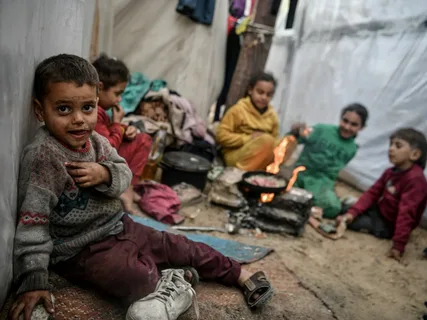
The lives of kids in Gaza remain shattered more than two years after the war began, even with a ceasefire technically in place. UNICEF State of Palestine reports tens of thousands of children killed, injured or displaced, while newer incidents in the occupied West Bank show how fragile daily survival still is for Palestinian families caught in the conflict.
Where Is Gaza Located
Gaza is a narrow coastal strip along the eastern Mediterranean Sea, bordered by Israel to the north and east and Egypt to the south. It sits west of the occupied West Bank, separated by Israeli territory, and together the two areas make up the Palestinian territories. Despite its small size, Gaza is home to more than two million people, a large share of them children, making the ongoing war one of the most densely concentrated child protection crises in the world today.
Background
The current war traces back to 7 October 2023, when hostilities between Israel and Hamas escalated sharply following Hamas’s attack on Israel. What followed was one of the deadliest and most destructive military campaigns in the region’s modern history, with entire neighborhoods flattened and the vast majority of Gaza’s population forced from their homes, some more than once.
An October ceasefire agreement between Israel and Hamas was meant to bring a measure of stability. Yet humanitarian organizations continue to document violence, displacement and deprivation on both sides of the Green Line, in Gaza and in the West Bank, long after the truce was announced.
Details
According to the UNICEF State of Palestine humanitarian situation report, at least 21,500 children in the Gaza Strip had been reported killed as of the end of March 2026, alongside more than 41,000 injured. The same report documents that even after the ceasefire took hold, at least 138 children in Gaza were reported killed in the months that followed, underscoring how incomplete the calm has been.
The scale of displacement is difficult to overstate. UNICEF figures show close to two million people, roughly 90 percent of Gaza’s population, have been forced from their homes at some stage of the war. Around 1.7 million children across the territory now need humanitarian assistance just to survive day to day.
Education has also collapsed for hundreds of thousands of children. UNICEF has reported that more than 630,000 children in Gaza are currently out of school, with the vast majority of school buildings damaged or destroyed. Malnutrition is another growing concern, with UNICEF surveys showing large numbers of young children eating dangerously limited diets, leaving hundreds of thousands at risk of wasting.
The West Bank, though less discussed internationally, has seen its own surge in child casualties. UNICEF recorded 248 Palestinian children killed there in conflict-related violence between October 2023 and the end of March 2026, alongside thousands more injured, many by live ammunition during search-and-arrest operations or clashes near checkpoints.
A recent case highlighted by Al Jazeera illustrates how access to basic healthcare remains a matter of life and death for Palestinian families. Four-month-old Ahmad Marouf Zeid died in early July 2026 after his family’s attempt to reach a hospital was blocked at a military checkpoint near the Deir Ammar refugee camp, northwest of Ramallah. His family had been racing to get him emergency care when soldiers at the checkpoint fired tear gas and stun grenades, forcing them to turn back and take a longer route. By the time Ahmad reached an ambulance, doctors could not save him.
Quotes
Laila Ghannam, the governor of Ramallah and el-Bireh, described the infant’s death as part of a wider pattern, calling it a “stain on the conscience of humanity” that reflected policies obstructing Palestinians’ access to healthcare and freedom of movement.
A relative who witnessed the family’s desperate attempt to reach the checkpoint, Fatima al-Abd Khalil, recalled that soldiers initially “yelled at us to get back” before the situation escalated further, according to Al Jazeera’s reporting from the scene.
The World Health Organization has separately documented 233 incidents affecting healthcare facilities, workers and ambulances across the West Bank in 2025 alone, most involving obstruction or denial of access, a pattern humanitarian groups say has become routine rather than exceptional.
Impact
The consequences of these conditions extend far beyond the immediate casualty figures. Aid agencies warn that an entire generation of Palestinian children is growing up without consistent access to school, safe drinking water, adequate nutrition, or mental health support. UNICEF’s Gaza Child-Focused Assessment, based on a survey of more than 2,000 households, found that repeated displacement and the collapse of basic services have created what the agency calls a severe, multidimensional crisis for children.
Regionally, the humanitarian strain has pushed neighboring countries, UN agencies and donor governments to repeatedly appeal for expanded access and funding. UNICEF’s 2026 appeal for the State of Palestine seeks more than 700 million dollars to fund emergency health, nutrition, education, and child protection programs, though funding gaps remain significant months into the year.
Internationally, cases like Ahmad’s death, along with the deaths of journalists and repeated strikes reported since the ceasefire, have kept scrutiny on whether the truce is holding in practice. Human rights organizations and Palestinian officials argue that restrictions on movement and healthcare access in the West Bank amount to a continuation of harm against civilians, even where large-scale bombing has paused.
Conclusion
For kids in Gaza and across the Palestinian territories, survival remains uncertain even as ceasefire terms are formally in place. UNICEF and partner agencies continue to call for unrestricted humanitarian access, faster reconstruction of schools and hospitals, and sustained international funding to prevent further loss of life. Whether the coming months bring meaningful relief or another cycle of escalation will depend heavily on how strictly the ceasefire is enforced and how quickly aid can reach the children who need it most.
Frequently Asked Questions
Can we adopt children from Palestine?
International adoption of Palestinian children is extremely difficult and, in most practical cases, not permitted. Palestinian family and child welfare matters are generally governed by local and religious legal systems, which strongly favor kinship-based care, such as placement with extended family members, over formal adoption by outsiders. In addition, ongoing conflict, damaged civil registries, and the difficulty of verifying whether a child is genuinely orphaned or separated from family make cross-border adoption from Gaza or the West Bank highly complicated and, in the current environment, not something recognized international agencies are facilitating. Families interested in helping Palestinian children are generally encouraged to support verified humanitarian organizations such as UNICEF, which focus on reuniting children with surviving relatives and providing shelter, healthcare and education rather than facilitating international adoption.
Are girls allowed to go to school in Palestine?
Yes, girls in Palestine, including in Gaza and the West Bank, have historically had strong access to education, with high enrollment and literacy rates compared to many other places in the region. There is no cultural or legal ban preventing girls from attending school. However, the ongoing war has disrupted education for all children regardless of gender, with the vast majority of school buildings in Gaza damaged, destroyed, or repurposed as shelters for displaced families. UNICEF reports that hundreds of thousands of children, both boys and girls, are currently out of school because of this destruction, not because of restrictions specifically targeting girls.
What are the rights of the Palestinian people?
Like all people, Palestinians are entitled to the protections outlined in international human rights and humanitarian law, including the right to life, safety, healthcare, education, freedom of movement, and protection from arbitrary displacement. Children specifically are covered under the UN Convention on the Rights of the Child, which guarantees protection from violence, access to education, healthcare, and family unity wherever possible. Humanitarian organizations, including UNICEF and the World Health Organization, have repeatedly documented violations of these rights throughout the Gaza war and in the West Bank, including restricted access to medical care, attacks on schools and hospitals, and mass displacement.