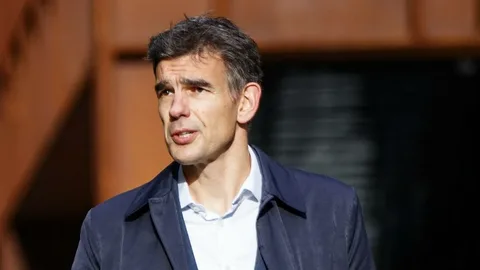
Matt Brittin BBC boss appointment is now confirmed — and it marks one of the most unconventional choices in the BBC’s 104-year history.
Former Google executive Matt Brittin has been named the new director-general of the BBC, taking the helm at the UK’s national broadcaster as it faces an uncertain future and a $10 billion lawsuit from President Donald Trump. Brittin will take the role from May 18 with an annual salary of £565,000.
The Matt Brittin BBC boss appointment makes him the 18th director-general in BBC history and the first to arrive without any direct television or journalism experience — a deliberate signal from the board that the broadcaster’s survival now depends on digital transformation more than editorial tradition.
Who Is Matt Brittin
The 57-year-old spent almost two decades at Google, rising to become the company’s president in Europe, the Middle East, and Africa. Before joining Google in 2007, he spent time in media, marketing, and strategy, including as a commercial director at Trinity Mirror. He also served for nine years on the board of Sainsbury’s and has been a trustee of charities including the Media Trust and the Climate Group.
Brittin joined Google in 2007 as its Managing Director for the UK, rising through the ranks to become vice president for Northern and Central Europe before being appointed president of EMEA business and operations in December 2014. He left the company in 2024 and had been on what he described on his LinkedIn as a gap year of reading and running before the BBC came calling.
Beyond the boardroom, matt brittin is known for a fiercely competitive athletic background. He represented Great Britain at the 1988 Seoul Olympics as a rower, competed in the Oxford-Cambridge Boat Race, and won a bronze medal at the World Rowing Championships in 1989. He was awarded a CBE in the King’s New Year Honours for services to technology and digital skills.
He is currently a non-executive director of the Guardian Media Group board — a role that, alongside his Media Trust trusteeship, gives him closer ties to public interest journalism than his Google career might suggest.
How Matt Brittin Got the Job
The road to the Matt Brittin BBC boss appointment was neither clean nor straightforward. The search process exposed just how difficult it has become to attract serious candidates to a role widely described as one of the toughest in British media.
Brittin became a leading contender after other candidates withdrew from the race, including Jay Hunt of Apple TV and former Channel 4 Chief Executive Alex Mahon. This means the wait for a female director-general at the 104-year-old broadcaster continues — possibly into another decade.
His candidacy was strengthened, sources said, by the absence of stronger alternatives. Although he has never worked in television, he is regarded as a champion of public broadcasting with the experience of managing a large and complex organisation through disruption. The BBC’s board concluded that his technology credentials were precisely what the moment required — a media landscape where YouTube has recently overtaken the BBC in some audience metrics and streaming giants dictate how people consume content.
On matt brittin twitter and across social media, reaction to the appointment was immediate and divided. Technology and digital media figures broadly welcomed the choice. Traditional broadcasting veterans questioned whether a man with no experience commissioning programmes or editing a newsroom could navigate the editorial crises that ended his predecessor’s tenure.
The Trump Lawsuit and the Editorial Crisis That Created the Vacancy
No account of the Matt Brittin BBC boss appointment is complete without understanding what drove Tim Davie from the role.
The BBC’s previous director-general resigned after the corporation was accused of editorial bias against US President Donald Trump. A Panorama documentary, broadcast in 2024 in the days before the US presidential election, spliced two clips from separate parts of a Trump speech into what appeared to be a single continuous quote — in which Trump appeared to urge supporters to march and fight like hell. The edit was misleading. Davie, along with BBC News CEO Deborah Turness, resigned in November 2025 over the scandal.
Trump is now suing the BBC for defamation in a Florida federal court, seeking $10 billion in damages. The BBC has formally asked the court to dismiss the case, arguing the documentary was never aired in Florida or available to stream in the United States. The lawsuit remains active and unresolved.
The brittle bbc boss label that critics applied to the director-general role itself in the wake of the scandal reflects a wider institutional fragility — a broadcaster under legal attack from the world’s most powerful political figure, haemorrhaging revenue, losing talent to streamers, and heading into a charter renegotiation without clear leadership.
The Challenges Brittin Inherits
The Matt Brittin BBC boss appointment comes with a precise and demanding set of institutional crises to manage at the same time.
The BBC lost more than £1.1 billion in revenues last year as fewer households felt the need to pay for a licence fee. A parliamentary committee report found that while the BBC remained a trusted institution, it was under serious pressure, struggling to retain its foothold in an evolving media landscape and among younger audiences.
The Royal Charter that defines everything the BBC is and does — its governance structure, its funding model, and its editorial independence — is due for renewal. Culture Secretary Lisa Nandy has voiced support for the BBC’s request for a permanent charter rather than the current ten-year review cycle, but that outcome is far from guaranteed.
At the top of Brittin’s immediate to-do list is the appointment of a new Director of BBC News to replace Deborah Turness, who resigned alongside Tim Davie. The BBC’s editorial credibility — its most valuable asset — is currently operating without its most senior news leader.
His confidence in parliamentary committee hearings will also be scrutinised closely. Ten years ago, in a parliamentary hearing about Google’s approach to paying corporation tax, Brittin claimed he did not know how much he was paid — a response that was widely ridiculed and one that critics have not forgotten.
What the BBC Board Said
BBC chair Samir Shah said Brittin brings deep experience of leading a high-profile and highly complex organisation through transformation, and that he is an outstanding leader with the skills needed to navigate the many changes taking place in the media market and in audience behaviours.
Shah added that Brittin joins the BBC at a critical time, with the government’s charter review underway and a clear need for radical reform of the BBC, its funding model, and the framework in which it operates. The stakes for the BBC, and for the future of public service broadcasting, have never been higher.
Quotes
“Now, more than ever, we need a thriving BBC that works for everyone in a complex, uncertain and fast-changing world. At its best, it shows us, and the world, who we are.” — Matt Brittin, BBC Director-General
“This is a moment of real risk, yet also real opportunity. The BBC needs the pace and energy to be both where stories are, and where audiences are.” — Matt Brittin, BBC Director-General
“Matt’s passion for the BBC, his understanding of the challenges facing the organisation, his commitment to its independence and his determination to maintain the BBC’s position as one of the country’s greatest national assets were critical factors in the Board’s decision.” — Samir Shah, BBC Chair
“While his experience in the world of big tech could be an advantage, Mr Brittin will have to quickly demonstrate a commitment to public service broadcasting.” — Caroline Dinenage, Chair, Culture Media and Sport Committee
Impact
For the BBC, the Matt Brittin BBC boss appointment is the most significant strategic pivot the corporation has made in its modern history. Choosing a technology executive over a broadcaster signals that the board has concluded its existential threats — streaming competition, licence fee collapse, digital audience fragmentation — require fundamentally different leadership than the kind that produced the Trump documentary crisis.
For British public service broadcasting more broadly, the appointment raises a question that will not be answered quickly. Can an executive whose career was built on maximising digital engagement for a commercial technology giant genuinely defend the values of public service journalism when those values come into conflict with audience metrics, political pressure, or financial necessity?
For the wider media industry, the Matt Brittin BBC boss story adds to a global pattern of legacy media institutions turning to technology executives when traditional leadership has run out of answers. Whether that pattern produces genuine transformation or simply delays harder structural decisions will be one of the defining media stories of the next decade.
Frequently Asked Questions
Who is the new director-general of the BBC?
Matt Brittin is the new director-general of the BBC — the 18th person to hold the role in the corporation’s 104-year history. The 57-year-old former Google EMEA president will take up the post on May 18, succeeding Tim Davie who resigned in November over the Trump-Panorama documentary editing scandal. Brittin is the first BBC director-general to arrive without any direct television or journalism experience, and will be paid an annual salary of £565,000.
How do I send an email to BBC?
The BBC can be contacted through its official website at bbc.co.uk, which carries a dedicated complaints and feedback section for members of the public. For editorial complaints, the BBC runs a formal process that begins with contacting the specific programme or service involved. For general audience enquiries, a central contact form is accessible through the BBC’s audience services section. Under the Matt Brittin BBC boss era, public trust and editorial accountability are stated priorities — making the complaints process a more visible institutional commitment than it has been in recent years.
Who is the big boss of BBC?
The director-general is the most powerful operational role in British broadcasting — responsible for over 20,000 employees, editorial direction, commercial strategy, and navigating intense scrutiny from parliament and the public. That role now belongs to Matt Brittin, who takes over from Tim Davie on May 18. Above the director-general sits the BBC board, chaired by Samir Shah, which sets strategic direction and is accountable to the UK government through the Royal Charter framework. The Matt Brittin BBC boss appointment places him as the operational head of the entire corporation — its journalism, its programming, its commercial arm BBC Studios, and its global World Service output.
Conclusion
The Matt Brittin BBC boss appointment is either the boldest decision the BBC board has made in a generation — or the clearest sign yet of how few strong options the broadcaster had left.
A $10 billion Trump lawsuit sits unresolved in a Florida federal court. The licence fee is shrinking by over a billion pounds a year. The director of BBC News has not been replaced. The Royal Charter that defines everything the BBC is expires within the year.
Matt Brittin has rowed for Great Britain at the Olympics, led Google’s largest regional division through a decade of digital disruption, and spent nearly two decades at the company that more than any other reshaped how the world consumes information.
Whether any of that prepares him for what the BBC now faces will not be answered on May 18 when he walks through the door. It will be answered in courtrooms, in parliamentary hearings, in newsrooms, and in the homes of the tens of millions of people who still turn to the BBC to make sense of the world.