

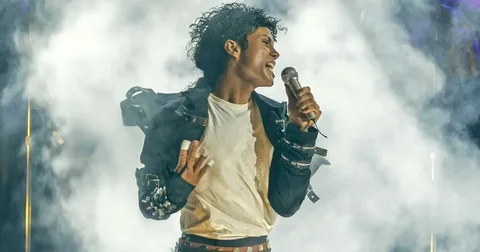
A Record Nobody Saw Coming This Big
When a biopic about Michael Jackson was first announced, expectations were reasonably high Jackson’s global fan base practically guaranteed solid box office numbers. What nobody quite predicted was that the film would end up rewriting box office history entirely, surpassing Oppenheimer to become the highest-grossing biographical film ever released, and doing it while closing in on a billion dollars worldwide.
That’s exactly what’s happened. And the story behind how it got there is worth understanding.
The Numbers That Made History
Michael has now earned approximately $977 million worldwide enough to overtake Christopher Nolan’s Oppenheimer, which previously held the all-time biopic record at around $975 million.
The breakdown tells its own story: roughly $370 million domestically, and more than $600 million from international markets. That international weighting matters it shows this wasn’t a film that succeeded primarily because of American nostalgia for Michael Jackson. It connected globally, in markets where Jackson’s music remains genuinely influential decades after his career peaked.
This wasn’t the film’s first record either. Earlier in its theatrical run, it surpassed Bohemian Rhapsody to become the highest-grossing music biopic ever made a record that had stood untouched since 2018. Breaking two major box office milestones within the same release cycle is the kind of achievement that genuinely surprised industry analysts who track these things for a living.
The Film Itself
Directed by Antoine Fuqua and written by John Logan, Michael traces Jackson’s journey from his earliest years performing with the Jackson 5 through the height of his global superstardom during the Bad Tour era.
The casting decision that generated significant pre-release buzz was Jaafar Jackson Michael’s actual nephew taking on the title role in his feature film debut. The resemblance alone created enormous curiosity before a single trailer dropped, and audiences seem to have responded well to his performance once they saw it on screen.
The supporting cast includes Nia Long, Colman Domingo, Miles Teller, Laura Harrier, and Larenz Tate a lineup that gave the film genuine dramatic weight alongside its musical sequences and large-scale production values.
Critical reception has been mixed, which is worth being honest about. Reviews haven’t been universally glowing. But audiences clearly didn’t care ticket sales remained strong throughout the theatrical run, defying the steep post-opening-weekend decline that most films, even successful ones, typically experience.
Why This Connected So Powerfully With Audiences
Industry analysts point to several factors working together, and none of them alone would likely have produced this scale of success.
Michael Jackson’s music has never really left popular culture. His catalog continues to generate billions of streams annually, and younger generations who weren’t alive during his peak years are still discovering his music through platforms and culture that didn’t exist when he was at his commercial height. That’s a genuinely unusual kind of staying power.
The Jaafar Jackson casting created a hook that marketing teams clearly leaned into the family connection gave the film an authenticity angle that’s hard to manufacture artificially. And the production’s recreation of Jackson’s most iconic performances gave longtime fans something specific to show up for: seeing defining moments of his career staged at scale on a movie screen.
Combine those elements with a coordinated international marketing push, and you get a film that performed well in opening weekend and then, unusually, kept performing well for months afterward rather than fading quickly.
What Beating Oppenheimer Actually Means
Oppenheimer’s box office success was itself considered something of an anomaly when it happened — a serious, three-hour biographical drama about nuclear physics becoming a genuine box office phenomenon wasn’t supposed to happen by conventional Hollywood logic. Most industry observers assumed that record would stand for years, simply because biographical films rarely achieve true blockbuster-level revenue.
Michael didn’t just match that achievement it surpassed it, while also taking the music biopic crown from Bohemian Rhapsody in the same run. That double achievement suggests something more significant than a single lucky release: it suggests biographical films, when built around the right subject and executed with genuine production ambition, can compete commercially with the franchise blockbusters that have dominated box office charts for the past decade.
There’s an interesting production note here too both Michael and Bohemian Rhapsody were produced by Graham King, which means one producer now holds two of the most commercially successful music biopics in film history. That’s not a coincidence worth glossing over; it suggests King has identified something about how to build these films that resonates broadly.
Is the Billion-Dollar Mark Realistic?
With theatrical runs still active in several international markets, industry analysts believe Michael has a genuine, realistic shot at crossing the $1 billion worldwide threshold.
Reaching that milestone would place the film in extremely rare company very few biographical films in cinema history have ever crossed into the billion-dollar club, a tier traditionally dominated by franchise sequels, superhero films, and animated blockbusters. A biopic reaching that number would be a meaningful statement about what kind of films audiences are still willing to show up for in theaters.
What This Means for the Industry
Hollywood has leaned heavily into biographical films over the past several years, with mixed commercial results. Michael’s performance gives studios a new benchmark to point to proof that with the right subject, the right casting, and genuine production investment, biopics can deliver returns that compete with the franchise tentpoles that usually dominate release calendars.
For an industry that’s been increasingly cautious about greenlighting original or mid-budget films in favor of established franchises, Michael’s success offers a useful counter-argument: audiences will turn out for theatrical experiences built around culturally significant, globally recognizable stories they don’t need a cinematic universe attached to justify the ticket price.
The Fan Reaction
Social media lit up when the box office milestone was confirmed, with fans celebrating both Jaafar Jackson’s performance and the broader statement the achievement makes about Michael Jackson’s cultural legacy nearly two decades after his death.
The sentiment running through a lot of the reaction is fairly simple: his music never actually left, and this film’s success is just the latest evidence of that. Entertainment commentators have made similar observations the sustained, genuinely global nature of the film’s box office performance reflects just how far Jackson’s artistic influence still reaches, well beyond audiences who experienced his career in real time.
The Bottom Line
Michael has done something genuinely rare in the modern box office landscape turned a biographical film into one of the year’s biggest commercial successes, surpassing both Oppenheimer and Bohemian Rhapsody in the process. With the billion-dollar mark within reach, the film has already cemented its place as one of 2026’s defining cinematic stories, and it’s likely to shape how studios think about biopics for years to come.
FAQs
Is Michael also the highest-rated biopic, not just the highest-grossing?
Not necessarily and it’s worth keeping these two things separate. Critical reviews have been mixed, while audience response has been considerably more enthusiastic, which is part of what drove the film’s strong and sustained box office performance. Financial success and critical acclaim measure genuinely different things; a film can dominate at the box office without dominating on review aggregator scores, and that’s essentially what’s happened here.
What’s officially the biggest biopic of all time now?
By worldwide box office revenue, it’s Michael. The film has surpassed Oppenheimer’s previous record for highest-grossing biographical film and also overtook Bohemian Rhapsody to claim the highest-grossing music biopic title. Both milestones happened within the same release cycle, making Michael the new reference point against which future biographical films will likely be measured.
Does Michael actually have a real shot at hitting $1 billion?
Yes, and industry analysts are fairly confident about it. With worldwide earnings already approaching $977 million and several international markets still actively contributing to the theatrical run, most experts expect the film to cross the billion-dollar threshold within the coming weeks. If it happens, Michael would join an extremely small group of biographical films to ever reach that level of global box office success.