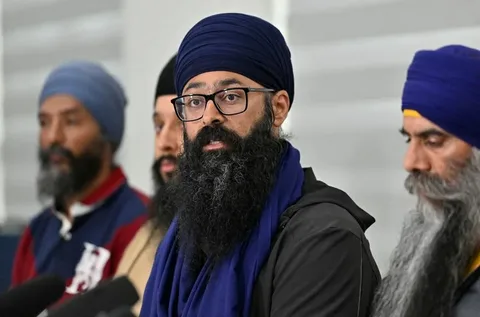
Moninder Singh Canada Sikh threats have escalated to a new level of urgency after the chairman of the Sikh Federation of Canada received an assassination warning covering not just himself but his wife and two children.
Moninder Singh said he remained defiant after learning of assassination threats against his family in Canada, where fellow Sikh activist Hardeep Singh Nijjar was killed. He told reporters he would not be silenced and was speaking at the United Nations European headquarters in Geneva, where he has been appealing for international action against India’s alleged targeting of Sikh activists abroad and against transnational repression more broadly.
The Moninder Singh Canada Sikh threats story has deepened a diplomatic crisis between Ottawa and New Delhi at a moment when Prime Minister Mark Carney was pursuing trade talks with India — talks that Sikh activists say normalise relations without accountability.
Background
Moninder Singh Canada Sikh Threats — The History Behind the Crisis
The Moninder Singh Canada Sikh threats cannot be separated from the killing of Hardeep Singh Nijjar — the event that made the threat against Singh not a hypothetical but a demonstrated reality.
The best-known case of India’s alleged targeting of Sikh activists abroad was the killing of Hardeep Singh Nijjar, a friend of Singh’s who was gunned down near the Sikh temple he led in a Vancouver suburb. Nijjar was a Canadian citizen and a prominent voice in the Khalistan movement. His assassination triggered a major rupture in Canada-India relations when Prime Minister Justin Trudeau accused India’s government of orchestrating the killing.
A year before Nijjar was killed, Canadian authorities had informed both Nijjar and Moninder Singh of credible threats against their lives. We did not know how to react, Singh said. We did not think that India would resort to assassinations on foreign soil.
The Khalistan dimension is central to understanding the Moninder Singh Canada Sikh threats. Like Nijjar, Singh is part of a group advocating for an independent Sikh state called Khalistan. The Khalistan campaign dates to India’s 1947 independence and has been blamed for the assassination of a prime minister and the bombing of a passenger jet. It has been a bitter issue between India and several Western nations with large Sikh populations.
India considers the Khalistan movement a terrorist campaign and denies targeting Sikh activists abroad.
Details
Moninder Singh Canada Sikh Threats — Four Warnings, One Answer
The Moninder Singh Canada Sikh threats have now reached four formal police warnings — each one more alarming than the last.
Moninder Singh said he was delivered a fourth duty to warn letter by Vancouver police about credible threats on his life just days before the threat became public. Singh said a confidential informant had shared information that he and his family faced a serious risk.
The last warning before Singh left for Geneva came before he departed to participate in the UN Human Rights Council’s main annual session. He said that an informant working within a criminal syndicate had told police of an imminent threat of assassination to himself, his wife and his two children. The threat extended to his family directly.
Singh shared an audio recording of the police visit. On the call, the officer said the threat extended to Singh, his wife and his two children. The officer appeared to agree that the threat may stem from his political activism.
Singh connected the Moninder Singh Canada Sikh threats directly to India. Canadian police have not officially confirmed that attribution — but the tone of their communication has left little ambiguity.
Singh said he was inspired by Hardeep Singh Nijjar’s courage, and determined not to go quiet. I have taken it in the opposite way, deciding now is the time to actually double down, he said. Since then, Singh has received three more duties to warn from Canadian police, informing him of a credible threat to his life.
Canada-India Relations — The Trade Deal Controversy
The Moninder Singh Canada Sikh threats escalated precisely as Prime Minister Carney prepared to visit India for trade talks — a sequence that Sikh activists called deeply troubling.
A senior Canadian official told reporters that the Carney government believed India had ceased its attempts at transnational repression in Canada, saying the government was confident that activity was not continuing. The official was briefing reporters ahead of the prime minister’s departure for New Delhi and Mumbai.
Singh said he worries India could wash their hands of past accusations if Canada moves forward with new agreements. He said putting trade before Canadian lives was what they had been worried about. It feels like a slap in the face, Singh said. He questioned how Canada can pursue new trade deals while its own intelligence agencies warn of foreign interference and violence.
Singh said it was deeply disturbing that the Canadian government normalised diplomatic relations so quickly without anything changing. We are going into India and shaking hands with the very people that have Canadian blood on their hands, he charged.
The UN Push Against Transnational Repression
The Moninder Singh Canada Sikh threats story has now reached the highest levels of international human rights institutions.
Singh and other Sikh activists are urging the UN Human Rights Council to appoint an expert to investigate transnational repression, or for existing special rapporteurs to focus more on the issue. Ben Saul, the UN special rapporteur on protecting rights while countering terrorism, said stronger focus would be a positive thing. He was among five independent UN rights experts who sent a communication to the Indian government in 2024 to enquire about Nijjar’s assassination, asking what steps India had taken to investigate the killing and why the activist had been listed as a terrorist.
Saul said the experts were absolutely not satisfied with the response from the Indian authorities, who essentially denied there was a problem.
Who Is Moninder Singh
Moninder Singh is a 44-year-old Canadian-born citizen and the chairman of the Sikh Federation of Canada. He was born and raised in Canada, making the Moninder Singh Canada Sikh threats directed at a Canadian citizen on Canadian soil — not a foreign national. His full name is Moninder Singh Bual and he lives in Surrey, British Columbia — the same city where Hardeep Singh Nijjar was killed outside a Sikh temple.
Quotes
“We won’t be silenced.” — Moninder Singh, Chairman, Sikh Federation of Canada
“Am I worried about the safety of my wife and kids? Of course. But that is not going to be enough to make me stop.” — Moninder Singh, speaking to reporters in Geneva
“I have taken it in the opposite way, deciding now is the time to actually double down.” — Moninder Singh, on the Moninder Singh Canada Sikh threats
“It kills me to know you’re in this position.” — Vancouver Police Officer, in audio recording shared by Moninder Singh
“Putting trade before Canadian lives is what we’ve been worried about.” — Moninder Singh, on Canada’s India trade talks
“We are absolutely not satisfied with the response from the Indian authorities, who essentially denied there was a problem.” — Ben Saul, UN Special Rapporteur on protecting rights while countering terrorism
“We are tackling it up front, working together with Canada. That’s how mature democracies work.” — Dinesh Patnaik, Indian High Commissioner to Canada
Impact
For Canada-India relations, the Moninder Singh Canada Sikh threats have made a fragile diplomatic normalisation even more complicated. A government official insisting the threat has ended on the same week police hand-delivered an assassination warning to a Canadian citizen’s home is a credibility problem that the Carney government cannot easily dismiss.
For the Khalistan movement, the Moninder Singh Canada Sikh threats story has brought global attention to a cause that many governments have tried to treat as a peripheral internal Indian matter. The UN involvement, the Geneva testimony, and the audio recording of a police officer expressing sympathy for Singh’s position have elevated the issue beyond bilateral Canada-India diplomacy.
For Hardeep Singh Nijjar’s legacy, the Moninder Singh Canada Sikh threats confirm that the killing of Nijjar was not an isolated incident but part of an ongoing pattern — one that four police warnings, a UN special rapporteur’s intervention, and a diplomatic rupture between two G20 nations have failed to stop.
For the broader question of transnational repression, the Moninder Singh Canada Sikh threats have become one of the most documented cases of alleged state-directed threat campaigns against diaspora activists currently before the UN Human Rights Council.
FAQs
Why are there so many Sikhs in Canada?
Sikh migration to Canada began in the early 1900s when Sikh soldiers travelling with a Hong Kong military contingent passed through Vancouver and learned of economic opportunities in the lumber, agriculture, and railroad industries. Word spread to Punjab and immigration began. By 1907, Sikhs made up 98 percent of Canada’s entire South Asian population.A second major wave followed the 1947 Partition of India, which displaced many Sikhs and drove further migration. In the 1980s, the Indian army’s attack on the Golden Temple in Amritsar and subsequent anti-Sikh violence pushed even more Punjabi Sikhs to seek safety abroad. Canada’s open immigration policies, established Sikh communities, and reputation for religious tolerance made it the destination of choice — producing the world’s largest Sikh diaspora outside India, directly connected to the Moninder Singh Canada Sikh threats story today.
What percentage of the population in Canada is Sikh?
According to the 2021 Census, approximately 771,790 people in Canada reported belonging to the Sikh faith, representing 2.1 percent of Canada’s total population.On a percentage basis, there are actually more Sikhs in Canada than in India — 2.12 percent of the Canadian population identifies as Sikh compared to 1.72 percent of India’s population.Ontario has the largest Sikh community with 300,435, followed closely by British Columbia with 290,870 — the province where the Moninder Singh Canada Sikh threats are centred and where Hardeep Singh Nijjar was killed.
Who is the Sikh officer in the Canada Army?
In 2011, Lieutenant Colonel Harjit Singh Sajjan became the first Sikh to command a Canadian Army reserve regiment when he was appointed commander of The British Columbia Regiment. He was later appointed as Canada’s Minister of National Defence in 2015 under Prime Minister Justin Trudeau.In 1990, the RCMP lifted a ban that had previously prevented turbaned Sikh officers from joining the force. In 1991, Baltej Singh Dhillon became the first RCMP officer allowed to wear a turban and was appointed to the Senate in 2025 to represent British Columbia.The presence of Sikhs in Canada’s military and political institutions is the institutional backdrop against which the Moninder Singh Canada Sikh threats represent such a stark contradiction.
Conclusion
The Moninder Singh Canada Sikh threats story is about one man who refuses to be silent — but it is also about something much larger.
Singh said silence is what they want and they are not going to get it from him. He said he remained determined to continue speaking, continue appearing in the community, and continue pushing for international accountability for what he describes as India’s transnational campaign against Sikh activists.
Hardeep Singh Nijjar was killed. Four warnings have been delivered to Moninder Singh’s door. The UN special rapporteur is unsatisfied with India’s response. And Canada is shaking hands in New Delhi.
The Moninder Singh Canada Sikh threats have placed the Khalistan question, transnational repression, and the limits of diplomatic normalisation at the centre of one of the most watched bilateral relationships in the Commonwealth world.
Singh’s answer to all of it remains the same. Silence is not an option.