
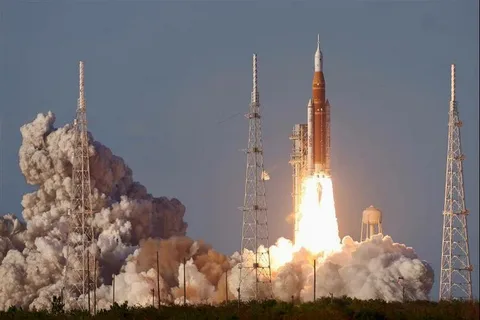

NASA Crewed Lunar Mission Makes History in April 2026
NASA has achieved a landmark moment in human spaceflight history by launching four astronauts on the first NASA crewed lunar mission in over half a century. The Artemis II mission lifted off from Kennedy Space Center in Florida on April 1 2026 marking the most significant NASA manned lunar mission since the Apollo program ended in 1972. The ten-day mission carries four astronauts on a free-return trajectory around the Moon before returning safely to Earth representing the dawn of a new era in deep space human exploration.
Artemis 2 Launch Date and Mission Overview
The Artemis 2 launch date of April 1 2026 was confirmed after months of preparation and two significant delays that tested the patience of the global space community. The 322-foot-tall Space Launch System rocket carrying the Orion spacecraft lifted off from Launch Complex 39B at 6:35 p.m. Eastern time delivering over 8.8 million pounds of thrust to propel the crew toward deep space.
The NASA crewed lunar mission will last approximately ten days with the crew travelling further from Earth than any humans in history breaking the record set during the Apollo 13 mission in 1970. The Artemis 2 launch date marks the first time humans have travelled beyond low Earth orbit since Apollo 17 in December 1972 making it a genuine generational milestone in the story of human spaceflight.
The Historic Crew of the NASA Crewed Lunar Mission
The four astronauts aboard the NASA crewed lunar mission represent a historic set of firsts that reflect how significantly human spaceflight has evolved since the NASA Moon Mission 1969 era of the Apollo program.
Commander Reid Wiseman is a veteran NASA astronaut and former International Space Station commander leading the Artemis II crew with extensive spaceflight and test pilot experience. Pilot Victor Glover is the first person of colour assigned to a lunar mission representing a historic milestone in the diversity of NASA crewed lunar mission crews. Mission Specialist Christina Koch holds the record for the longest single spaceflight by a woman and becomes the first woman to travel to the vicinity of the Moon. Mission Specialist Jeremy Hansen of the Canadian Space Agency is the first non-American and first Canadian to travel toward the Moon making the NASA crewed lunar mission a landmark moment for international space cooperation.
How the NASA Crewed Lunar Mission Compares to 1969
The NASA Moon Mission 1969 achieved what remains one of humanity’s greatest achievements when Apollo 11 commander Neil Armstrong and lunar module pilot Buzz Aldrin became the first humans to walk on the lunar surface on July 20 1969. The NASA Moon Mission 1969 was the product of an extraordinary decade of development driven by Cold War competition and national determination that culminated in six successful lunar landings before the Apollo program concluded with Apollo 17 in 1972.
The current NASA crewed lunar mission differs from the NASA Moon Mission 1969 era in several important ways. Where the Apollo missions were driven by Cold War urgency the Artemis program is designed as a sustainable long-term architecture for lunar exploration and eventual Mars missions. The NASA crewed lunar mission also benefits from decades of technological advancement and international partnership that the NASA Moon Mission 1969 program could not draw upon.
What Happens During the 10-Day NASA Manned Lunar Mission
The NASA manned lunar mission follows a carefully planned ten-day timeline that begins with the crew orbiting Earth to check spacecraft systems before a critical engine burn sends Orion on its trajectory toward the Moon.
The crew will conduct a manual pilot demonstration testing the Orion spacecraft’s handling capabilities perform life support system checks and carry out scientific investigations including the AVATAR study examining the effects of deep space radiation on human health. On day six the NASA manned lunar mission reaches its most dramatic moment when Orion conducts a multi-hour lunar flyby giving the crew their closest views of the Moon’s surface including areas of the far side never previously observed by human eyes. The mission concludes with splashdown in the Pacific Ocean off the coast of San Diego.
NASA Moon Mission 2027 and Beyond
The Artemis II NASA crewed lunar mission is not an end point but a critical step in a progressive program of increasingly ambitious missions. Artemis III planned as a crewed low Earth orbit mission will practice rendezvous with lunar landing systems while Artemis IV targeted for early 2028 aims to achieve the first crewed lunar landing since 1972 using either SpaceX’s Starship or Blue Origin’s lunar lander.
The NASA Moon Mission 2027 phase of the Artemis program will involve testing the human landing systems in low Earth orbit to validate the technology needed for the eventual lunar surface return. The long-term vision extends beyond the NASA Moon Mission 2027 milestones toward establishing a permanent lunar base that will serve as the foundation for eventual crewed missions to Mars.
FAQs
Is NASA Planning a Manned Moon Mission?
Yes NASA is not only planning a manned moon mission it has already launched one. The Artemis II NASA crewed lunar mission launched on April 1 2026 sending four astronauts on a ten-day journey around the Moon for the first time since 1972. Beyond Artemis II the NASA manned lunar mission program continues with Artemis IV targeting the first actual lunar landing since the Apollo era planned for early 2028. The long-term NASA moon mission program aims to establish a permanent human presence on the lunar surface and use it as a stepping stone toward sending astronauts to Mars making this the most ambitious sustained manned lunar mission program in human history.
Who Are the Three Men Lost in Space?
No astronauts have been permanently lost in space though several have lost their lives in space-related accidents. The Apollo 1 crew of Gus Grissom Ed White and Roger Chaffee died on January 27 1967 during a launch pad test when a fire broke out in the command module. The Space Shuttle Challenger disaster of 1986 claimed seven lives and the Columbia disaster of 2003 claimed another seven. Soviet cosmonaut Vladimir Komarov died during the Soyuz 1 mission in 1967 becoming the first confirmed in-flight spaceflight fatality. These tragedies have shaped every subsequent NASA crewed lunar mission and deep space program including the safety protocols built into the current Artemis II mission.
Who Lost Life in Space?
Several astronauts and cosmonauts have lost their lives in the course of humanity’s space exploration efforts. The most notable in-flight fatalities include Soviet cosmonaut Vladimir Komarov who died during Soyuz 1 in 1967 and the Soyuz 11 crew of Georgi Dobrovolsky Viktor Patsayev and Vladislav Volkov who died during reentry in 1971. American losses include the Apollo 1 crew in 1967 the seven Challenger astronauts in 1986 and the seven Columbia astronauts in 2003. These sacrifices form a solemn backdrop to the current NASA crewed lunar mission with every safety system aboard the Artemis II Orion spacecraft designed in part to honour the memory of those lost and ensure that the NASA manned lunar mission program never repeats those tragedies.