
Pakistan has delivered one of its most direct statements to the United Nations Security Council in years placing the Palestinian issue root cause instability Middle East argument at the very centre of global diplomacy at a moment when the entire region is in crisis.
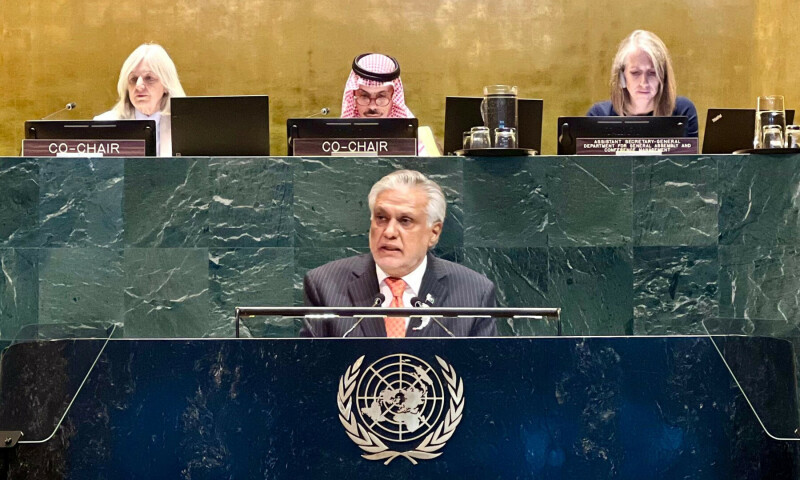
Speaking during a UNSC open debate on the situation in the Middle East, Pakistan’s Permanent Representative to the UN, Ambassador Asim Iftikhar Ahmad, said the root cause of instability in the region remains the “unresolved question of Palestine” and the “continued Israeli occupation of Arab lands. His remarks came as the Security Council debated a region consumed by war on multiple fronts simultaneously.
What Ambassador Asim Said at the UNSC
Rejecting alternative narratives, Ambassador Asim stressed that “not the expansionist ambitions; not the suppression of rights; not the use of force,” but rather “the vacation of occupation” and realisation of a Palestinian state would pave the way for peace. He said a just and lasting peace in the region could only be achieved through ending occupation and realising an independent Palestinian state under the two-state solution framework adding that “not expansionist ambitions, nor illegal wars” but the end of occupation remains the only viable framework for comprehensive peace. Pakistan’s position on the Palestinian issue root cause instability Middle East debate has remained consistent across decades of UNSC engagement.
800 Palestinians Killed Since Ceasefire Pakistan’s Warning
In Gaza, Ambassador Asim warned the Security Council that more than 800 Palestinians had been killed by Israeli strikes since the announcement of the ceasefire, highlighting the scale of the crisis and the fragility of the truce. He called for full respect for the ceasefire and demanded sustained, unhindered humanitarian assistance. The Pakistani envoy said the current deadlock over Phase II of the Gaza Peace Plan aimed at rebuilding the war-ravaged enclave must be resolved without delay, warning that “any delay risks eroding the hard-won momentum and deepening human suffering. The Security Council resolution on Gaza adopted as Resolution 2803 in November 2025 endorsed this peace framework, which Pakistan now wants urgently implemented.
West Bank A Rapidly Deteriorating Situation
Pakistan’s UNSC statement did not limit itself to Gaza. Ambassador Asim expressed alarm over developments in the occupied West Bank, citing rising violence and settlement expansion. “The rapidly deteriorating situation in the West Bank is also alarming. Escalating settler violence, continued expansion of illegal settlements and illegal legislative measures are grave violations of international law,” he said. The Palestinian issue root cause instability Middle East argument gains force precisely because both Gaza and the West Bank are simultaneously under pressure creating a dual crisis with no diplomatic resolution currently in sight. Pakistan urged the council to treat both situations as connected and equally urgent.
Hormuz, Lebanon, Iran Pakistan Links All Crises to Palestine
Pakistan broadened its statement beyond Gaza to address the full regional picture. Ambassador Asim said broader regional tension continued to pose serious risks to international peace and security, as well as to global economic stability. “The situation in the Strait of Hormuz is adversely impacting countries around the world, including Pakistan. Pakistan reaffirms its full support for the sovereignty, territorial integrity, and political independence of all brotherly states in the region,” he said. He also referenced the recent US-Iran talks hosted in Islamabad as evidence of Pakistan’s active diplomatic engagement. For Islamabad, the Security Council resolution on Gaza, the Hormuz crisis, and the Lebanon war are not separate issues they are symptoms of the same unresolved Palestinian question.
UNSC Dynamics Divided Council, Limited Action
The Palestinian issue root cause instability Middle East debate unfolded in a Security Council that remains deeply divided. A Russian-drafted resolution urging all parties to stop military activities and return to diplomacy received only four votes in favour from China, Russia, Pakistan, and Somalia with two votes against from Latvia and the US, and nine abstentions. A separate resolution endorsed by 136 countries and adopted 13-2 condemned Iranian obstruction of the Strait of Hormuz but made no comparable demands on Israel regarding Gaza or Lebanon. The structural imbalance where Western veto power protects Israel from binding Security Council resolution on Gaza enforcement is precisely what Pakistan’s ambassador described as the root cause of the crisis deepening unchecked.
Pakistan’s Consistent Position Decades of UNSC Advocacy
Pakistan’s April 29, 2026 statement is not a departure it is a continuation. Pakistan has consistently used every UNSC platform to argue that the Palestinian issue root cause instability Middle East logic must be central to any regional peace framework. In 2022, Pakistan’s then-Ambassador Munir Akram told the same 15-member Council that the main cause of instability across the Middle East was “the festering wound of the Israeli occupation and atrocities in occupied Palestine.” Pakistan has also co-sponsored emergency UNSC sessions on Gaza, backed multiple ceasefire resolutions, and used its current non-permanent seat on the Council to push for action on settler violence in the West Bank. Pakistan’s position two-state solution, full implementation of international law, immediate humanitarian access has not changed in over 30 years.
Frequently Asked Questions
What is the root cause of the Palestine-Israel conflict?
The Palestinian issue root cause instability Middle East argument, as presented by Pakistan and supported by the majority of UN member states, traces the conflict to the displacement of Palestinians in 1948, the subsequent Israeli occupation of the West Bank, Gaza, and East Jerusalem in 1967, and the continued expansion of illegal settlements in violation of UN Security Council resolutions and international humanitarian law. The failure to establish an independent Palestinian state through the two-state solution endorsed by the vast majority of the international community is widely cited as the single most destabilising unresolved issue in the Middle East.
What is the Security Council resolution on Gaza and what does it require?
The most recent binding Security Council resolution on Gaza is Resolution 2803, adopted on November 17, 2025. It endorsed the US-proposed “Comprehensive Plan to End the Gaza Conflict” a phased framework that calls for a ceasefire, the release of hostages held by Hamas in exchange for Palestinian detainees, a partial withdrawal of Israeli forces, and increased humanitarian access. Phase II of the plan, which covers reconstruction and a political process toward Palestinian statehood, remains deadlocked. Pakistan has consistently called for full implementation of Resolution 2803 without delay, warning that the current stalemate risks collapsing the ceasefire entirely.
Who actually started the Israel-Palestine conflict and why does it matter today?
The modern conflict traces to the 1947 UN Partition Plan for British Mandatory Palestine, which proposed dividing the territory into separate Jewish and Arab states. The Jewish leadership accepted the plan; Arab leaders rejected it. Following Israel’s declaration of independence in May 1948, neighbouring Arab states launched a war. The conflict resulted in the displacement of approximately 700,000 Palestinians an event Palestinians call the Nakba, meaning catastrophe. Israel views its establishment as the legitimate fulfilment of the right to Jewish self-determination. Palestinians view it as the beginning of an occupation that has never ended. This foundational disagreement over legitimacy, land, and sovereignty is why the Palestinian issue root cause instability Middle East argument resonates so broadly in global diplomatic forums.