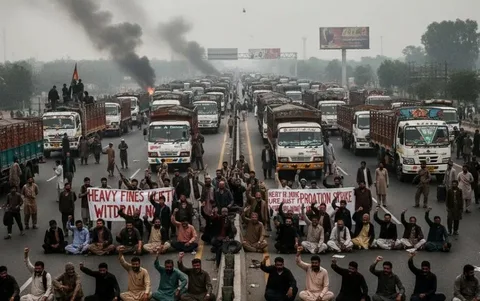

The strike in Rawalpindi hit commuters immediately and hard. In Islamabad and Rawalpindi, operations of public transport remained partially suspended as transporters observed a wheel-jam strike. At the start of the day, less than usual traffic was seen on the roads in the twin cities, and passengers faced difficulties at main bus stands.
Pirwadhai General Bus Stand, one of the main bus terminals in Rawalpindi, saw less than usual activity, and vehicles for inter-provincial travel were seen lined up in bus bays.School van owners joined the protest in many areas, leaving parents without transport for their children. Daily wage workers, hospital patients, and office commuters found themselves stranded at bus stops across the city.
What the Transporters Are Demanding
At the heart of the transporters strike Islamabad Rawalpindi is a straightforward demand: fair treatment. Muttahida Transport Federation chairman Raja Muhammad Riaz told Dawn that heavy fines from PKR 5,000 to PKR 20,000 had become routine and destroyed their businesses, arguing that the government was shifting its economic burden onto transport operators already dealing with high fuel and spare-part costs.
Goods Transport Association President Shakeel Qureshi said the amendments to customs laws were tantamount to economic murder of transporters and argued that authorities should consider stakeholder concerns before making policy changes, criticising that decisions were being made by listening to only one side. It is difficult to argue with this position. Legislation that significantly affects an entire industry should not be rushed through without dialogue with those most affected.
Transporters also demanded construction of key road infrastructure, an end to FIRs being registered against drivers for minor violations, and confirmation that the National Highway Authority would expand major freight routes.These are not radical demands. They are the basic expectations of a sector that keeps Pakistan’s economy functioning.
Section 144 and the April 9 PTI Rally
The transport strike update today in Pakistan cannot be fully understood without the political context layered on top of it. The Rawalpindi deputy commissioner imposed Section 144 based on intelligence reports citing imminent threats, particularly around sensitive installations, major roads, and other critical infrastructure.
The District Administration imposed Section 144 in Rawalpindi, restricting all forms of gatherings, rallies, and processions, with police and law enforcement agencies placed on high alert.This is a pattern Pakistan has seen repeatedly. Every time PTI announces a major political action, Section 144 follows — roads are sealed, containers are placed on major intersections, and the Metro Bus service is disrupted.
When the Strike Was Called Off — And Why It Matters
In a previous episode of the transporters strike Islamabad Rawalpindi, the situation was eventually resolved through negotiation. After talks between Punjab government representatives led by Transport Minister Bilal Akbar and a delegation of the Muttahida Transporters Association, the transporters called off the strike after the government accepted their demands.
Apart from revision of the Punjab Motor Vehicles (Amendment) Ordinance 2025, the transporters also demanded an end to FIRs against drivers and owners of heavy vehicles over even minor violations of traffic laws.The fact that a deal was reached shows dialogue is possible. But the fact that another transport strike update today in Pakistan is dominating headlines suggests those earlier concessions were either insufficient or poorly implemented.
QUOTES
“Transporters were facing problems due to heavy fines, and it was difficult to manage their household budgets. Heavy fines had become routine and destroyed their business.” — Raja Muhammad Riaz, Chairman, Muttahida Transport Federation of Twin Cities Rawalpindi-Islamabad (Dawn)
“Amendments to the laws being made are tantamount to economic murder of transporters. Decisions should not be made by listening to only one side.” — Shakeel Qureshi, President, Goods Transport Association Rawalpindi (Dawn)
“If permission is not granted for the April 9 rally, participants will stage protests in their respective areas.” — KP Chief Minister Sohail Afridi (Shafaqna Pakistan)
“Section 144 has been imposed across Rawalpindi. Police and relevant authorities will work in coordination to ensure peace and security.” — Deputy Commissioner Hassan Waqar Cheema, Rawalpindi (Express Tribune)
IMPACT
Who Suffers When Rawalpindi Islamabad Transport Today Shuts Down
The impact of a strike in Rawalpindi falls hardest on those with the fewest alternatives. Daily wage workers lose a full day of income when they cannot reach their workplace. Students miss classes. Patients delay hospital visits. Families in low-income neighbourhoods, where owning a private vehicle is not an option, are effectively placed under house arrest not by any law, but by the collapse of public transport.
Industrialists estimated the textile sector alone incurred losses of around $500 million during a previous 10-day transport strike, while stranded consignments attracted demurrage and detention charges at ports and factory premises, with production lines forced to slow down or shut due to disruptions in raw material supply.When the Rawalpindi Islamabad transport today network collapses, the economic damage spreads far beyond the twin cities.
The Governance Problem This Exposes
The deeper issue revealed by every transport strike update today in Pakistan is a failure of institutional communication. Laws like the Punjab Traffic Ordinance 2025 are drafted and passed without adequate consultation with the people they affect most. When enforcement begins, it triggers a crisis that only negotiation can resolve — but that negotiation happens after damage has already been done.
This cycle — law, protest, strike, negotiation, temporary resolution — repeats itself because the underlying problem is never properly fixed. Transporters need fair regulations, not zero regulations. Citizens need accountable governance, not emergency laws and sealed roads every few months.
CONCLUSION
What Needs to Change in Rawalpindi and Beyond
The strike in Rawalpindi today and the broader transport strike update today in Pakistan point to a governance gap that politicians of every stripe have failed to close. The Punjab government must implement traffic reforms in genuine partnership with the transport sector not through unilateral ordinances followed by crisis management.
On the political side, the pattern of imposing Section 144 every time PTI announces a rally is becoming a form of governance by suppression. Whether one supports PTI or not, the repeated use of emergency legal measures to prevent political assembly is a legitimate democratic concern. Pakistan’s constitution guarantees the right to peaceful protest, and the transportation network should not be weaponised or simply collateral damage in the battle between the government and opposition.
FAQs
What is Section 144 in Pakistan?
Section 144 is a provision under the Code of Criminal Procedure (CrPC) of Pakistan that empowers a district magistrate or deputy commissioner to issue orders restricting certain activities in a defined area for a limited period. Section 144 of the Criminal Procedure Code is a legal provision that empowers district administrations to prohibit an assembly of four or more people in an area for a limited period.It is commonly invoked ahead of political protests, large gatherings, or in situations where authorities anticipate a law and order threat. In Rawalpindi, it has been imposed multiple times in recent years ahead of PTI rallies and political demonstrations.
What happens under Section 144?
When Section 144 is in force, all forms of public gatherings, demonstrations, and rallies are restricted, and no individual or group is allowed to organise protests or hold public events.Practically speaking, this means roads are sealed with containers, police are deployed at key intersections, the Metro Bus service may be suspended, and checkpoints are established on all major entry and exit points. Citizens are advised to avoid public spaces and remain at home. Violations can result in immediate arrest by law enforcement authorities.
What is the punishment for violating Section 144 (PPC)?
Violation of a Section 144 order is a criminal offence under Pakistani law. Anyone who disobeys a lawful order issued under Section 144 can be arrested without a warrant and prosecuted under Section 188 of the Pakistan Penal Code (PPC), which deals with disobedience to an order issued by a public servant. The punishment can include imprisonment of up to one month, a fine, or both. In cases where the disobedience causes or tends to cause danger to human life, health, or safety, the punishment can extend to six months imprisonment and a heavier fine. In practice, authorities in Rawalpindi have arrested scores of political workers under this provision during periods of heightened political tension.