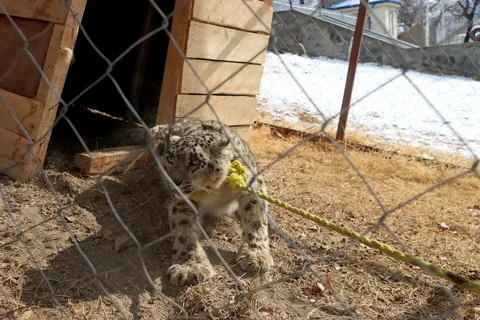
A leopard kills livestock protest has erupted in northern Pakistan after a snow leopard entered a livestock enclosure overnight and slaughtered more than 40 animals belonging to a single farming family — a devastating financial blow that has driven local residents to block a main road artery and demand immediate government action.
In the remote Gobor Bakh area of Lotkoh Valley, a snow leopard attacked a livestock enclosure during the night, killing more than 40 animals. The predator entered the shed of a poor farmer, identified as Wali Rehman, and slaughtered a large number of goats and sheep. The incident has caused a huge financial loss to the affected family, who depended on livestock for their livelihood. The attack has also spread fear and panic among residents of the area, who now feel unsafe and vulnerable to similar incidents.
Residents took to the roads following the attack, blocking the main artery through the area and refusing to clear it until the Wildlife Department appeared with concrete answers about compensation, protection measures, and a plan to prevent the next attack. The leopard kills livestock protest is the latest and most dramatic expression of a crisis that has been building across Pakistan’s northern and central regions for years — as wildlife populations grow and expand into human-settled areas without any adequate support system for the communities bearing the cost.
What Happened in Lotkoh Valley
The attack followed a pattern that has become grimly familiar to farming communities living on the edges of leopard territory across Pakistan.
Local community members have urged the relevant authorities, particularly the Wildlife Department, to take immediate notice of the situation. They have demanded adequate compensation for the affected farmer and called for effective measures to prevent such incidents in the future. Residents said that while the protection of wildlife is important, ensuring the safety of human life and property must also be a priority to avoid further tragedies.
For Wali Rehman and his family, the 40-plus animals killed in a single overnight attack represent far more than a number on a livestock register. In remote rural Pakistan, goats and sheep are not just agricultural assets — they are savings accounts, pension plans, and the primary financial buffer against illness, drought, or crop failure. A family that loses its entire herd in one night does not simply suffer an inconvenience. It faces a crisis that can take years to recover from, if recovery is possible at all.
That economic reality is the fuel behind the leopard kills livestock protest. This is not abstract environmental grievance. It is the financial ruin of a poor family and the fear of every neighbouring family that they could be next.
The Islamabad Leopard Incident — A City on Edge
The Lotkoh Valley attack arrives against a backdrop of intensifying leopard-human encounters across Pakistan — including a series of leopard incident Islamabad events that have placed even the capital’s residents on notice.
A wild leopard was spotted near a famous university in Islamabad, with wildlife teams deployed and actively monitoring the situation in sectors H-10 and H-12, where the animal’s movement was tracked. Experts noted that leopards are native to the nearby Margalla Hills and occasionally enter city areas at night through green belts and drainage channels. Authorities urged residents to remain cautious, avoid unnecessary outdoor movement, and immediately report any sightings.
Saidpur is one of around 12 villages in the immediate vicinity of Margalla Hills National Park, just north of Islamabad. Reports of leopards in the Margalla Hills area have been making the rounds since at least 2015, but increased after 2019. Citing loss of livestock to leopards, villagers near the Margalla Hills were reported to be leaving out poisoned meat for the big cats.
The leopard incident Islamabad pattern reflects a city that is geographically unusual — a national capital with a genuinely wild leopard population living in its forested fringe. That proximity creates a tension that has no easy resolution: leopards in Margalla Hills are legally protected, ecologically vital, and increasingly bold in their movements into settled areas where livestock is easy to find and livestock owners are increasingly desperate.
When Leopards Die in Pakistan — The Retaliatory Killing Crisis
The leopard kills livestock protest in Lotkoh Valley raises a question with implications far beyond the immediate incident. When the Wildlife Department does not respond quickly enough — or when no compensation arrives and no protection materialises — what do farmers do?
Unpublished data collected in 2024 indicates that 45 leopards were killed in Pakistan in the past five years — the same number recorded over the previous 12 years. Many killings go unreported. While leopards are sometimes killed for their valuable pelts, the majority of recorded cases are acts of retaliation — triggered by attacks on people or, more frequently, their farm animals.
Retaliatory killings following livestock depredation emerged as the primary cause of leopard death in Pakistan, accounting for 63 percent of verified mortality cases. Retaliatory killings are particularly concerning, often targeting reproductively important individuals. Leopards in northern Pakistan face a range of threats including habitat degradation, deforestation, mining, infrastructure expansion near protected areas, prey depletion, poaching for skins and bones, and retaliatory killings by livestock owners.
This is the cycle that the leopard kills livestock protest exposes and that Pakistan’s conservation authorities have consistently failed to break. A leopard kills livestock. A family loses its income. The government does not compensate them or protect them adequately. They retaliate by killing the leopard. The leopard population declines. Conservationists raise the alarm. And the next attack, the next loss, and the next retaliatory killing follow in sequence.
A WWF-Pakistan official pointed out the dilemma in such cases: when a big cat attacks livestock, especially in an enclosed area, they kill all the animals, which is a loss of livelihood for people from poor communities. Since there are no insurance schemes to cover these losses, people have no option but to eliminate the threat before it kills more of their livestock.
Why Leopards Are Moving Into Human Settlements
Understanding the leopard kills livestock protest requires understanding why these encounters are becoming more frequent — and the answers point to pressures on both sides of the human-wildlife boundary.
Conservationists attribute the growing frequency of leopard encounters to habitat fragmentation, poaching, dwindling wild prey populations, and retaliatory killings. For small-scale farmers, the loss of even a few goats or cattle can be economically devastating, often fuelling retaliatory killings despite legal protections for leopards.
In areas of increased human activities and depleted prey, large carnivores increasingly prey on livestock. Livestock depredations by leopards can result in severe economic losses to local people in northern Pakistan. Encouraging continued use of corrals, increased guarding of livestock, particularly in the afternoon and during summer, and restoring native prey species could reduce the frequency of livestock depredations and facilitate human-leopard coexistence.
Less snowfall and drought in the mountains force snow leopards either to migrate or move to low-lying areas, resulting in snow leopards attacking livestock. This movement is increasingly driven by climate change, which is reducing the high-altitude habitat that snow leopards have historically depended on and pushing them into lower elevations where they encounter farming communities.
The confluence of habitat loss, depleted wild prey, climate-driven range shifts, and the complete absence of a functional compensation system for affected farmers has created the conditions in which leopard kills livestock protests like the one in Lotkoh Valley are not exceptional events. They are the predictable outcome of a policy vacuum that has existed for decades.
What the Wildlife Department Has — and Has Not — Done
The leopard killed in Islamabad incidents and the broader pattern of livestock attacks have prompted some institutional response from Pakistan’s wildlife authorities — but conservation experts say it falls far short of what is needed.
There are only a handful of protected areas for leopards such as the Margalla Hills National Park in Islamabad, Ayubia National Park in Khyber Pakhtunkhwa, and Machiara National Park in Azad Jammu and Kashmir. Estimates indicate the common leopard population is currently in the hundreds. The most pressing dangers to the leopard population are loss of habitat, poaching and hunting, and deadly encounters with humans. As human settlements increasingly expand into forest lands, there is more leopard-human conflict.
Residents near Margalla Hills have asked for the establishment of a compensation fund, saying that a number of their goats and cows have been hunted by wild cats, causing huge financial losses. The Islamabad Wildlife Management Board conducted awareness campaigns regarding the importance of wildlife for the ecosystem following a leopard death in the area.
Awareness campaigns and verbal commitments to compensation are not the same as a functioning, fully-funded, rapidly-disbursing compensation scheme that reaches affected families before they make the decision to eliminate the threat themselves. The leopard kills livestock protest in Lotkoh Valley is a direct consequence of the gap between what has been promised and what has been delivered.
Quotes
“While the protection of wildlife is important, ensuring the safety of human life and property must also be a priority to avoid further tragedies.” — Residents of Gobor Bakh, Lotkoh Valley, following the snow leopard attack
“When a big cat attacks livestock, especially in an enclosed area, they kill all the animals, which is a loss of livelihood for people from poor communities. Since there are no insurance schemes to cover these losses, people have no option but to eliminate the threat.” — Senior official, WWF-Pakistan
“The number of leopard killings has dramatically increased in the past few years. Many killings go unreported.” — Muhammad Waseem, World Wildlife Fund Pakistan
“Leopards in Margalla Hills National Park are better protected than other areas of Pakistan because we have very strict patrolling, and we have communicated to the villagers that these leopards are protected under law, so harming them is a criminal offence.” — Rina Saeed, Head, Islamabad Wildlife Management Board
“I believe rates are even higher than the data suggests.” — Muhammad Waseem, WWF-Pakistan, on unreported leopard killings
Impact
For the farming family at the centre of this leopard kills livestock protest, the immediate impact is financial devastation. More than 40 animals killed overnight represents the loss of what may be years of accumulated agricultural capital — a loss that no amount of official sympathy can reverse without material compensation delivered quickly.
For the leopard killed in Pakistan conservation crisis, every livestock attack that goes uncompensated increases the probability of retaliatory killing. With 45 leopards killed in five years — a rate that has accelerated dramatically from historical levels — the species can absorb very little additional mortality pressure before the population consequences become irreversible in specific regions.
For the leopard incident Islamabad pattern and the broader human-wildlife dynamic in Pakistan, the Lotkoh Valley protest is a signal that communities have reached the limit of what they are willing to absorb without institutional support. The protests are not anti-conservation. They are pro-livelihood. The families blocking roads are not asking for leopards to be eliminated. They are asking for a functioning system that protects their animals, compensates their losses, and treats their welfare as a policy priority rather than a secondary consideration in a conservation framework built around wildlife rather than people.
Frequently Asked Questions
Do leopards attack livestock?
Leopards mainly kill goats, followed by dogs, with depredations typically occurring during summer months, particularly in afternoon and late evening hours, with over half of reported depredations occurring outside villages. Livestock depredations by leopards can result in severe economic losses to local people in northern Pakistan, and guarding strategies used by farmers often do not reduce depredations effectively.Research across multiple districts of Pakistan confirms that livestock attacks are not random — they follow predictable seasonal and temporal patterns, concentrated in summer, peaking in afternoon and early night hours, and driven primarily by the depletion of wild prey in leopard territories. For small-scale farmers, even a single attack can cause financially devastating losses.
Has there ever been a leopard attack on humans in Pakistan?
Yes, leopard attacks on humans have occurred across multiple regions of Pakistan, though they remain far less common than livestock attacks. A leopard infiltrated a village in Upper Khanpur, Haripur, attacking two homes and killing several goats, with the leopard attempting to attack a local resident before retreating into the forest after villagers raised an alarm. This incident followed a previous attack in the area where a big wild cat injured a father and son and killed dozens of livestock.A leopard shot dead in Tharparkar had injured eight people before residents chased and killed the wildcat.Attacks on humans typically occur when leopards are cornered, when they enter homes at night, or when a person unexpectedly encounters a leopard at close range. Women in rural areas face elevated risk due to their traditional responsibilities of collecting water and firewood through forested areas.
Can a leopard take down a cow?
Yes, though cows represent a smaller proportion of leopard livestock kills than smaller animals. A study of leopard depredation incidents in Khyber Pakhtunkhwa recorded that incidents involved primarily goats at 60.5 percent, followed by sheep at 31.5 percent, and cows at 8 percent.Common leopards are powerful predators capable of killing prey significantly larger than themselves — they are well documented killing adult deer, wild boar, and domestic cattle across their range. Larger livestock such as adult cows and buffaloes are less frequently targeted than small ruminants, but calves and young cattle are vulnerable, particularly when inadequately secured at night. The leopard kills livestock protest in Lotkoh Valley, where both goats and sheep were killed in a single enclosure attack, reflects the typical pattern of what happens when a predator enters an enclosed livestock area — the kills accumulate rapidly because the animals cannot escape.
Conclusion
The leopard kills livestock protest on the main artery of Lotkoh Valley is the latest and most visible expression of a crisis that Pakistan’s wildlife authorities have been warned about for years.
Retaliatory killings following livestock depredation account for 63 percent of all verified leopard mortality in northern Pakistan. Without addressing the root causes of human-leopard conflict — compensation mechanisms, livestock protection infrastructure, and prey restoration — the cycle of attack, loss, retaliation, and conservation decline will continue regardless of how many awareness campaigns are launched or how many laws protect leopards on paper.
The families blocking the road in Lotkoh Valley are not the enemies of the snow leopard. They are the people living closest to it — absorbing the cost of its presence without receiving any of the institutional support that would make coexistence genuinely possible.
Until Pakistan builds a functional, funded, and rapidly-responsive system for compensating livestock losses and protecting farming communities in leopard territory, the leopard died in Pakistan headlines will keep accumulating. And so will the protests.