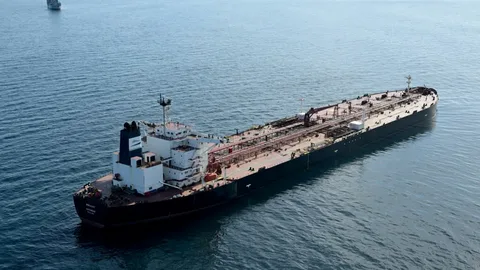

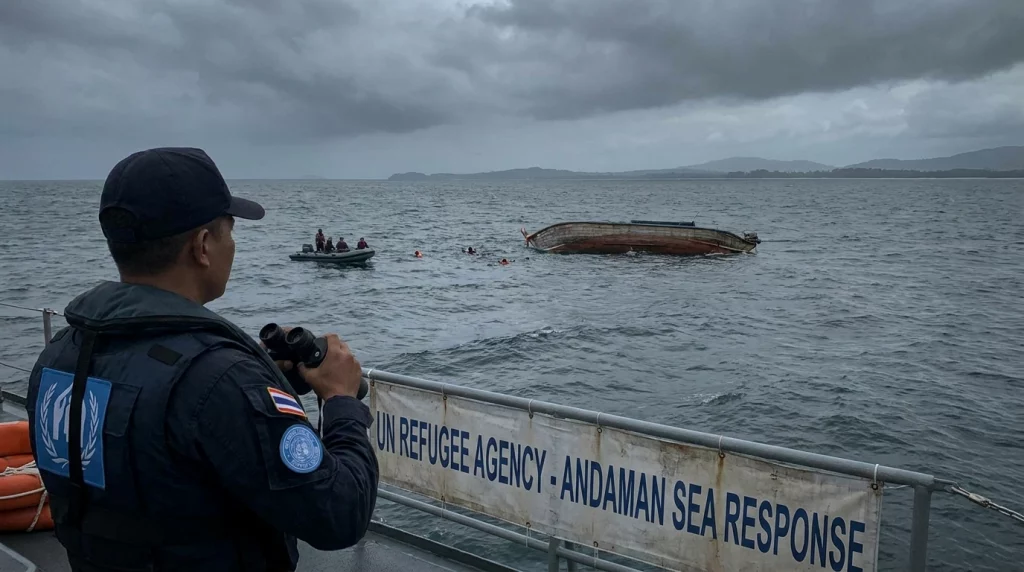
Approximately 250 Rohingya refugees and Bangladeshi nationals are missing after a Rohingya boat capsizes in the Andaman Sea, the United Nations refugee agency and the International Organization for Migration confirmed in a joint statement. The trawler had departed Teknaf in southern Bangladesh and was attempting to reach Malaysia when it went down.
The UN High Commissioner for Refugees and the IOM said the overcrowded trawler sank due to strong winds, rough seas and overcrowding. Nine survivors were rescued by a Bangladesh coastguard vessel on April 9, including one woman, found floating on drums and logs in deep water. Of the nine rescued, six were suspected of involvement in human trafficking and have been detained.
What Happened — The Andaman Sea Disaster
The boat rohingya disaster unfolded over several days before the world learned of it. The trawler departed from Teknaf in the southern Bangladeshi district of Cox’s Bazar carrying a large number of passengers — men, women and children pressed together in an overcrowded wooden vessel making for Malaysia.
The vessel travelled for four days before it capsized. A survivor, Rafiqul Islam, told reporters he was lured onto the boat by traffickers who promised him a job in Malaysia. He described being held in the trawler’s holding area where some passengers died from suffocation and overcrowding during the four-day journey. He said 25 to 30 people died from suffocation and overcrowding before the boat even went down. He was burned by oil that spilled from the trawler.
The Scale of What Is Missing
The rohingya boat sinks disaster has left a humanitarian gap that the numbers make clear but cannot fully convey. Approximately 250 people boarded the trawler. Nine were rescued. The fate of the remaining passengers — the vast majority — is unknown.
Boat rohingya crossings of this type carry no distress equipment, no life jackets for every passenger, no communication systems capable of reaching rescue authorities before capsizing occurs. They succeed when the weather holds and the overcrowding does not collapse the vessel. When either condition fails, the sea swallows the evidence of what happened and the only testimony comes from the handful of survivors the ocean does not take.
Why They Got on the Boat
The rohingya boat capsizes disaster did not happen because 250 people made a reckless choice. It happened because 250 people had run out of safer ones.
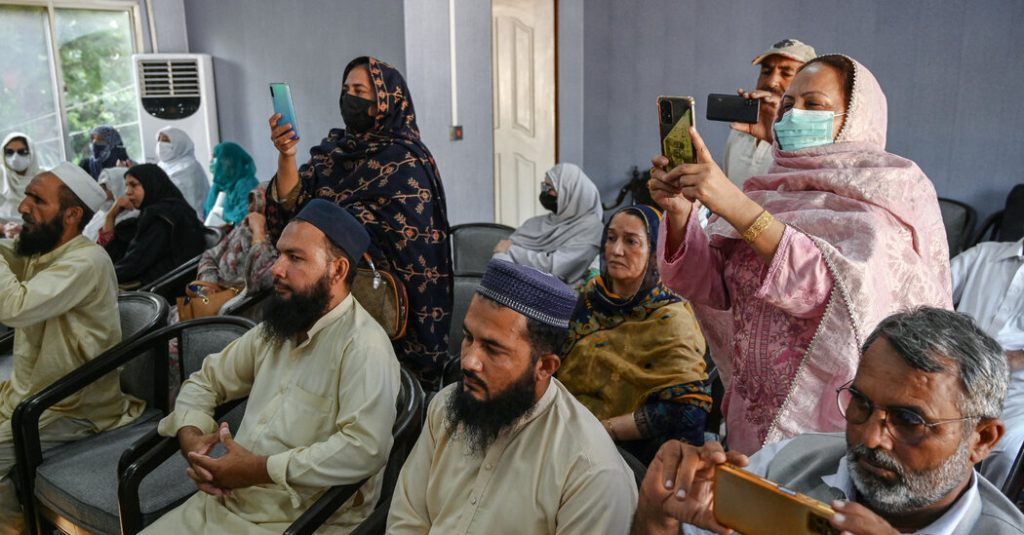
Ongoing violence in Myanmar’s Rakhine state has made the Rohingya’s safe return to Myanmar uncertain, while limited humanitarian assistance, restricted access to education and employment in refugee camps continue to push vulnerable Rohingya refugees to choose risky sea journeys, often based on false promises of higher wages and better opportunities abroad, the UNHCR and IOM stated.
Rafiqul Islam said he was lured onto the boat by traffickers who promised him a job in Malaysia. His story is not exceptional — it is the standard operating procedure of the smuggling networks that make money from Rohingya desperation. By the start of 2026, the Rohingya refugee population in Bangladesh had increased to almost 1.2 million people, more than half of them children. More than 235,000 refugee children aged 5 to 17 were estimated to be out of school. Humanitarian aid is critical, with 95 percent of Rohingya households in Bangladesh dependent on humanitarian assistance.
The UN Response and International Call to Action
The UNHCR and IOM used the rohingya boat capsized tragedy as the occasion for a direct call on the international community to do more — not just to respond to individual disasters but to address the conditions producing them.
The agencies urged the international community to strengthen funding and solidarity to ensure lifesaving assistance for Rohingya refugees in Bangladesh, which has sheltered more than 1 million Rohingya from Myanmar. They called on states in the region to ensure the principle of non-refoulement — meaning no survivor rescued at sea should be forced back to persecution — is upheld regardless of national immigration policy.
The tragedy reflects the dire consequences of protracted displacement and the absence of durable solutions for the Rohingya, the agencies said. That assessment is not new. The international community has heard it after every boat rohingya disaster for the past decade. What has changed is the scale of the crisis that produces these departures — and the growing distance between what the international response provides and what the situation requires.
Trafficking — The Criminal Layer
The boat rohingya disaster also illuminates the criminal infrastructure that operates within and around the Rohingya refugee crisis. Of the nine people rescued from the capsized trawler, six were suspected of being involved in human trafficking and have been detained.
Smuggling networks have thrived in the vacuum created by the absence of legal migration pathways, the desperation of displaced populations, and the inability of regional governments to coordinate maritime interdiction without also committing to rescue obligations. They charge thousands of dollars per person — money that Rohingya families scrape together from savings, loans, and the sale of whatever assets they still possess — for berths on vessels that are fundamentally unsafe.
Quotes
“This tragedy highlights the devastating human cost of protracted displacement and the continued absence of durable solutions for the Rohingya.” — Joint statement, UNHCR and International Organization for Migration
“A number of us were kept in the holding area of the trawler, some died there. I was burned by oil that spilled from the trawler. We floated for nearly 36 hours before a ship rescued us from deep water.” — Rafiqul Islam, survivor of the Andaman Sea capsize
“Spotted several people floating in the sea using drums and logs and rescued them from deep waters.” — Lieutenant Commander Sabbir Alam Sujan, Bangladesh Coastguard Spokesperson
“People are dying in the fighting, dying from hunger. So some think it is better to die at sea than to die slowly here.” — Rohingya refugee, on the decision to attempt sea crossings
Impact
For the missing 240-plus passengers, the rohingya boat capsizes event has almost certainly ended in death. The Andaman Sea in rough weather does not release those it takes. The absence of any further rescue reports in the days since the Bangladesh coastguard found the nine survivors suggests that for the overwhelming majority of those on board, there will be no account, no rescue, no confirmation — only the UN’s tally of the missing.
For Bangladesh, which hosts more than 1.2 million Rohingya refugees in the world’s largest refugee camp at Cox’s Bazar, the boat rohingya departure pattern represents both a political pressure point and a humanitarian failure. Bangladesh is not a party to the 1951 Refugee Convention and restricts refugees from working or freely leaving the camps — conditions that, combined with deep poverty and no prospect of repatriation, make the sea crossing a rational calculation for some.
Frequently Asked Questions
Are Rohingya Sunni or Shia?
The Rohingya are predominantly Sunni Muslim. They are a Muslim ethnic minority who have lived in Myanmar, formerly known as Burma, for centuries — practising Sunni Islam in a country that is predominantly Buddhist. Their Muslim identity has been one of the drivers of the discrimination and persecution they have faced, as Myanmar’s government and nationalist Buddhist movements have at various times characterised them as illegal immigrants from Bangladesh rather than an indigenous ethnic group with centuries of presence in Rakhine State. The rohingya boat capsizes disasters are driven not by religious conflict alone but by the convergence of ethnic persecution, statelessness, and the physical and economic desperation of life in overcrowded refugee camps.
What is the solution to the Rohingya refugee crisis?
There is no single solution, but a durable resolution requires progress on several interconnected fronts simultaneously. The most fundamental requirement is conditions in Myanmar that would allow Rohingya families to return home safely — including safety from violence, citizenship rights, free movement, and access to health and education. Myanmar’s government and the Arakan Army, which now controls much of Rakhine State, must participate in credible repatriation negotiations. Regional countries — particularly Malaysia, Indonesia, and Thailand — must provide legal pathways that eliminate the need for boat rohingya crossings. Bangladesh needs sustained international funding at the scale the crisis requires, not the declining levels that have forced food ration cuts and school closures. And the criminal smuggling networks that profit from Rohingya desperation must face coordinated regional law enforcement pressure that reduces their operational capacity.
How many Rohingya refugees are in Bangladesh in 2026?
By the start of 2026, the Rohingya refugee population in Bangladesh had increased to almost 1.2 million people, more than half of them children. They are hosted primarily in 33 highly congested camps in the Cox’s Bazar district, along with approximately 35,000 people relocated to Bhasan Char island since 2021. The Cox’s Bazar settlement is the world’s largest refugee camp. More than 235,000 refugee children aged 5 to 17 were estimated to be out of school, and 95 percent of Rohingya households are entirely dependent on humanitarian assistance. The rohingya boat sinks pattern of departures reflects the conditions in those camps — where there is no legal right to work, no clear pathway to permanent status, and no prospect of return to Myanmar while violence continues in Rakhine State.
Conclusion
The rohingya boat capsizes tragedy in the Andaman Sea is the latest disaster in a decade-long pattern that has claimed thousands of Rohingya lives at sea — and that shows no sign of ending until the conditions producing it are fundamentally changed.
Approximately 250 people boarded a trawler in Teknaf. Nine were found floating on drums in deep water. The rest have not been found. A UN statement was issued. The international community was urged to act. And in the camps of Cox’s Bazar, more than a million people remain — waiting for the conditions that would make the sea crossing unnecessary, and calculating, some of them, whether the water is worth the risk.