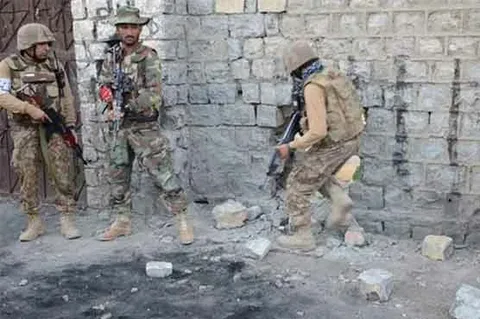

A large-scale security operation ongoing 3rd day in North Waziristan’s Shewa tehsil has resulted in the killing of at least seven militants, including two key commanders. Search and clearance operations have continued across the region, with several militant hideouts destroyed. The security operation reflects the Pakistan Army’s intensified counter terrorism campaign in one of the country’s most sensitive tribal belt areas.
Curfew remains in place across affected localities. Thousands of civilians have been displaced, and daily life has come to a complete standstill. The ongoing operation is being described as one of the most significant military pushes in the Shewa region in recent years.
Background Why Shewa Tehsil Became a Flashpoint
Historically, Shewa was considered one of the relatively peaceful areas of North Waziristan. Residents primarily depended on agriculture, livestock, and small-scale businesses, and the area was known for its simplicity and strong tribal cohesion.
Even during the military operations launched after 2014, the Shewa tehsil remained comparatively less affected. Normal life returned here sooner than in other parts of the district. It was a region that many hoped would stay insulated from the conflict that plagued neighboring areas.
However, over the past year, the situation has deteriorated sharply. Residents attribute the worsening conditions to a rise in targeted killings, quadcopter attacks, and increased activity by outlawed militant groups. The security vacuum allowed extremist networks to regroup and establish new hideouts across the tehsil.
Details What Is Happening on the Ground
A large-scale security operation against militants continued for the third consecutive day in the Shewa tehsil and adjoining areas of North Waziristan. Security forces conducted aggressive search and clearance operations in multiple localities, targeting known militant strongholds.
In the Dorwazanda area of Shewa tehsil, the Alam Khel Market was reportedly almost completely demolished during the operation. Local residents claimed that militants had allegedly been using the market as hideouts and movement routes.
In the Anarkhel area, an alleged militant hideout and a residential compound were also destroyed with explosive material. The scale of destruction in these communities highlights how deeply militant networks had embedded themselves in civilian infrastructure.
Security forces also took control of several important buildings and installations during the operation, including the Governor Model School, which militants were allegedly using for their activities. The use of educational institutions by armed groups is a deeply concerning development that local communities have repeatedly flagged.
Door-to-door search operations were continuing in Dorwazanda and nearby areas, while additional contingents of security personnel had been deployed. Security forces also conducted raids on several suspected locations and reportedly seized weapons and other materials.
Casualties and Militant Activity
Reports claim seven militants were killed during the ongoing security operation, including two key commanders. These figures come from local sources and have not been independently verified through official military channels.
Sources claimed the slain militants were allegedly involved in attacks on security forces and police personnel, as well as incidents of targeted killings. The elimination of command-level figures represents a strategic blow to the militant networks operating in the region.
Security operations were also launched in the Sarkhani area, where intermittent firing and explosions continued to be heard. The sounds of battle across multiple fronts indicate that the security forces are pursuing a broad operational sweep rather than targeting a single location.
Civilian Impact Displacement and Curfew
A curfew remained imposed across the affected areas, severely disrupting daily life and causing difficulties for residents. Several families were said to have shifted to safer locations, while business activities remained completely suspended.
The human cost of this operation is significant. Families are leaving behind their homes, livelihoods, and belongings. Markets are closed, schools are non-functional, and movement is heavily restricted. The tribal communities of North Waziristan have now endured successive waves of displacement for over a decade.
In March, after the evacuation of Dorwazanda, Alamkhel, Malokhel, and Anarkhel villages in Shewa, families from nearby localities were also fleeing their homes to relatively safer districts. The humanitarian situation continues to worsen with each passing day of the ongoing operation.
Official Stance Purpose of the Operation
Security officials stated that the purpose of the operation is to eliminate militant elements from the area and restore peace and stability. The military framing focuses on long-term regional security rather than the immediate tactical gains.
Pakistan’s counter terrorism doctrine in the tribal belt has increasingly involved simultaneous kinetic and intelligence-based operations. The 12 Core formation of the Pakistan Army, which is responsible for security in tribal districts including parts of KPK, plays a central role in these clearance missions. The 12 Core is a frontline military command specifically tasked with managing security challenges along Pakistan’s western borders.
This operation in Shewa tehsil is also significant in terms of cyber security dimensions. Pakistan’s intelligence and security apparatus has increasingly relied on digital surveillance, drone technology, and cyber security protocols to track militant movements and communications. The integration of a cyber security operation alongside ground forces has become a defining feature of modern military campaigns in the region.
Regional and National Impact
The security operation in North Waziristan carries broad implications that extend well beyond the Shewa tehsil. Militant networks operating in this region have historically had cross-border links, making the clearance operation a matter of national and regional security.
In January, unknown attackers blew up a bridge over the Kurram River, which served as a vital link between several villages, compounding difficulties faced by residents. Infrastructure destruction further weakens civilian connectivity and increases the military’s logistical burden.
For Pakistan, ongoing operations in the tribal belt reflect the government’s stated commitment to eliminating terrorist safe havens. The broader context includes increasing pressure from international stakeholders for visible and sustained counter terrorism results along the Afghan border corridor.
The parallel cyber security operation being conducted alongside physical operations points to a new doctrine in Pakistan’s security framework one that merges digital intelligence with conventional military force to achieve more comprehensive results against modern militant networks.
Conclusion What Comes Next
The security operation ongoing in North Waziristan shows no signs of slowing down. Military sources suggest that operations will continue until the area is fully cleared of militant presence. The destruction of hideouts and seizure of weapons represents meaningful tactical progress, but full stabilization will require sustained follow-through.
Experts believe that post-operation governance restoring schools, reopening markets, rebuilding bridges, and ensuring displaced families can return safely will be as critical as the military campaign itself. Without a strong civil administration footprint after the guns go silent, North Waziristan risks falling back into instability.
Pakistan’s security establishment has demonstrated in previous operations, from Zarb-e-Azb to Radd-ul-Fasaad, that sustained military pressure can degrade militant capability. However, the recurring nature of unrest in areas like Shewa tehsil underscores the need for a comprehensive approach that combines military action, political engagement with tribal communities, and robust economic development.
The coming days will reveal how deeply the operation succeeds in uprooting the militant infrastructure that has embedded itself into the Shewa region and whether the security operation ongoing for a 3rd day marks the beginning of lasting peace or another chapter in a long cycle of conflict.
Frequently Asked Questions (FAQs)
Q: What is 12 Core in Pakistan Army?
The 12 Corps (also written as 12 Core) is a Pakistan Army formation headquartered in Quetta, Balochistan. It is responsible for security operations in Balochistan and parts of the Federally Administered Tribal Areas (FATA). It plays a key role in counter terrorism and border security operations along Pakistan’s western frontier with Afghanistan and Iran. The Corps is part of the Army’s broader command structure and is directly involved in clearance operations in sensitive tribal regions.
Q: Is the MM Alam story real?
Yes, the story of Squadron Leader Muhammad Mahmood Alam, popularly known as M.M. Alam, is real. He was a legendary Pakistan Air Force pilot who became famous during the 1965 Indo-Pakistan War. He is credited with shooting down five Indian aircraft in less than a minute a world record in aerial combat. His extraordinary bravery made him a national hero in Pakistan, and he remains an iconic figure in the history of the Pakistan Armed Forces.
Q: What is special about 23rd September?
September 23rd is celebrated as Pakistan’s Defence and Martyrs’ Day. This date commemorates the bravery and sacrifices of Pakistan’s armed forces, particularly during the 1965 war with India. It was officially designated as a national day of observance to honor the soldiers, officers, and civilians who gave their lives defending the country. National ceremonies, military parades, and tributes to martyrs are held across Pakistan on this day every year.