
Karachi’s long-delayed Red Line Bus Rapid Transit project has reached a decisive turning point. The Sindh government has officially cancelled the construction contract for Lot 2 of the BRT Red Line and announced plans to re-award it on an emergency basis — a move that Senior Provincial Minister Sharjeel Inam Memon says is necessary to finally get the project moving.
The Sindh BRT Red Line contract cancellation covers the Mosamiyat-to-Numaish section of University Road, the most troubled and most critical stretch of the entire 26.6-kilometre corridor.
Background: A Project Built on Broken Deadlines
The Red Line BRT was launched in 2022 with an original 30-month completion window, targeting June 2024. That deadline passed without a single bus running on the route. Repeated extensions followed, and by 2026 no clear completion date has been announced.
Initiated by the Government of Sindh and the Asian Development Bank, the Red Line corridor spans 26.6 kilometres, running from Malir Halt through Malir Cantonment, Safoora, University Road, and ending at Numaish — with a 2.4-kilometre common corridor extending to Tower. When complete, it is expected to serve over 1.5 million people and accommodate approximately 300,000 daily commuters.
The project was divided into two sections. Lot 1 stretches from Airport signal to Mosamiyat, while the larger Lot 2 runs from Mosamiyat to Numaish. It is Lot 2 that has been a persistent source of trouble — financial disputes, court cases, suspended work, and questions about quality that grew louder with every passing month.
Why the Contract Was Cancelled
The formal decision to proceed with the Sindh BRT Red Line contract cancellation came after a delegation from the Asian Development Bank visited the project site and raised serious concerns.
TransKarachi, the Sindh government’s implementing agency, stated that the ADB delegation questioned both the pace and quality of work being carried out by the contractor. The team also raised reservations about compliance with health, safety, and environmental requirements on site.
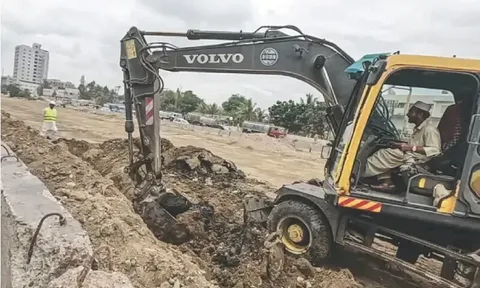
This deadlock reduced work on Lot 2 to near standstill. Labourers were present at some sites, but machinery was largely missing and construction activity remained limited. In several key stretches — including Peoples Chowrangi, Hasan Square and up to NIPA — substantial portions of the corridor showed no active work despite their importance to the project.
With the ADB’s patience running thin and the project years behind schedule, the Sindh BRT Red Line contract cancellation became unavoidable.
Sharjeel Memon Announces Emergency Re-Award
Speaking to media following the termination, Senior Minister Sharjeel Inam Memon confirmed the decision and said the government intended to re-award the Lot 2 contract on an emergency basis to prevent further loss of time.
Memon, who holds the portfolios of Information and Transport in the Sindh cabinet, has been the public face of the Red Line project through its many setbacks. He has acknowledged repeatedly that the situation reached a point where suspension was a real risk — but maintained each time that the Sindh government was committed to seeing it through.
The emergency re-award process means the government will bypass the standard competitive bidding timeline in order to bring a new contractor onto the Lot 2 section as quickly as possible. District authorities have already sealed the office of the contractor linked to Lot 2 as formal proceedings to finalise the termination move forward.
What This Means for Karachi Commuters
Hundreds of thousands of University Road users have been living with torn-up roads, diverted traffic, and dust for years. The Sindh BRT Red Line contract cancellation does not fix that immediately — in fact, the transition period between contractors is likely to cause further short-term disruption before work picks up again.
The overall project cost has already increased significantly. Originally estimated at Rs79 billion, the revised cost approved by ECNEC is expected to reach Rs103 billion — an increase of roughly 30 per cent — driven by inflation in steel prices, utility relocation costs, and project delays.
The Red Line is funded through the Government of Sindh, with financial backing from the ADB, the Asian Infrastructure Investment Bank, France’s Agence Française de Développement, and the Green Climate Fund. Cancelling and re-awarding a contract under an ADB-funded project involves formal procedures and procurement compliance requirements, which means the emergency re-award will need to satisfy the bank’s standards even while moving quickly.
A Pattern of Delays and Disputes
The Red Line has attracted criticism from multiple directions over the past few years. Karachi Mayor Murtaza Wahab at one point called the project’s delay “a source of embarrassment for the government,” even though the Red Line BRT is a Sindh government venture, not a KMC project. He cited frustration from residents who were blaming KMC for disruptions caused by the stalled construction.
President Asif Ali Zardari also took notice of the delays at an earlier stage, directing the Sindh government to remove bottlenecks and accelerate completion.
On the customs front, new buses procured for the Red Line have been held at the port for months. Memon alleged that customs authorities charged Punjab just one percent duty while demanding 17 to 18 percent from Sindh, adding that the provincial government had written to the Federal Board of Revenue seeking uniform treatment.
The Bigger Picture: Karachi’s BRT Network
The Red Line is part of a larger urban transport overhaul for Karachi. The city’s Karachi Breeze network is planned across six dedicated BRT lines. Currently, the Green and Orange lines are operational, the Red and Yellow lines are under construction, and the Blue and Brown lines remain in the planning stage.
The 29-kilometre Red Line will run from Model Colony to Numaish, while the 20.4-kilometre Yellow Line connects Dawood Chowrangi to Saddar and Numaish. Both projects are central to the city’s long-term transport strategy, which also includes the revival of the Karachi Circular Railway.
The Green Line, operational since December 2021, currently carries around 55,000 passengers per day. The Red Line, when complete, is projected to carry 300,000 daily — making it the highest-capacity line in the network.
Conclusion
The Sindh BRT Red Line contract cancellation marks a hard reset on the most troubled section of what is supposed to become Karachi’s most important public transport corridor. Whether the emergency re-award process moves faster than the years already lost depends on how quickly a capable contractor can be brought in and whether the underlying issues — payment disputes, utility relocation, and coordination with federal agencies — are genuinely resolved this time.
Sharjeel Memon and the Sindh government have staked considerable political credibility on finishing this project. With the ADB watching closely and Karachi residents watching even more closely, the next contractor will have very little room for the same mistakes.
Frequently Asked Questions
Q1: How many BRT lines are there in Karachi?
Karachi’s public transport masterplan includes six BRT lines under the Karachi Breeze network. As of 2026, two lines are fully operational: the Green Line, which has been running since December 2021 along an 18-kilometre route from Surjani Town to Jamia Cloth Market, and the short Orange Line (also called the Edhi Line) covering 3.9 kilometres in Orangi Town. The Red Line and Yellow Line are both under construction. The Blue Line and Brown Line are still in the planning and design stages. Together, the six lines are intended to form an interconnected mass transit network across the city, with interchange stations linking BRT lines to each other and eventually to the Karachi Circular Railway.
Q2: How much did the Karachi BRT project cost?
The Red Line BRT alone, which is the largest of the under-construction lines, was originally budgeted at Rs79 billion. Following cost escalations driven by rising steel prices, utility relocation expenses, and extended construction timelines, the revised cost approved by ECNEC reached approximately Rs103 billion — an increase of around 30 per cent from the original estimate. The project receives financial support from the Asian Development Bank, the Asian Infrastructure Investment Bank, the French development agency AFD, and the Green Climate Fund. The Green Line BRT, which was funded separately by the federal government, cost several billion rupees and is already operational. Total expenditure across all BRT lines combined, once completed, is expected to run into several hundred billion rupees.
Q3: What is Red Line BRT?
The Red Line BRT is a 26.6-kilometre Bus Rapid Transit corridor being built in Karachi under the Sindh government’s TransKarachi initiative, with funding from the Asian Development Bank and other international co-financiers. It runs from Malir Halt in the east, through Malir Cantonment, Safoora Junction, and University Road, terminating at Numaish Chowrangi — with a short extension to Tower in the city centre. It will have 22 dedicated stations, operate a fleet of over 200 buses, and is expected to serve approximately 300,000 commuters daily. The project is also notably the first in the world to receive funding from the UN Green Climate Fund specifically for its use of biogas — produced from cattle waste at Karachi’s Cattle Colony — to power its bus fleet. The Sindh BRT Red Line contract cancellation of Lot 2 and the planned emergency re-award are the latest developments in a project now in its fourth year of construction.