

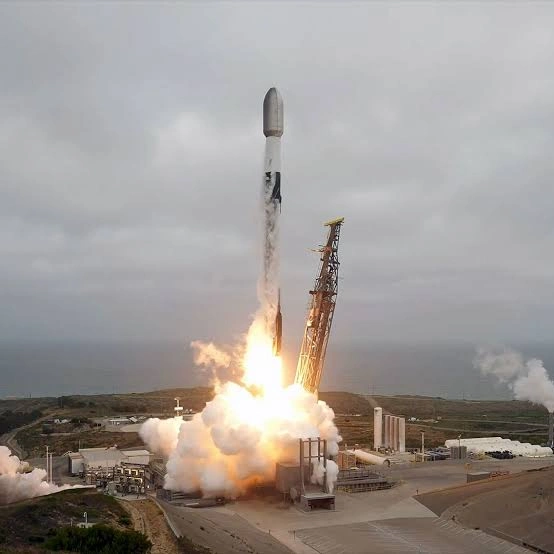
VANDENBERG, California: SpaceX successfully launched another batch of 24 Starlink V2 Mini satellites on Saturday, expanding its global satellite internet network with a flawless Falcon 9 mission from California’s Vandenberg Space Force Base.
The Starlink 17-51 mission lifted off at 8:51 a.m. PDT (11:51 a.m. EDT / 1551 UTC) from Space Launch Complex 4E at Vandenberg Space Force Base. The Falcon 9 rocket followed a southerly trajectory, targeting a 97-degree inclination orbit for satellite deployment.
The launch marked another milestone in SpaceX’s aggressive satellite deployment campaign aimed at strengthening the company’s global broadband internet coverage through its rapidly expanding Starlink constellation.
The Falcon 9 first-stage booster, designated B1100, completed its eighth flight before making another successful landing on the autonomous drone ship “Of Course I Still Love You,” positioned approximately 380 miles downrange in the Pacific Ocean.
Booster B1100 has previously supported the NROL-105 national security mission for the U.S. National Reconnaissance Office (NRO) and six earlier Starlink launches, highlighting SpaceX’s continued success with reusable rocket technology.
The precision landing allows the company to refurbish and reuse the booster, significantly reducing launch costs and increasing mission frequency.
Just over an hour after liftoff, SpaceX confirmed the successful deployment of 24 Starlink V2 Mini satellites into a 168 x 160-mile low-Earth orbit.
The newly launched satellites will join thousands already operating within the Starlink constellation, enhancing internet coverage, network capacity, and connectivity for customers around the world, particularly in underserved and remote regions.
Starlink has become one of the world’s largest satellite internet networks, providing high-speed broadband services across dozens of countries.
Vandenberg Becomes SpaceX’s Busiest Launch Site
The Starlink 17-51 mission marked the seventh of eight planned Falcon 9 launches from Vandenberg Space Force Base during July, underlining the growing importance of the California launch facility.
While SpaceX continues preparing its next-generation Starship system in Florida, Vandenberg has emerged as the company’s busiest operational launch complex for Falcon 9 missions.
By comparison, Cape Canaveral Space Force Station in Florida has hosted four Falcon 9 launches this month, with one additional mission still scheduled before the end of July.
SpaceX continues launching Starlink satellites at a rapid pace as demand for reliable satellite broadband services grows worldwide.
The company’s reusable Falcon 9 rocket remains central to this strategy, enabling frequent and cost-effective launches while maintaining one of the highest launch success rates in the commercial space industry.
With each successful mission, Starlink moves closer to providing faster internet speeds, improved network reliability, and broader global coverage for residential, commercial, maritime, and aviation customers.