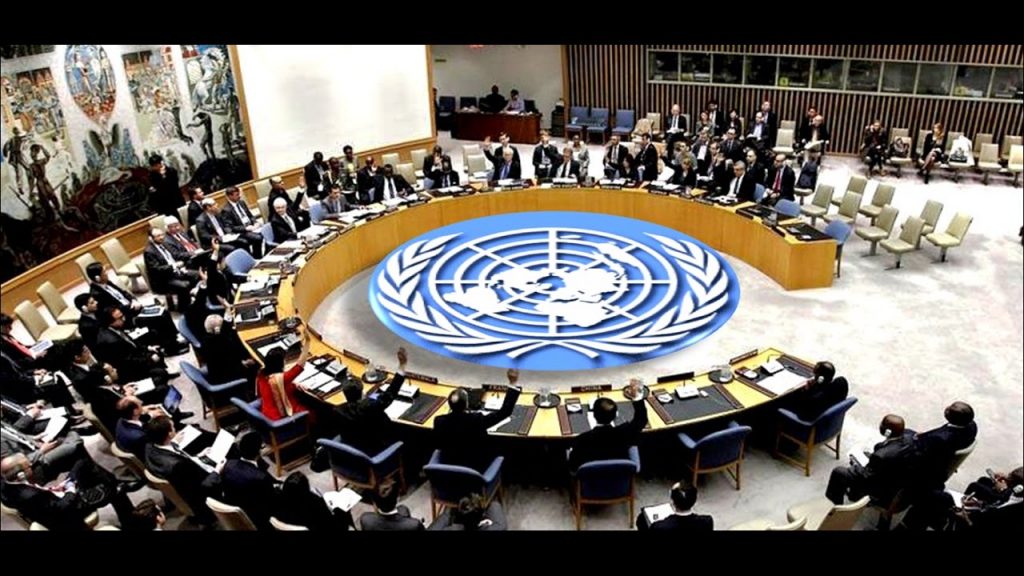

The UN Security Council has passed a landmark resolution against Iran, condemning its military attacks on multiple neighboring countries. The 15-member Council adopted Resolution 2817 (2026) by a vote of 13 in favour to none against, with 2 abstentions from China and the Russian Federation.The vote marks one of the most significant UN Security Council actions on Iran in recent years.
Background
The Middle East has been engulfed in rapidly escalating violence since late February 2026. Both draft resolutions addressed the escalating crisis in the Middle East, which was triggered by the joint US-Israeli strikes on Iran that began on 28 February and Iran’s subsequent retaliation across the region.
At an emergency briefing on 28 February, the US described Iran’s nuclear and ballistic missile programmes as threats to international peace and security, stating that the objective of the joint military campaign with Israel was to destroy those capabilities and disrupt Iran’s support to militant proxy groups. Iran strongly rejected those justifications, calling the strikes a violation of international law.
Details of UNSC Resolution 2817
Adopted on March 11, 2026, UN Security Council Resolution 2817 condemned Iran’s “egregious attacks” against the Gulf states Bahrain, Kuwait, Oman, Qatar, Saudi Arabia, and the UAE and Jordan during the 2026 Iran war. It also condemned Iran’s attacks on ships transiting through the Strait of Hormuz.The resolution demands the immediate cessation of attacks against residential areas and civilian objects, and calls on Iran to halt its threats and support to proxy groups across the region. This was a sweeping and historically broad rebuke at the UN level.
Submitted by Bahrain on behalf of the Gulf Cooperation Council members and Jordan, the resolution was co-sponsored by 135 UN member states.That level of co-sponsorship is considered extraordinary in UN Security Council history, reflecting the breadth of international concern over Iran’s actions.
The resolution passed with 13 votes in favor and none against, with China and Russia abstaining and no vetoes cast, underscoring Iran’s growing diplomatic isolation.The absence of a veto from either Moscow or Beijing allowed the resolution to pass cleanly.
Co-Sponsors and the Vote
The UNSC resolution on Iran drew remarkable global support. The text was sponsored by Bahrain and 134 other countries, and passed on March 11 with 13 votes in favor and two abstentions from China and Russia.
The resolution also invoked a key provision of international law. The United Nations Security Council adopted the resolution invoking Article 51 of the UN Charter member states’ collective or individual right to self-defense against the retaliatory attacks by Iran across the Gulf region.Russia attempted to table its own competing draft, but it was rejected by the Council. The Council rejected a second draft tabled by the Russian Federation,which sought to include context around the US-Israeli strikes that initiated the conflict.
Quotes From Key Officials
Several major powers and affected nations voiced strong positions during and after the vote.
Israel’s Representative: Israel’s representative, welcoming the Gulf States’ initiative to condemn Iran’s attacks, said the Council’s message is clear: “Targeting civilians is wrong, targeting cities is wrong, and Iran must stop.” He also stressed that Iran used diplomacy as cover while it fortified its nuclear programme.
Iran’s Representative: Tehran’s delegate called the resolution’s adoption “a serious setback to the Council’s credibility” and said it leaves “a lasting stain on its record,” adding: “Let me make it clear this resolution is a manifest injustice against my country, the main victim of a clear act of aggression.”
Russia’s Representative: Russia’s Ambassador Vassily Nebenzia, explaining his abstention, said the text was “one-sided” because it failed to acknowledge the US-Israel attacks on Iran, adding that both countries targeted Tehran despite ongoing diplomatic efforts by Oman.
United States: The US representative, serving as Council President for March, said: “Iran shoots in all directions,” noting that nations that previously had serious disagreements with each other have now joined together and spoken with one voice.
Pakistan’s Representative: Pakistan’s representative, who voted in favour of the text, said he would also support the second draft tabled by the Russian Federation, expressing that “to our deep regret, the resolution that just passed is expressed in a biased and one-sided tone.”
Impact: Global and Regional
The passage of this UN Security Council resolution on Iran carries significant weight across multiple dimensions.
The measure reaffirms the targeted states’ right to self-defense under Article 51 of the UN Charter, and the resolution’s passage highlights Iran’s growing isolation after years of relative impunity.
Iran has reportedly taken steps to close the Strait of Hormuz, an important waterway through which 20 percent of the world’s oil flows,raising serious concerns about energy security for global markets.
The conflict has caused widespread casualties. In a 6 March statement, Iran’s Permanent Representative said over 1,300 people had been killed in Iran since 28 February. During the initial US-Israeli strike, an elementary school in the Iranian town of Minab was hit, resulting in the deaths of at least 175 people, many of them children.
China echoed concerns about the broader war’s consequences. China’s representative declared: “This is a war that should not have happened, and a war that benefits no one,” even while expressing regret that Russia’s competing draft was not adopted.
Conclusion: What Comes Next
The UN Security Council vote on Iran signals a new diplomatic chapter in the Middle East crisis. The US is expected to maintain that its ongoing joint military operation with Israel is a legitimate response to Iran’s nuclear programme, while calling on the international community to support these efforts and welcome the adoption of Resolution 2817.
European Council members are likely to call on Iran to assure the international community of the programme’s exclusively peaceful nature, while the IAEA has been unable to verify those assurances.
Meanwhile, divisions at the Security Council remain deep. China and Russia are likely to maintain that the snapback mechanism’s invocation was null and void, and may continue to express support for Iran’s right to self-defence while criticising Resolution 2817 as unbalanced.
The road ahead for diplomacy remains uncertain. The broader conflict continues to affect civilian populations across the region, and the international community faces mounting pressure to seek a ceasefire, protect civilians, and prevent further escalation of this already dangerous Middle East war.
FAQs
What is the UNSC resolution against Iran?
UNSC Resolution 2817 is a United Nations Security Council resolution adopted on March 11, 2026. It condemns Iran’s military attacks on Bahrain, Kuwait, Oman, Qatar, Saudi Arabia, the UAE, and Jordan. The resolution demands Iran immediately halt strikes on civilian areas and stop supporting proxy armed groups in the region. It was co-sponsored by 135 UN member states and passed with 13 votes in favor, with China and Russia abstaining.
Who are the Big 5 in the UN?
The “Big 5” refers to the five permanent members of the UN Security Council, also known as the P5. These are the United States, the United Kingdom, France, China, and the Russian Federation. Each of these countries holds a permanent seat on the UNSC and possesses veto power, meaning they can individually block any substantive resolution. Their permanent status was established by the UN Charter in 1945.
What did UN Resolution 242 do?
UN Security Council Resolution 242 was adopted in November 1967, following the Six-Day War in the Middle East. It called for the withdrawal of Israeli forces from territories occupied during the conflict and for the acknowledgment of every state’s right to live in peace within secure and recognized boundaries. Resolution 242 became a foundational document for subsequent Middle East peace negotiations and remains one of the most referenced resolutions in the Arab-Israeli conflict.