
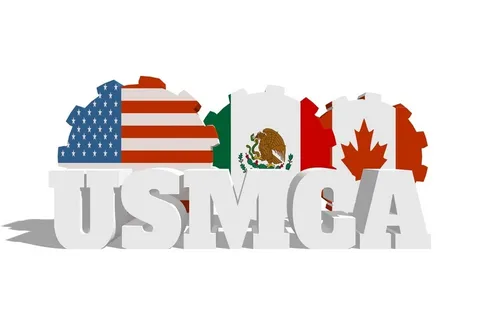
The USMCA agreement is once again at the center of North American trade discussions as governments, businesses, and economists prepare for its first major joint review. While the agreement remains in force, uncertainty over future negotiations has raised concerns about investment, manufacturing, and regional economic stability.
The scheduled review does not automatically end the trade pact. However, experts say the outcome could influence business confidence across the United States, Canada, and Mexico. Companies involved in cross-border supply chains are closely monitoring the process for signs of policy changes.
USMCA Agreement Remains in Effect
The USMCA agreement continues to be the official trade framework connecting the three North American economies. It replaced the North American Free Trade Agreement (NAFTA) in July 2020 after years of negotiations aimed at modernizing regional trade rules.
Despite recent political debates, there has been no official decision to terminate the agreement. Governments from all three countries continue implementing its provisions while preparing for the mandatory review process outlined in the treaty.
Trade analysts note that the agreement includes mechanisms designed to encourage dialogue rather than sudden withdrawal. This provides businesses with greater certainty compared to an immediate expiration scenario.
Background: From NAFTA to the USMCA Agreement
The USMCA vs NAFTA debate began several years ago when policymakers argued that the older trade agreement no longer reflected modern economic realities. Negotiators introduced updated provisions covering digital commerce, intellectual property, labor standards, environmental protections, and automotive manufacturing.
The agreement was signed by the governments of the United States, Canada, and Mexico before entering into force in 2020. Since then, it has governed hundreds of billions of dollars in annual trade among the three countries.
Many economists consider the USMCA an updated version of NAFTA rather than a completely new trade system. While preserving tariff-free trade for most goods, it introduced stronger compliance requirements in several industries.
USMCA News Focuses on the 2026 Review
Recent USMCA news has centered on the agreement’s scheduled six-year review. Under the treaty, member countries must evaluate whether the agreement continues serving their economic interests.
This review is intended to encourage cooperation rather than create uncertainty. If all three governments agree, the agreement continues with another review scheduled six years later. If concerns remain unresolved, additional annual discussions may take place until consensus is reached or the agreement approaches its sunset timeline.
Business organizations across North America have urged governments to maintain policy stability, arguing that predictable trade rules support investment and employment.
USMCA Negotiations Could Shape Future Trade
Although the agreement is active, new USMCA negotiations may address emerging economic challenges.
Possible discussion areas include:
- Digital trade and artificial intelligence
- Electric vehicle supply chains
- Semiconductor manufacturing
- Energy cooperation
- Agricultural market access
- Labor compliance mechanisms
- Environmental commitments
- Border infrastructure improvements
Trade experts believe negotiations are more likely to focus on updating existing rules than replacing the agreement entirely.
USMCA Trump Debate Returns to the Spotlight
Discussions surrounding USMCA Trump have re-emerged as former President Donald Trump has again commented on North American trade policy.
Trump originally pushed for renegotiating NAFTA, arguing that American workers needed stronger protections. His administration negotiated the USMCA, describing it as an improvement over the previous agreement.
More recent political statements have led businesses to question whether another round of significant trade reforms could occur if future administrations pursue different economic priorities.
Analysts caution that political rhetoric does not automatically translate into treaty changes, since modifications require cooperation among all three member countries.
USMCA vs NAFTA: Key Differences
Understanding the USMCA vs NAFTA comparison helps explain why the agreement remains important for regional trade.
Automotive Rules
USMCA increased regional content requirements for vehicles, encouraging more manufacturing within North America.
Labor Standards
The agreement introduced stronger labor protections and faster enforcement mechanisms.
Digital Commerce
Unlike NAFTA, USMCA includes comprehensive digital trade rules reflecting modern online business.
Intellectual Property
Updated protections were introduced for trademarks, copyrights, and patents.
Environmental Commitments
Environmental obligations became more detailed and enforceable than under NAFTA.
These updates were designed to reflect changes in global commerce since NAFTA first entered into force in the 1990s.
Is USMCA Still in Effect?
A common question among businesses is: Is USMCA still in effect?
The answer is yes.
The agreement remains fully operational, and trade continues under its current rules. Goods continue moving across North American borders under USMCA provisions while governments prepare for the scheduled review.
No official announcement has been made indicating that the agreement has expired or been suspended.
USMCA Headquarters and Administration
Unlike many international organizations, the USMCA headquarters does not exist as a single permanent institution.
Instead, the agreement is administered jointly by the governments of:
- United States
- Canada
- Mexico
Each country manages implementation through its own trade authorities while working together through committees and dispute settlement panels established under the treaty.
This decentralized structure allows each government to oversee domestic compliance while coordinating on regional trade matters.
The Importance of the USMCA Document
The official USMCA document outlines every chapter governing trade among the three countries.
It covers areas including:
- Trade in goods
- Customs procedures
- Agriculture
- Digital trade
- Financial services
- Government procurement
- Intellectual property
- Labor
- Environment
- Investment
- Small business cooperation
- Dispute settlement
Businesses often consult the official treaty text when evaluating compliance requirements or planning investments across North America.
Economic Impact Across North America
The USMCA supports one of the world’s largest trading relationships.
Manufacturers depend on integrated supply chains stretching across all three countries. Automotive production, agriculture, electronics, pharmaceuticals, and energy sectors all rely heavily on predictable cross-border trade rules.
Economists warn that prolonged uncertainty could delay investment decisions, increase business costs, and complicate long-term planning.
However, many analysts also believe the review process itself is designed to reduce uncertainty by encouraging governments to resolve disagreements through negotiation rather than abrupt policy changes.
Business Community Calls for Stability
Industry groups representing manufacturers, exporters, farmers, and logistics companies have repeatedly emphasized the importance of maintaining stable trade rules.
Businesses argue that certainty encourages investment in factories, transportation infrastructure, and technology while supporting employment across North America.
Several economic organizations have also stressed that supply chains developed under the USMCA would be difficult and costly to restructure if major policy changes occurred.
Global Impact
Although the agreement covers only three countries, its influence extends well beyond North America.
International investors closely watch developments because the region remains one of the world’s largest manufacturing and consumer markets.
Changes to the agreement could affect global supply chains, commodity markets, automobile production, technology manufacturing, and international investment decisions.
Many multinational companies rely on North American operations that span multiple borders before finished products reach consumers worldwide.
What Happens Next?
Government officials are expected to continue consultations during the review process while businesses monitor negotiations closely.
Most trade specialists expect discussions to focus on improving implementation rather than abandoning the agreement altogether.
Even if disagreements emerge, the treaty provides structured procedures for continued negotiations before any long-term decisions are made.
For now, companies continue operating under existing USMCA rules while awaiting further developments from the three member governments.
Conclusion
The USMCA agreement remains one of the most important trade frameworks in the global economy. As the scheduled review approaches, governments face the challenge of balancing national priorities with the need for regional economic stability.
While political debate continues, the agreement remains fully in force. Businesses, investors, and policymakers will closely watch upcoming USMCA negotiations for signs of future changes. For now, the focus remains on preserving predictable trade rules while adapting the agreement to evolving economic realities.
FAQs
What happens if the USMCA expires?
If the USMCA were ever allowed to expire after all treaty procedures were exhausted, North American trade could face significant uncertainty. Governments might return to previous tariff arrangements under World Trade Organization rules or negotiate a replacement agreement. Such a scenario could increase costs for manufacturers, disrupt supply chains, and reduce investment confidence. However, the treaty contains review and consultation mechanisms specifically designed to avoid an abrupt expiration.
Did Trump violate the USMCA?
There have been political disagreements and legal disputes over trade policies introduced during and after Donald Trump’s administration, but whether any specific action violated the USMCA depends on legal interpretations and dispute-settlement decisions under the agreement. Trade disagreements have generally been addressed through formal consultation and arbitration mechanisms established by the treaty rather than through unilateral determinations.
Is CUSMA going to be renewed?
CUSMA, the Canadian name for the USMCA, has not yet reached a final renewal decision. The agreement remains fully in effect while Canada, the United States, and Mexico conduct the scheduled review process. Many economists and business organizations expect negotiations to continue because maintaining stable regional trade benefits all three economies. Final decisions will depend on discussions among the member governments during and after the review process.