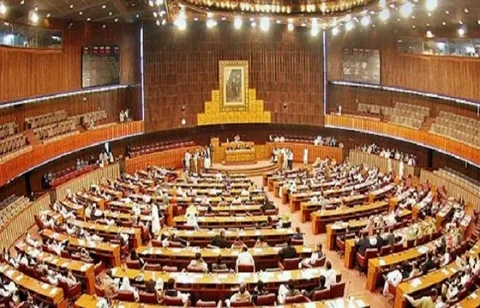
Women MNAs in the National Assembly contributed approximately 48 percent of the regular plenary agenda of the lower house during the second parliamentary year of the 16th National Assembly — despite making up less than 22 percent of its total membership. The Women MNAs National Assembly performance report released by the Free and Fair Election Network (FAFEN) titled “Women Did It Again!” confirms that Pakistan parliament female members submitted agenda items at more than three times the rate of their male colleagues. The Women MNAs National Assembly contribution remains one of the most striking legislative performance stories in Pakistan’s parliamentary history — and a powerful argument for expanding female representation beyond reserved seats.
Background: Who Are the Women MNAs in Pakistan’s National Assembly?
Women MNAs in the National Assembly of Pakistan are female Members of the National Assembly — legislators sitting in the lower house of Pakistan’s bicameral Parliament. The National Assembly currently has 336 constitutionally mandated seats, of which 60 are reserved for women and three for non-Muslims. Women MNAs National Assembly membership currently stands at below 22 percent of the total house.
Most women MNAs in the National Assembly enter through reserved seats allocated to political parties based on their share of general seats — rather than through direct constituency-based elections. This distinction matters for performance analysis because Women MNAs National Assembly members elected on general seats and those on reserved seats show different engagement patterns, as the latest FAFEN report confirms.
Pakistan parliament female members are present across all major parties. The Women MNAs National Assembly include members from the Pakistan Muslim League-Nawaz (PML-N), Pakistan Peoples Party (PPP), Muttahida Qaumi Movement-Pakistan (MQM-P), and Pakistan Tehreek-e-Insaf (PTI) — alongside several independent and smaller party women MNAs.
PTI Female Members — Names and Background
The PTI female MNA list for the current 16th National Assembly emerged from one of the most contested reserved seat battles in Pakistan’s parliamentary history. After the Supreme Court’s July 2024 verdict restored PTI’s eligibility for reserved seats, PTI submitted a list of 67 women candidates to the ECP covering National Assembly and provincial assembly seats.
Prominent PTI female members in the National Assembly include Kanwal Shauzab — PTI Women’s Wing President — along with Rubina Shaheen, Seemabiya Tahir, Farkhunda Kokab, Aaliya Hamza, Shahnaz Tariq, Dr Misbah Zafar, Rubiya Jameel, Rehana Dar, Dr Nosheen Hamid, Rabia Sultan Cheema, Farah Agha, and Firdous Rehana.
For historical reference, the PTI female MNA list 2018 — when PTI formed government for the first time — included Shandana Gulzar Khan, Nafeesa Inayatullah Khattak, Uzma Riaz, Zile Huma, Syma Nadeem, Ghazala Saifi, Nuzhat Pathan, Nusrat Wahid, Munawara Bibi Baloch, and Zartaj Gul — several of whom became prominent voices for Women MNAs National Assembly issues during the 15th Assembly.
Details: Women MNAs National Assembly — FAFEN Report 2025–2026
Women MNAs National Assembly — Agenda Contribution Numbers
Female members contributed around 48 percent of the regular plenary agenda of the lower house during the second parliamentary year 2025–2026 of the 16th National Assembly.This Women MNAs National Assembly performance figure is significantly higher than women’s share of total assembly membership, which remains below 22 percent.
On a per capita basis, female MNAs submitted agenda items at a substantially higher rate than male MNAs. On average, each female MNA submitted 16 agenda items during the year, compared with five items per male MNA.
The Women MNAs National Assembly contribution of 48 percent in 2025–2026 represents a decline from the 55 percent recorded in the previous parliamentary year 2024–2025 — but remains far above proportional representation and continues the trend of Women MNAs National Assembly members consistently punching well above their numerical weight.
Pakistan Parliament Female Members — Policy Areas Covered
The Women MNAs National Assembly agenda was not limited to women’s issues. Agenda submitted by female MNAs covered a wide range of policy areas, including economic policy, taxation, national security, local governance and parliamentary procedure, in addition to legislation relating to women’s rights and social protection. Overall, 72 percent of agenda items submitted by female MNAs addressed national-level policy issues.
This is a critical finding for the Women MNAs National Assembly debate — Pakistan parliament female members are not simply advocates for gender-specific legislation. They are active contributors to the full national legislative agenda.
Women MNAs National Assembly — Gender Responsiveness Score
The FAFEN report introduced a new metric for the Women MNAs National Assembly assessment: the Gender Responsiveness Score (GRS). The overall GRS for the reporting period stands at 1.0, indicating that the National Assembly addressed women lawmakers’ agenda at a similar rate as that of male MNAs.
However, the Women MNAs National Assembly picture has nuances. Private members’ bills, motions for public interest discussions, and proposals to amend the assembly’s rules of procedure submitted by female MNAs were addressed less frequently than those submitted by male MNAs in these categories. This suggests that while Women MNAs National Assembly members contribute proportionally to overall proceedings, their most substantive legislative initiatives still face institutional resistance.
Pakistan Parliament Female Members — Attendance Performance
Women MNAs National Assembly members consistently outperformed male colleagues in attendance throughout the reporting period. Female MNAs maintained consistently higher participation rates than their male counterparts, attending 70 sittings — 75 percent of 93 sittings — on average compared to 59 sittings — 63 percent of 93 sittings — by male MNAs across 13 sessions.
Top-performing Women MNAs National Assembly members in attendance included Shahistan Khan of PML-N, Aasia Ishaq Khan of MQM-P, and Nuzhat Sadiq of PML-N.
General Seat vs Reserved Seat — Two Types of Women MNAs National Assembly
The analysis identifies differences between women elected on general seats and those occupying reserved seats. Women MNAs elected on general seats participated in debates at higher rates than reserved-seat ones. On the other hand, female MNAs elected on reserved seats contributed a larger number of agenda items.
This Women MNAs National Assembly finding reveals a structural pattern — reserved seat Women MNAs National Assembly members use their position to formally submit more legislative business, while general seat Women MNAs National Assembly members are more active in floor debate where direct constituency accountability applies.
PTI Female MNA List — Role in Current Assembly
PTI’s female members in the current Women MNAs National Assembly have had a turbulent journey. After winning reserved seats through the July 2024 Supreme Court verdict, PTI Women MNAs National Assembly members have been active in opposition proceedings — raising issues of constitutional rights, political prisoners, and institutional accountability.
PTI female members of the National Assembly including Kanwal Shauzab and Rubina Shaheen have participated in debate proceedings — adding to the Women MNAs National Assembly contribution that FAFEN’s report celebrates. In the Senate, Senator Falak Naz of PTI was among the top three female Senators by attendance — reflecting the broader Women MNAs National Assembly and Senate performance pattern across party lines.
Women MNAs National Assembly — Historical Performance Trend
The Women MNAs National Assembly 48 percent contribution in 2025–2026 is part of a consistent upward trend. Women’s contribution to the National Assembly business was significantly higher as compared to recent years but was still lower than their highest-recorded contribution of 65 percent in 2016–2017.
FAFEN has tracked Women MNAs National Assembly performance since 2011–2012. The consistent finding across every report is the same: Pakistan parliament female members contribute far more to parliamentary business than their membership numbers suggest they should.
Quotes
FAFEN Report “Women Did It Again!” 2025–2026, on Women MNAs National Assembly contribution: “Female members contributed around 48 percent of the regular plenary agenda of the lower house — significantly higher than women’s share in the assembly’s membership, which remains below 22 percent.”
SDPI analysis, on Women MNAs National Assembly institutional barriers: “The National Assembly addressed only 67 percent of women-sponsored agenda items in 2024–25, a decline from 81 percent in 2021–22. While part of this reflects broader parliamentary inefficiencies, it also signals the limited priority assigned to women’s legislative efforts.”
FAFEN research note, on per capita Women MNAs National Assembly performance: “On average, each female MNA submitted 16 agenda items during the year, compared with five items per male MNA — more than three times the male per capita rate.”
ANFREL assessment, on Pakistan parliament female members’ broader contribution: “Women legislators championed a diverse range of public concerns, including institutional accountability, climate resilience, economic inequality, and infrastructural challenges — positioning women legislators as pivotal architects of Pakistan’s legislative future.”
SDPI researcher, on the invisible barriers facing Women MNAs National Assembly: “There’s an invisible line that women in Pakistan’s legislative chambers cannot cross — drawn by institutional patriarchy and normalised political exclusion. The numbers show they are trying harder than anyone. The system is making them work harder for less recognition.”
Impact: What Women MNAs National Assembly Performance Means for Pakistan
For Legislative Quality
The Women MNAs National Assembly performance data consistently shows that Pakistan parliament female members are among the most productive legislators in the house — not just on women’s issues but on economic policy, national security, taxation, and governance. The Women MNAs National Assembly contribution of 48 percent from 22 percent membership is a legislative efficiency ratio that male colleagues have not matched in any FAFEN reporting year.
For the Reserved Seat Debate
The Women MNAs National Assembly findings reignite the debate over reserved versus general seats. Critics of the reserved seat system argue that Women MNAs National Assembly members appointed through party lists lack constituency accountability. FAFEN’s data complicates that argument — reserved seat Women MNAs National Assembly members submit more agenda items than general seat Women MNAs National Assembly members, even if they participate less in floor debates.
For PTI Female Members
The PTI female MNA list — both the 2024 reserved seat members and the historical PTI female MNA list 2018 veterans — contributes to the Women MNAs National Assembly opposition voice that holds the government accountable on constitutional rights, rule of law, and democratic norms. Their participation adds to the multiparty character of Women MNAs National Assembly performance that FAFEN’s report documents.
For UN Representation Targets
Pakistan remains far from the UN’s 33 percent women’s representation target. The Women MNAs National Assembly membership of below 22 percent — already inflated by reserved seats — means that without reserved seats, Women MNAs National Assembly representation would fall to single digits. SDPI confirmed that only five out of 19 parliamentary parties complied with the 5 percent women’s general seat nomination requirement under Elections Act provisions.
Conclusion
The FAFEN report “Women Did It Again!” says it simply — Women MNAs in the National Assembly are outperforming their numbers. With 22 percent of seats, Women MNAs National Assembly members are generating 48 percent of the legislative agenda. Each woman MNA submits 16 items per year. Each male MNA submits five.
Pakistan parliament female members — whether from PML-N, PPP, MQM-P, PTI, or any other party — are demonstrating that representation produces results. The Women MNAs National Assembly are not just filling gender quotas. They are filling the legislative calendar.
The PTI female MNA list — from the veterans of the PTI female MNA list 2018 to the current reserved seat holders — is part of a cross-party Women MNAs National Assembly story that Pakistan’s political establishment has not fully reckoned with.
Women MNAs National Assembly members contribute nearly half the agenda on less than a quarter of the seats. The question Pakistan’s parliament must now answer is not whether Women MNAs National Assembly members can perform — the data already answers that. The question is whether Pakistan will give them the seats to match the performance they have already proved they can deliver.
FAQs
What is the purpose of the National Assembly of Pakistan?
The National Assembly of Pakistan makes laws for the country, represents the people, and oversees the government’s work.
How is a bill passed in Pakistan?
A bill in Pakistan is passed when it is introduced in Parliament, debated and approved by both the National Assembly and Senate, and then signed by the President to become law.
What is the main role of the National Assembly?
The main role of the National Assembly of Pakistan is to make laws, represent the people, and oversee the government.