
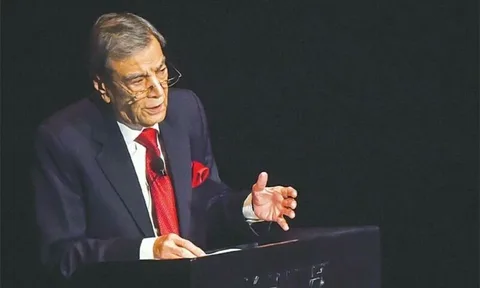
The Zia Mohyeddin Documentary, officially titled The Colour of My Heart (Rung Hai Dil Ka Mere), has become one of the most talked-about cultural releases to come out of Pakistan in recent memory. Directed by Umar Riaz, the film revisits the extraordinary life of the late actor and orator through rare archival material, personal interviews and readings of Urdu poetry that shaped his legacy.
Quick Summary
The documentary chronicles the life of legendary actor and broadcaster Zia Mohyeddin, weaving together his personal struggles with the poetry of Faiz Ahmed Faiz. It first released in Pakistani cinemas in early 2026 and has since travelled to international festivals, including a reported screening at the Asian American International Film Festival in New York. As of now, the film has not been confirmed for release on any major streaming platform such as Netflix, Amazon Prime or Hulu, so cinema and festival screenings remain the primary way to watch it.
Background of the Documentary
Umar Riaz spent close to fifteen years working on this project, starting with the first shots captured in December 2010. The idea began as a simple recording of Zia Mohyeddin’s annual Urdu poetry reading in Lahore, an event he hosted every year on the 31st of December. Over time, the footage grew into something far bigger than a single evening of recitation.
The film is actually a reworked and expanded version of Riaz’s earlier 2018 project, Some Lover to Some Beloved. Riaz has said in interviews that convincing Zia Mohyeddin to be filmed so candidly took years of patience, since the actor was known to be a private and, at times, difficult subject.
What The Colour of My Heart Is About
Rather than presenting a simple biography of achievements and awards, the documentary leans into something more personal. It explores Zia Mohyeddin’s insecurities, his loneliness, his relationships, and his lifelong devotion to keeping Urdu poetry alive for a new generation. The narrative is structured in chapters, with the late human rights activist and educationist Dr Arfa Sayeda Zehra guiding viewers through the different phases of his life.
A significant portion of the film is devoted to the poet Faiz Ahmed Faiz, whose work Zia Mohyeddin recited for decades. His daughters, Salima and Muneeza Hashmi, appear on screen to share memories of their father, adding an emotional depth that many reviewers have singled out as the heart of the film.
The documentary also touches on Zia Mohyeddin’s early years abroad, his discovery by director David Lean, his role in Lawrence of Arabia, and his time hosting The Zia Mohyeddin Show on Pakistan Television. His three marriages are also addressed, with his former wives interviewed to give their own perspective on his personality.
Where Was It Released
The Colour of My Heart premiered at a multiplex in Karachi and went on to secure a countrywide release in Pakistani cinemas. Reports place its wider theatrical rollout around late January and early February 2026, making it one of the first full-length documentaries to receive a proper cinema release across Pakistan. Critics have called this a landmark moment for the country’s documentary film industry, since such projects rarely make it to mainstream theatres.
International Screenings and Festival Recognition
Following its Pakistani release, the documentary has continued to draw attention on the international festival circuit. It has been reported to screen as part of the Asian American International Film Festival, an event organised by Asian CineVision that focuses on stories from the Asian and Asian American diaspora. This kind of recognition places the film alongside other South Asian documentaries gaining traction with global audiences interested in language, identity and cultural memory.
Quotes From the Director
Speaking about the making of the film, Umar Riaz explained that his intention was never to simply list Zia Mohyeddin’s accomplishments. He wanted to understand how the artist’s mind worked and how he approached his craft on a deeper level. Riaz has also acknowledged that his subject’s guarded nature was one of the biggest hurdles during production, which is part of why the project stretched across so many years.
Where to Watch the Zia Mohyeddin Documentary
For viewers asking where they can currently watch the film, the honest answer is that it remains largely a theatrical and festival release. It has not yet appeared on Netflix, Amazon Prime Video, Hulu or any other major streaming platform. Audiences in Pakistan were able to catch it in cinemas during its theatrical run, while international viewers have had access mainly through film festival screenings such as AAIFF. Anyone hoping to watch it outside of these windows should keep an eye on official festival listings and Pakistani cinema chains, since no confirmed digital or streaming release date has been announced so far.
Impact of the Documentary
The film’s impact goes beyond simple entertainment value. For many in Pakistan, it has reignited interest in Urdu poetry and literature at a time when younger generations are increasingly disconnected from the language. Critics have noted that the documentary functions as both a personal tribute and a broader commentary on the erosion of native languages and cultural identity in South Asia.
Internationally, the film’s festival appearances are helping introduce global audiences to figures like Zia Mohyeddin and Faiz Ahmed Faiz, both of whom remain largely unknown outside South Asian literary circles. This exposure could open doors for future distribution deals, though nothing concrete has been confirmed yet.
Conclusion and What Comes Next
The Zia Mohyeddin Documentary stands as a rare and deeply personal look at one of Pakistan’s most respected cultural figures. With its festival run continuing through 2026, there is a reasonable chance that a wider digital release could follow if distributors take notice of the positive critical response. Until then, fans and curious viewers will need to rely on cinema listings and festival schedules to catch this fifteen-year labour of love on the big screen.
Frequently Asked Questions
Was Zia Mohyeddin in any TV show?
Yes, Zia Mohyeddin was a well-known television personality long before this documentary was made. He hosted the immensely popular Pakistan Television talk show The Zia Mohyeddin Show between 1969 and 1973, which became known for its sophisticated style and variety format. Later in his career, while based in the United Kingdom, he also produced and hosted Here and Now for Central Television during the late 1980s, a multicultural magazine programme that ran for several years.
Who was Zia Mohyeddin’s first wife?
Zia Mohyeddin was married multiple times over the course of his life, and different biographical accounts describe the order of his marriages somewhat differently. He is widely reported to have married the celebrated Kathak dancer Nahid Siddiqui during his early years back in Pakistan, and the couple had a son together. He was later married to Sarwar Zamani and, in the mid-1990s, to Azra Mohyeddin, with whom he had a daughter. Because sources vary on the exact sequence of these marriages, readers are encouraged to treat the specific “first wife” claim with some caution.
What is the cause of death of Zia Mohyeddin?
Zia Mohyeddin passed away on 13 February 2023 at the age of 91 in Karachi. Reports at the time indicated that he had been admitted to hospital and underwent surgery related to an aneurysm shortly before his death. He is generally described as having died of natural causes related to his age and health complications, rather than from any single sudden incident.