
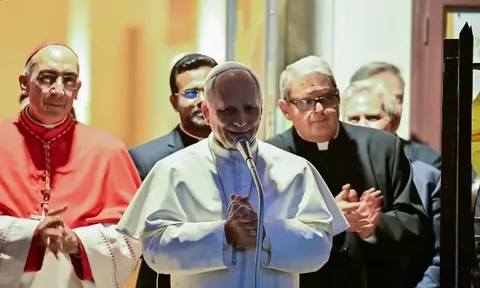
Pope Leo XIV issued his most direct condemnation yet of the Iran conflict on March 16, 2026 — delivering a powerful statement in which the Pope condemns religious war as a fundamental distortion of faith, stating that God is light and can never be invoked by those who operate in the darkness of war and hatred. The Pope condemns religious war statement was delivered during the Sunday Angelus address at St Peter’s Square and was widely understood as directed at both the US-Israeli military campaign against Iran — which some American evangelical and Christian Zionist figures have framed as a divinely sanctioned conflict — and at Iranian leaders who have used Islamic revolutionary language to frame their own cause. The Pope condemns religious war statement is the Vatican’s most explicit intervention against the 2026 Iran war to date — and has drawn an immediate response from Washington, Jerusalem, and Tehran.
Background: Who Is Pope Leo XIV and What Is the Context for the Pope Condemns Religious War Statement?
The Pope condemns religious war message delivered on March 16 came from Pope Leo XIV — born Cardinal Robert Francis Prevost — who was elected as the 267th Pope of the Catholic Church on May 8, 2025, becoming the first American-born Pope in history. Pope Leo XIV’s election was itself a historic moment — with the new pontiff taking the name Leo in reference to Pope Leo XIII, the author of the landmark social encyclical Rerum Novarum, signalling an intention to engage seriously with questions of political economy, justice, and peace.
The Pope condemns religious war statement on March 16 is Leo XIV’s clearest direct engagement with the 2026 Iran conflict — a war that has drawn Vatican commentary since its outbreak in late February. Pope Leo XIV had previously called for dialogue, de-escalation, and protection of civilians in Iran — but the March 16 Pope condemns religious war statement went further, explicitly criticising the theological framing that some participants have placed around the conflict.
The Pope condemns religious war context is important to understand. The Iran war of 2026 has attracted explicit religious framing from multiple sides. American evangelical and Christian Zionist organisations — influential in Trump’s political base — have described the elimination of Iran’s Islamist government as consistent with biblical prophecy and have supported the strikes with explicitly theological language. Israeli political and military figures have invoked the language of divine mandate in describing the campaign. Iranian leaders have used Islamic revolutionary language to frame their nation’s resistance. The Pope condemns religious war statement addresses all of these framings simultaneously.
The Pope condemns religious war statement also lands in the context of Pope Leo XIV being the first American Pope — and therefore the head of the Catholic Church in the country currently waging the Iran war. The question of did the Pope speak out against Trump is therefore answered directly by the March 16 statement — the Pope condemns religious war in terms that are impossible to read as anything other than a challenge to the theological framing that some Trump allies have placed around Operation Epic Fury.
Details: Pope Condemns Religious War — Full Story
Pope Condemns Religious War — What Leo XIV Said on March 16, 2026
Pope Leo XIV delivered the Pope condemns religious war statement during the Sunday Angelus address from the window of the Apostolic Palace overlooking St Peter’s Square on March 16, 2026. The Angelus address was attended by tens of thousands of faithful in St Peter’s Square and broadcast globally by Vatican Media.
The Pope condemns religious war statement was delivered in three parts. First, Pope Leo XIV made a direct appeal for an immediate ceasefire in the Iran conflict — calling on all parties to lay down their weapons and enter into genuine dialogue. Second, the Pope condemns religious war statement addressed the use of religious language to justify military action — stating that no authentic religious tradition can sanctify the killing of civilians, the destruction of cities, or the pursuit of military dominance under God’s name. Third, the Pope condemns religious war statement included the theological statement that has drawn the most international attention — that God is light and in him there is no darkness at all, and that therefore those who invoke God’s name while operating in the darkness of war and hatred are not speaking of the God of any genuine religious tradition.
The Pope condemns religious war statement was delivered in Italian but simultaneously released in English, Spanish, Arabic, and Farsi translations — a deliberate multilingual reach that signals the Vatican’s intention for the Pope condemns religious war message to be heard across all parties to the conflict.
Pope Leo War Is Not Holy — The Direct Statement
The Pope Leo war is not holy designation comes from the most direct passage in the March 16 Angelus address — in which Pope Leo XIV stated explicitly that there is no holy war, there is no sacred violence, and there is no divine mandate for the slaughter of the innocent. The Pope Leo war is not holy statement is the most direct papal condemnation of the just war framing that has accompanied the Iran conflict from its earliest stages.
The Pope Leo war is not holy statement has particular significance because it was delivered by a Pope who is himself a citizen of the country waging the war. Pope Leo XIV’s American nationality makes the Pope Leo war is not holy statement more than routine Vatican diplomatic commentary — it is the head of the world’s largest Christian denomination and a citizen of the United States telling his own government that the theological framing some of its allies have used to justify the Iran campaign is morally and theologically indefensible.
The Pope Leo war is not holy statement has been welcomed by Catholic peace organisations globally — including Pax Christi International, the Catholic Worker Movement, and the Justice and Peace commissions of bishops’ conferences in Europe, Latin America, and Africa. The Pope Leo war is not holy statement has been criticised by some American Catholic conservatives who support the Iran campaign — including figures associated with the Catholic integralist movement whose Rome conference Peter Thiel recently hosted.
Pope Warning Trump — Did the Pope Speak Out Against Trump?
The question of did the Pope speak out against Trump is answered by the March 16 Pope condemns religious war statement — though the Vatican has not named Trump directly in any of its Iran war commentary. The Pope condemns religious war statement is the most direct Pope warning Trump in the sense that it explicitly challenges the theological framing that some of Trump’s evangelical and Christian Zionist supporters have used to justify the campaign.
The Pope warning Trump dimension is most explicit in the Pope condemns religious war statement’s reference to those who claim God’s blessing for military action. Trump himself has used religious language in his Iran war communications — describing the strikes as God’s judgment on a regime that had oppressed its people and threatened the world. The Pope condemns religious war statement that God cannot be enlisted by those operating in darkness of war is a direct theological response to that framing.
Did the Pope speak out against Trump in personal terms? The Vatican has maintained diplomatic protocol — Pope Leo XIV has not named Trump in any statement and has called for peaceful dialogue that implicitly includes the US among the parties it addresses. But the Pope condemns religious war statement of March 16 leaves very little room for interpretation — a Pope who is himself American, addressing an American-led war, stating explicitly that war is not holy and God cannot be invoked to justify it, is making a statement that every observer in Washington understands as a Pope warning Trump regardless of whether Trump’s name appears in the text.
Pope Condemns Religious War — Vatican’s Broader Iran War Position
The March 16 Pope condemns religious war statement builds on a series of Vatican interventions since the Iran war began in late February 2026. Pope Leo XIV called for de-escalation immediately after the initial US-Israeli strikes on February 28. The Vatican’s Secretary of State Cardinal Pietro Parolin contacted both US Secretary of State Marco Rubio and Iranian diplomatic representatives in the days following the strikes — offering the Vatican as a neutral venue for any ceasefire negotiations.
The Pope condemns religious war statement escalation on March 16 reflects the Vatican’s assessment that diplomatic channels have not produced any meaningful movement toward de-escalation — and that stronger moral language was required. The Pope condemns religious war statement deliberately avoids describing the conflict in terms of which side is right — instead challenging the entire framework of religiously sanctioned warfare that multiple sides have employed.
Pope Condemns Religious War — Response from Washington, Jerusalem, and Tehran
The White House responded to the Pope condemns religious war statement by noting that President Trump respects the Pope’s pastoral role but believes the United States had a responsibility to prevent Iran from developing nuclear weapons. The White House statement did not directly engage with the Pope condemns religious war theological argument.
The Israeli Prime Minister’s office stated that Israel’s military actions were in defence of its existence and that of the Jewish people — and that the Pope condemns religious war statement, while respected, did not alter Israel’s assessment of the existential threat it faces. No Israeli official directly engaged with the Pope Leo war is not holy theological claim.
The Iranian government — whose Islamic Revolutionary framework has itself been challenged by the Pope condemns religious war statement — said through its foreign ministry that Pope Leo XIV’s call for ceasefire was welcomed and that Iran had always been the victim of aggression rather than the aggressor. Tehran did not address the Pope condemns religious war statement’s implicit critique of Iranian revolutionary Islamic framing.
Quotes
Pope Leo XIV, Angelus address St Peter’s Square, March 16, 2026 — the Pope condemns religious war statement: “God is light and in him there is no darkness at all. Those who invoke God’s name while operating in the darkness of war, hatred, and the destruction of the innocent are not speaking of the God revealed to us in Jesus Christ. There is no holy war. There is no sacred violence. There is no divine mandate for the slaughter of the innocent.”
Pope Leo XIV, on the Iran conflict ceasefire appeal accompanying the Pope condemns religious war statement: “I appeal to all parties in this conflict — lay down your weapons. Enter into genuine dialogue. The path of war leads only to more death, more suffering, more destruction. The path of peace is always available to those who choose it.”
Cardinal Pietro Parolin, Vatican Secretary of State, on the Pope condemns religious war diplomatic context: “The Holy Father’s statement is not a political commentary. It is a moral and theological statement rooted in two thousand years of Catholic teaching on the sanctity of human life and the conditions for just peace. We urge all parties to hear it in that spirit.”
Pax Christi International, welcoming the Pope condemns religious war statement: “Pope Leo XIV has said what needed to be said. The Pope condemns religious war in terms that leave no room for ambiguity. We call on Catholic leaders in the United States, Israel, and Iran to hear the Pope’s voice and act on it.”
American Catholic conservative commentator, criticising the Pope condemns religious war statement: “With respect to the Holy Father, the Church has always recognised the possibility of just war. The Pope condemns religious war framing ignores legitimate questions about Iran’s nuclear threat and the right of nations to self-defence.”
White House spokesperson, on did the Pope speak out against Trump and the Pope warning Trump dimension: “President Trump deeply respects Pope Leo XIV. The United States acted to prevent a nuclear-armed Iran from threatening the world. The Pope’s pastoral concerns are noted and respected.”
Impact: What the Pope Condemns Religious War Statement Means
For the Iran Conflict
The Pope condemns religious war statement from the head of 1.4 billion Catholics carries moral weight that extends well beyond the Catholic community. The Pope Leo war is not holy declaration challenges the theological framing that has made the Iran conflict easier to justify domestically in both the United States and Israel — where religious communities that support the war have used sacred language to sustain political support. The Pope condemns religious war statement gives religious opponents of the war in both countries explicit papal authority for their position.
For Pope Leo XIV’s Relationship with Trump
The Pope warning Trump dynamic created by the Pope condemns religious war statement is the most delicate dimension of Leo XIV’s papacy to date. As the first American Pope, Leo XIV occupies a unique position — neither a foreign critic of American policy nor a domestic figure subject to American political pressure. The Pope condemns religious war statement tests whether the Vatican can maintain that independence in the face of an American administration that has cultivated strong Catholic conservative support as a political base.
Did the Pope speak out against Trump? The March 16 Pope condemns religious war statement answers that question with theological precision — not in personal terms, but in terms that make the moral challenge to the Iran war’s religious framing unmistakably clear.
For Global Religious Communities
The Pope condemns religious war statement resonates across religious communities beyond Catholicism. Muslim leaders across the world — from the Organisation of Islamic Cooperation to individual national mufti offices — have cited the Pope condemns religious war statement in their own condemnations of the Iran conflict. The Pope Leo war is not holy statement provides an ecumenical moral framework for opposition to religiously framed warfare that extends across denominational lines.
For Vatican Diplomacy
The Pope condemns religious war statement establishes the Vatican’s Iran war position more firmly than any previous diplomatic communication — giving Cardinal Parolin and Vatican diplomats a clear moral baseline from which to conduct any future ceasefire mediation. The Pope condemns religious war statement’s offer of dialogue implicitly positions the Vatican as a potential neutral venue for negotiations — a role the Holy See has played in previous conflicts including the Cold War and the Colombian peace process.
Conclusion
The Pope condemns religious war statement of March 16, 2026, is the most significant papal intervention in a major military conflict since Pope John Paul II’s opposition to the 2003 Iraq invasion. The Pope Leo war is not holy declaration is theologically unambiguous — no authentic religious tradition can sanctify war, and invoking God’s name in the pursuit of military dominance is a distortion of every genuine faith.
Did the Pope speak out against Trump? The Pope condemns religious war statement speaks against the theological framing that has made the Iran war spiritually palatable to parts of Trump’s base — and in doing so, it is a Pope warning Trump that carries the full moral authority of the papacy, delivered by the first American Pope in history, in the shadow of an American-led war.
The Pope Leo war is not holy message has been heard in Washington, Jerusalem, and Tehran. Whether it changes any of their calculations is another question. But the Pope condemns religious war statement ensures that when the history of the 2026 Iran conflict is written, the moral voice of the world’s oldest international institution will be recorded on the side of peace — and against those who claimed God’s blessing for their bombs.
FAQs
What was Pope Leo’s controversial comment?
Pope Leo XIV, breaking with his previous reserve, stated during a press interview on September 30, 2025, at Castel Gandolfo: “A person who says, ‘I am against abortion,’ but supports the death penalty is not truly in favor of life,” as reported by Vatican News.
Is the Bible allowed in Iran?
It is currently illegal to distribute Christian literature in the official language, Persian. Muslims who change their faith to Christianity are subject to societal and official pressure which may lead to the death penalty.
What was the Pope’s final message?
Pope Francis’ final message to the world was a simple, powerful plea: peace. May we honor his legacy by striving for peace in our communities, our country, and our world.