The Fifty-Billion-Dollar Loss: Is America Leaving the Gulf?
By: Mian Iftikhar Ahmed
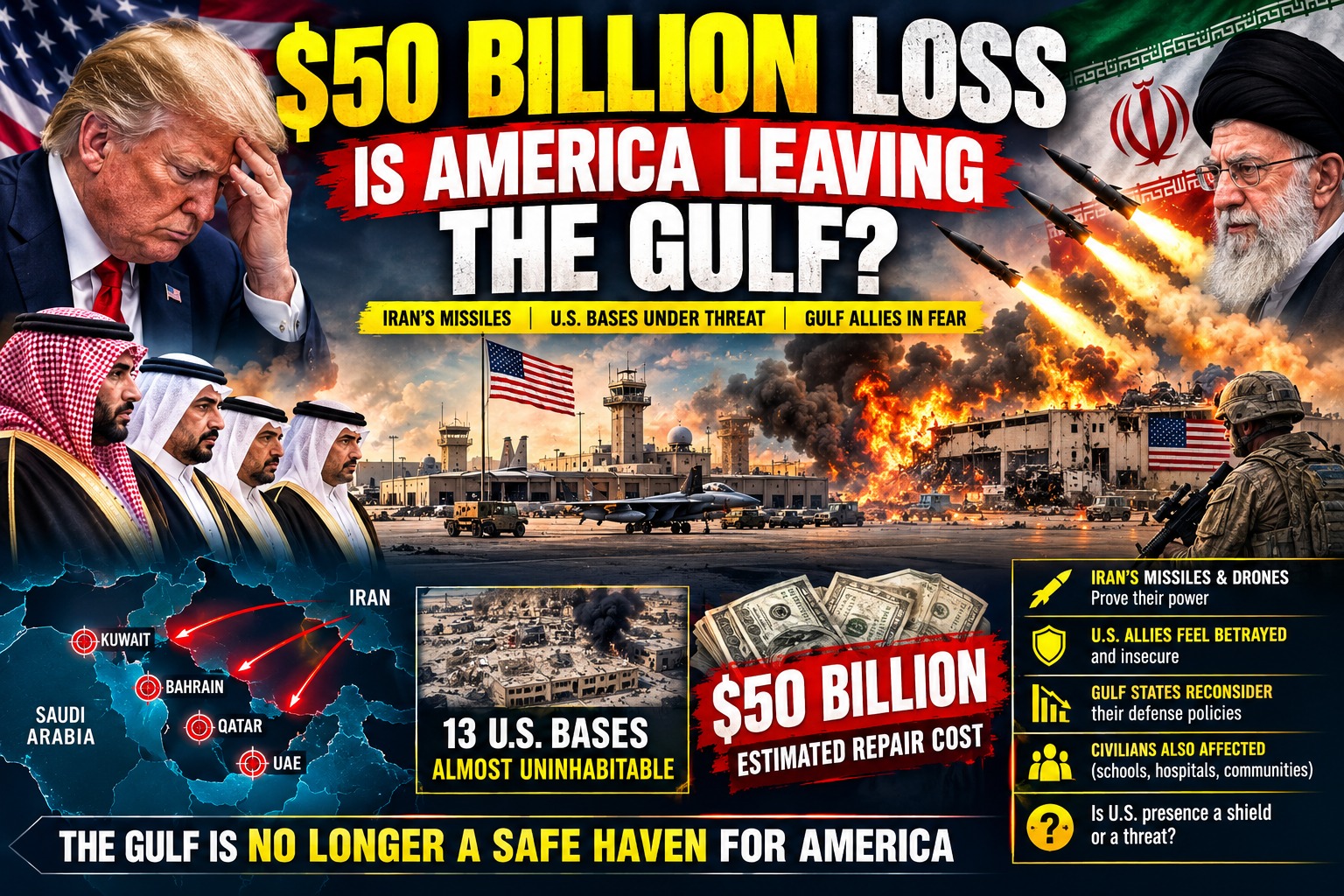
The American military fortresses in the Gulf are currently under the shadow of Iran’s missiles. Anxiety is mounting among Gulf allies, as the American bases are beginning to feel like a burden rather than a shield. According to conservative estimates, the United States has so far suffered losses amounting to fifty billion dollars. If Washington prepares for a withdrawal, the Gulf States will be compelled to devise entirely new defence strategies. The Iran-America war has fundamentally transformed the political and military dynamics of the Middle East, and one of the most critical aspects of this conflict is the changing status of the American military bases located in the Gulf countries. These bases, once regarded as strategic assets and symbols of American power, are now increasingly appearing as major liabilities and risks for their host governments. The prolonged nature of the war, the escalating human and financial toll, and the uncertainty surrounding American military strategy have pushed the Gulf allies toward deep frustration and a search for alternative security arrangements.
The Gulf allies, including Saudi Arabia, the United Arab Emirates, Qatar, Kuwait, and Bahrain, are profoundly disillusioned with President Donald Trump’s protracted war and his apparent inability to find a diplomatic solution. A Gulf official famously remarked, “Donald Trump started this war, and we are paying its price.” This statement captures the sentiment prevalent across Gulf capitals that they are bearing the consequences of a conflict over which they had no control and which was initiated without their genuine consent. The contradictory messages emanating from the White House, at times suggesting a ceasefire and at other times hinting at full-scale military escalation, have only added to their anxiety. In Riyadh and Abu Dhabi, questions are now being raised about whether America truly has a coherent plan for the region, or whether the war machine is simply moving forward on its own momentum, dragging every country in its path into the vortex of destruction.
For Gulf rulers, it is deeply unsettling to find themselves part of a war where they exercise no authority over either its commencement or its conclusion. This realization confronts them daily with the fact that the American bases on their soil are no longer sanctuaries but targets. Earlier, these military installations were tolerated as a “necessary evil”—it was accepted that American military presence was essential for regional stability despite its associated complications. But today, their utility and presence are being seriously questioned. Qatari analyst Anas bin Ziyad notes that recent events have exposed a complex dimension of this relationship. On the one hand, the American military presence contributed to maintaining regional equilibrium for decades; on the other hand, the escalation of regional conflicts and the use of these bases as launch pads for combat operations have turned them into active participants in the very conflicts they were meant to deter.
When American strikes against Iran originate from these same bases, they become natural targets for retaliation, forcing the Gulf states to reconsider their foreign and defence policies. They are now compelled to ask whether these bases truly protect them or merely make them targets for Iran. Is America’s presence in the region a source of peace, or is it fuel that keeps the fires of conflict burning? These are the questions that Gulf rulers are now forced to answer openly, as their own publics are raising their voices against the war and beginning to view American bases as threats to their national sovereignty.
Iran’s missile and drone attacks have inflicted severe damage on American bases across the region. According to a New York Times report, thirteen bases in the area had become virtually uninhabitable, with repair costs estimated at forty to fifty billion dollars. This is such an enormous sum that the annual defence budget of any Gulf state pales in comparison. More importantly, these losses are not confined to infrastructure and buildings alone; the military personnel stationed at these bases and their families have also endured repeated attacks. The headquarters of the US Fifth Fleet in Bahrain suffered extensive damage, disrupting its operations and forcing the evacuation of personnel and their families. This underscores that these installations on Gulf territory are not just military assets but entire communities, complete with schools, hospitals, and residential areas. When these come under attack, the repercussions are not limited to military circles but affect the broader economy and society.

In Kuwait, Ali Al Salem Air Base and Camp Arifjan also faced multiple strikes, damaging satellite communication equipment and other critical infrastructure. The Al Dhafra Air Base in the United Arab Emirates was also hit, impacting Abu Dhabi’s economic activities, as the base is vital not only for military operations but also for commercial and logistics purposes. These attacks were not isolated incidents; they recurred multiple times throughout the war, leading Gulf states to realize that the American presence on their soil would keep them in Iran’s crosshairs as long as the conflict persisted. The attacks made it abundantly clear that American bases lie well within Iran’s reach, and Tehran can strike them with precision. Iran has proven that its missiles and drones can challenge even the most advanced air defence systems, and its capabilities extend far beyond its own borders, enabling it to project power across the entire Gulf region. This has raised serious question marks over Gulf security and forced them to reconsider whether the American protection model is still effective or in need of fundamental change.
Iran’s strikes have also exposed the Gulf states to the reality that no matter how powerful the United States may be, its defence systems are not impregnable, and its presence cannot guarantee complete safety for any country. The American government did not include the repair costs of these bases in its official war budget, signalling that it is contemplating a shift in its military posture. Instead of large permanent bases, the United States is now favouring smaller, more flexible military installations that are less vulnerable to Iranian strikes. This is a strategy already tested in places like Guam and Japan, where America has closed large bases and replaced them with smaller, more mobile centres. However, the Gulf’s geopolitical and strategic landscape is vastly different. Iran’s proximity and its missile capabilities render this flexibility extremely difficult to achieve. Within the Pentagon, debates continue over whether to completely vacate these bases or equip them with advanced defence systems. But in either scenario, one thing is clear: under the current circumstances, these bases have lost their original utility, and their presence is causing more harm than good for the Gulf states.
This American strategic shift sends a dangerous message to the Gulf allies: is America willing to leave them to fend for themselves in order to protect its own forces? Professor Hal Brands of Johns Hopkins University observes that American bases in the Gulf, particularly the large ones, are highly vulnerable, and Washington may eventually move them beyond the range of Iran’s missiles. This implies that the Gulf states are facing an America that prioritizes its own security, even if that comes at the expense of its allies. This is the reality that has plunged Gulf rulers into deep anxiety. Having relied on American protection for decades, they now suddenly confront the realization that this security umbrella is no longer certain. This situation is forcing the Gulf states to move away from total reliance on American security guarantees and seek new defence partners. One example is the mutual defence agreement between Saudi Arabia, Turkey, and Pakistan. Furthermore, their relations with China and Russia have also seen significant improvement, and they are now building a multilateral defence network that includes European nations, rather than depending solely on the United States.
This shift was unthinkable just a few years ago, but today it has become a reality. In addition, the Gulf States are strengthening their domestic defence industries so that they can be prepared for any future American withdrawal and ensure that their security is not dependent on a single power. To this end, they have launched large-scale defence programmes, including the acquisition of advanced fighter jets, drones, and missile systems, while also seeking to develop such technologies locally. This war marks a new and complex chapter in the relationship between America and its Gulf allies. Where once reliance on American military protection for peace and order was a given, it is now becoming a liability. Gulf governments are being forced to explore alternative paths to security. American bases are no longer just symbols of power; they have become targets, financial burdens, and sources of political embarrassment. Their presence is also generating resentment among Gulf populations, who see their countries being drawn into the American war machine and bearing its costs in both lives and livelihoods.
Within Gulf societies, debates are intensifying over whether these bases truly serve their interests, or whether they should be closed in favour of autonomous defence agreements with regional countries. In this context, the Gulf states need to adopt more independent and diversified strategies for their national security, while Washington must also reassess its ties with its allies to restore trust, lest these relationships deteriorate further and cause lasting damage to American influence in the Middle East. Gulf rulers now understand that the United States is an ally that acts according to its own interests, with no permanent loyalties. Therefore, they must shoulder the responsibility for their own security, and they are using every possible means to achieve this.
In the near future, decisions will be made that will determine under which new security architecture the strategic region of the Persian Gulf will be reorganized. Will it return to American dominance, or will it become part of a multipolar world where China, Russia, Turkey, and regional powers also play their roles? It is clear that old certainties no longer hold, and the time has come to acknowledge new realities. Gulf rulers must now decide whether they view hosting American bases as a strategic risk or as part of a new balance of power. At the same time, Washington must recognize that the trust in its presence has eroded, and it needs to provide its allies with renewed assurance, or else these ties could further sour. Amid all this, the most important question is whether the Gulf states and the United States will confront this new challenge together, or whether their paths will diverge, affecting global political and economic dynamics in the years to come. The Gulf is not merely a regional conflict zone but the world’s central hub for energy supply and international trade. Any decision taken here will have worldwide repercussions, compelling all major powers to determine their own stances.
In this backdrop, it will be interesting to see whether the Gulf states can maintain their strategic autonomy or whether they will once again become junior partners to a major power. Their geographic location and oil and gas reserves will always keep them in the spotlight of major powers, and they cannot escape this reality. However, they need to adopt wiser and more balanced strategies to protect their interests, so that they can deal with any future crisis. The future of American bases in the Gulf is now an open debate, and a decision on it is inevitable sooner or later. But one thing is certain: the old situation will not return, and the region’s security map will be redrawn, requiring all parties to clarify their positions and face new challenges.