
President Donald Trump, in his first primetime address since launching Operation Epic Fury, declared the Iran war is “nearing completion” while simultaneously threatening to bomb Iran “back to the stone ages.” Iran’s response to Trump has been defiant, with its military promising more “crushing and destructive” attacks, and the Islamic Revolutionary Guard Corps (IRGC) threatening 18 major American companies including Nvidia and Boeing. As Trump’s Iran speech time dominated global headlines on April 1, 2026, the world watched oil prices spike above $105 a barrel and stock markets rattle with uncertainty.
Background: How the US-Iran War Began
The question what is the issue between the US and Iran? has a long and complicated answer rooted in decades of tension. The United States and Iran have been adversaries since the 1979 Islamic Revolution. Hostility deepened after the January 2020 assassination of Iranian General Qasem Soleimani under Trump’s first term, the 2023 Gaza war, and Israel’s Twelve-Day War against Iran in June 2025, in which the U.S. participated with strikes against Iranian nuclear facilities.
By early 2026, internal Iranian protests had been violently suppressed, and U.S. intelligence raised fresh concerns about Iran’s ballistic missile development. On February 28, 2026, the United States and Israel launched coordinated surprise airstrikes across Iran, assassinating Supreme Leader Ali Khamenei and several top Iranian military commanders. This marked the beginning of what the White House officially called Operation Epic Fury the largest U.S. military buildup in the Middle East since the 2003 Iraq invasion.
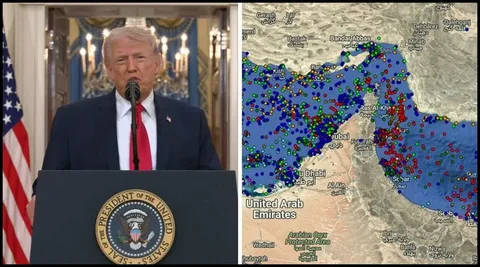
Iran’s response to Trump’s military campaign was immediate. Iranian forces launched missile and drone strikes against Israel, U.S. military bases across the Persian Gulf, and U.S.-allied nations in the region. Crucially, Iran closed the Strait of Hormuz the waterway through which approximately 20% of the world’s oil supply passes triggering a global energy crisis that sent oil prices soaring and U.S. gasoline prices above $4 per gallon for the first time since 2022.
Details: Trump’s Speech Today What He Said and When
Trump’s Iran speech time was set for 9 p.m. ET on Wednesday, April 1, 2026. Speaking from the Cross Hall of the White House, Trump delivered a roughly 19-minute address marking just over one month since Operation Epic Fury began. It was his first formal primetime speech to the nation on the Iran war.
The Trump speech today carried four central messages: the war was necessary, the war has essentially been won, the war must continue, and the war will end soon. However, experts and analysts were quick to note that Trump’s Iran speech time produced no major new announcements.
“Tonight, Iran’s navy is gone. Their air force is in ruins. Their leaders, most of them, are now dead,” Trump said, describing the military campaign as achieving “swift, decisive, overwhelming victories.”
Trump also issued stark warnings regarding Iran’s infrastructure. He threatened to strike every one of Iran’s electric generating plants, possibly simultaneously, if a deal is not reached within two to three weeks. He further warned of potential strikes on Iranian oil infrastructure.
“Over the next two to three weeks, we’re going to bring them back to the stone ages where they belong,” Trump said, a line that drew sharp reactions globally.
Trump justified the war by arguing that without U.S. intervention, Iran which he called “the most violent and thuggish regime on earth” would have been free to operate behind a nuclear shield. He also claimed there would be “no Middle East and no Israel” without his decision to exit the Obama-era nuclear deal.
Notably, Trump’s speech offered no clear exit strategy, no firm end date, and no mention of how the Strait of Hormuz which Iran has effectively blocked would be reopened. He told other nations that they would need to “take care of that passage” themselves.
Iran’s Response to Trump: “More Crushing and Destructive” Attacks
Iran’s response to Trump has been consistent and forceful. Following the April 1 speech, Iran’s military command vowed to carry out “more crushing, broader, and more destructive” attacks, according to Iranian state media.
Iran’s Foreign Minister Abbas Araghchi told Al Jazeera that Tehran is prepared for “at least six months” of war and flatly denied that any negotiations with Washington are taking place, despite Trump’s insistence that talks are ongoing with a “new, more reasonable” Iranian leadership.
“Negotiation is when two countries engage in talks to reach an agreement, and such a thing does not exist between us and the United States,” Araghchi said.
Iran’s Foreign Ministry also called Trump’s claim that Iran requested a ceasefire “false and baseless.”
On Easter Sunday, April 5, 2026, Trump escalated once again. In a profanity-laced social media post, he warned Iran: “Open the [Strait], you crazy bastards, or you’ll be living in Hell JUST WATCH!” Trump set a new deadline of 8 p.m. ET on Tuesday, April 7, for Iran to reach a deal, and told Fox News Sunday he was “considering blowing everything up and taking over the oil” if no agreement is reached.
Iran News on American Companies: A Serious Economic Threat
Perhaps the most alarming development for U.S. businesses involves Iran’s direct threats toward American corporations. Iran news on American companies has become a major concern in corporate boardrooms.
The Iranian Revolutionary Guard Corps (IRGC) released a list of 18 major U.S. companies it threatens to destroy as retaliation for what it describes as these firms aiding the U.S.-Israeli war effort. The list, broadcast by Iranian state media outlet IRIB, includes high-profile names such as Nvidia and Boeing, among others. The IRGC warned that starting from April 1 (Tehran time), these companies should “expect the destruction of their relevant units.”
Beyond direct threats, Iran news on American companies has also encompassed broader economic damage. The war has already cost the U.S. an estimated $25 billion, with ongoing daily costs around $500 million. The disruption of the Strait of Hormuz has sent shockwaves through global supply chains.
A survey by the Airforwarders Association found that 7 in 10 of its member companies including freight forwarders, airlines, trucking firms, and warehouse operators are experiencing disruption from the war. Input costs for U.S. manufacturers are rising at their fastest pace since pandemic-era supply shocks.
Goldman Sachs estimates the economic impacts of the Iran war will result in 10,000 fewer jobs per month through the end of the year. Consumer sentiment has plunged to near-record lows, and Walmart has noted that customers are cutting discretionary spending and trading down to save money.
Quotes: What Officials and Experts Are Saying
Donald Trump (April 1, 2026 address): “We are on track to complete all of America’s military objectives shortly, very shortly. We are going to hit them extremely hard over the next two to three weeks.”
Iran’s Foreign Minister Abbas Araghchi (to Al Jazeera): “We do not set any deadlines for defending ourselves. We will defend our country and our people as far as necessary and by any means required.”
Sina Azodi, assistant professor of Middle East Politics, George Washington University: “I did not detect anything new. Essentially, it was a summary of all of the tweets he has issued over the last 30 days, almost in chronological order.”
Trita Parsi, executive vice president, Quincy Institute: “Precisely because it does not appear to have anything new in it, it reveals that he really does not have a plan.”
Australia’s Prime Minister Anthony Albanese (April 2, 2026): “Now those objectives have been realized, it is not clear what more needs to be achieved or what the endpoint looks like.”
Iran’s military command (after Trump’s April 1 speech): Iranian forces vowed to launch “more crushing, broader, and more destructive” attacks in the days ahead.
Impact: Global and Regional Consequences
The Trump-Iran war is reshaping global politics, energy markets, and the world economy in real time.
Energy Markets: Oil prices surged above $105 per barrel (Brent crude) following Trump’s April 1 speech a more than 4% single-night spike. U.S. gasoline prices have climbed approximately 35% since February 27, 2026, the day before the war began. The closure of the Strait of Hormuz has directly disrupted 20% of global oil supply.
Stock Markets: Wall Street has responded poorly to the war. Stocks are down nearly 5% since the war began and just ended the worst quarter in nearly four years. Markets swung violently after Trump’s speech, as hopes for a quick end to the war were dashed by his aggressive rhetoric.
Food Security: The World Food Programme warns that if current conditions continue through June, an additional 45 million people worldwide could fall into acute hunger bringing the global total to 363 million.
Allied Nations: Australia, which relies heavily on oil through the Strait of Hormuz, is facing potential shortages that triggered panic buying. Britain’s Prime Minister Keir Starmer announced that 35 countries signed a statement committing to restore maritime security in the region once the war ends.
Iran on Trump’s threats to American companies: Beyond Iran’s military response, the IRGC’s targeting of U.S. corporations represents an unprecedented escalation in economic warfare one that rattled technology and defense sector stocks globally.
Who is stronger, Israel or Iran? Militarily, Israel and the United States have a commanding advantage in technology, air power, and naval capability. Iran’s strength lies in its asymmetric capabilities missiles, drones, proxy forces, and its ability to close the Strait of Hormuz. The war has demonstrated that while Iran cannot match U.S. firepower conventionally, it can inflict serious economic pain on the entire world.
Who is Israel’s best friend? The United States remains Israel’s closest and most powerful ally, providing military hardware, intelligence, and direct air power in Operation Epic Fury. The UK and Gulf states such as Saudi Arabia and the UAE have also played supporting roles, with U.S.-allied Gulf nations reportedly pressing Trump to continue until significant changes occur in Iranian leadership.
Conclusion: What Comes Next?
As of April 5, 2026, the U.S.-Iran war remains active with no definitive end in sight. Trump has set a new deadline of April 7 for Iran to open the Strait of Hormuz or face what he calls the most devastating bombardment in the history of warfare targeting power plants, bridges, oil infrastructure, and desalination plants simultaneously.
Iran’s response to Trump’s latest ultimatum has been defiant. Iran’s leadership insists it can sustain the war for months and has shown no sign of accepting U.S. terms. Indirect talks whose very existence remains disputed have produced no breakthroughs.
The international community is increasingly alarmed. The UN Security Council is holding consultations with Gulf and Arab League states. NATO allies are growing restless, and Trump himself has floated the idea of the U.S. withdrawing from NATO over the alliance’s limited military participation in the war.
For American companies, the Iran news grows more threatening by the day from supply chain disruption and surging energy costs to explicit IRGC target lists. Whether a deal materializes before Tuesday’s deadline or the war enters a devastating new phase, the coming week may be one of the most consequential in U.S. foreign policy history.
Frequently Asked Questions (FAQs)
Q: What is the issue between the US and Iran?
The US-Iran conflict stems from decades of geopolitical rivalry rooted in the 1979 Islamic Revolution, which overthrew a U.S.-backed government. Key flashpoints include Iran’s nuclear program, its support for militant proxy groups across the Middle East, the 2020 U.S. assassination of General Qasem Soleimani, and Iran’s repeated threats against Israel. In February 2026, the U.S. and Israel launched military strikes to dismantle Iran’s missile capability and prevent it from ever acquiring a nuclear weapon — triggering the current war.
Q: Who is stronger, Israel or Iran?
In terms of conventional military technology, Israel holds a decisive advantage particularly in air power, precision strike capability, and intelligence. Israel also possesses an undeclared nuclear deterrent. Iran, however, is a much larger country with a population exceeding 90 million and relies on asymmetric warfare: ballistic missiles, drone attacks, and a network of regional proxy forces. In the current war, the U.S. military’s involvement has dramatically shifted the balance of power in Israel’s favor.
Q: Who is Israel’s best friend?
The United States is widely considered Israel’s closest and most powerful ally. The U.S. provides billions of dollars in annual military aid, has vetoed UN Security Council resolutions critical of Israel, and has directly participated in military operations alongside Israel most recently in Operation Epic Fury against Iran. Other strong allies include the United Kingdom, Germany, and several Gulf Arab states that share concerns about Iranian regional influence.