
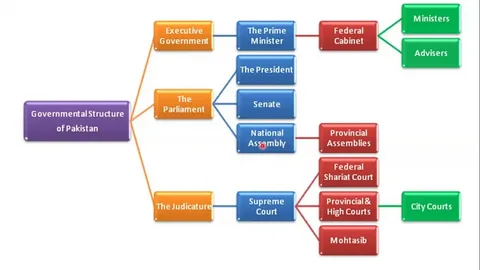
The local government system in Pakistan represents the third tier of governance, below the federal and provincial levels. Despite constitutional guarantees under Article 140-A, local bodies have repeatedly been weakened, dissolved, or left without elections for years. Today, the near-term future of strong grassroots democracy remains uncertain despite escalating pressure in an intensifying national debate, with ruling parties apparently unwilling or unable to uphold the principles underlying the empowerment of the third tier of government.
Background: Who Introduced Local Government System in Pakistan?
The history of local government in Pakistan stretches back to the colonial era. The British introduced municipal committees and local bodies in the subcontinent as early as the 1850s to manage civic affairs at the grassroots level.
After Pakistan’s independence in 1947, local government structures were inherited from the British system but remained largely ceremonial. The first major formal push came under General Ayub Khan, who introduced the Basic Democracies Order in 1959 — a system designed to create a network of local councils across the country, though critics argued it was used to consolidate military rule rather than genuinely empower communities.
General Ziaul Haq later introduced the Local Government Ordinance of 1979, which created a more structured tier of district, tehsil, and union councils. However, the most sweeping change in the system of local government in Pakistan was brought in by General Pervez Musharraf through the Local Government Ordinance (LGO) 2001, which introduced the Devolution of Power Plan. This system created a new three-tier structure of district governments, tehsil municipal administrations, and union administrations — with elected Nazims heading each tier.
Local Government Structure in Pakistan
The local government structure in Pakistan, as it exists under the constitutional and legal framework, is built on three tiers. At the base is the Union Council or Union Administration, which covers rural villages or urban wards. Above it sits the Tehsil or Town Municipal Administration, managing a group of union councils within a sub-district area. At the top of the local government structure is the District Government, responsible for the overall administration of a full district.
Each province has enacted its own Local Government Act, giving it the authority to define the scope, powers, and election rules for these bodies. This has led to significant differences between how local governments function in Punjab, Sindh, Khyber Pakhtunkhwa (KP), and Balochistan.
Change in the System of Local Government in Pakistan
The most dramatic change in the system of local government in Pakistan was brought in through General Musharraf’s 2001 devolution plan, which shifted significant administrative and financial powers to district Nazims. However, when civilian governments returned, most of these powers were clawed back by the provinces.
The 18th Constitutional Amendment of 2010 further complicated matters. While it devolved many federal powers to provinces, it did not adequately protect local governments from being weakened by provincial governments. Article 140-A obligates provinces to establish elected local governments and devolve political, administrative, and financial responsibility to them — but this obligation has rarely been honoured in spirit.
Former PTI leader Asad Umar, addressing a seminar in Hyderabad in April 2025, stressed that it was “the right time to seriously discuss the LG issue threadbare before finding a solution.” He noted that local governments were constitutionally the third tier of government, but without constitutional protection.
In KP, changes have continued in recent years. The KP government is now working on a proposal to restore the district tier of the province’s local government system, which was abolished in 2019. This reversal itself reflects how frequently the local government structure in Pakistan has been altered based on shifting political priorities.
History of Local Government in Pakistan: A Timeline
Understanding the history of local government in Pakistan requires tracing its evolution across different political eras:
1959 — Basic Democracies Order (Ayub Khan): Created 80,000 basic democrats as an electoral college. Local bodies used as political tools rather than service delivery units.
1979 — Local Government Ordinance (Zia ul Haq): Introduced union councils, tehsil councils, and district councils with elected members. Women’s reserved seats introduced.
2001 — Local Government Ordinance (Musharraf): The biggest structural shift. District Nazim system introduced. Police, health, and education devolved to district level. Widely seen as the most ambitious decentralisation attempt.
2010 — 18th Amendment: Devolution from federal to provincial level. Local government responsibility transferred to provinces, who largely failed to protect it.
2013–present — Provincial LG Acts: Each province passed its own local government law, often weakening the system compared to the 2001 model.
Issues of Local Government in Pakistan
The issues of local government in Pakistan are deep-rooted and multi-dimensional. The most fundamental problem is the absence of genuine devolution. Provincial governments consistently resist sharing power, funds, and administrative authority with local councils.
Analyst and lawyer Nadeem Khurshid argues that “establishing empowered local governments with fiscal and decision-making authority is a constitutional duty, not a policy option.” Yet in practice, this duty has been ignored. He points out that even in developed countries, local governments wield immense economic power and fiscal authority citing New York City’s budget of over $100 billion covering transport, housing, sanitation, policing, and public health.
A second major issue is the chronic delay in holding local government elections. In Punjab, elections could not be held since late April 2022 as the provincial government kept amending the LG law from time to time. This has left millions of citizens without representation at the most basic level of governance.
Financial dependence is another critical problem. Local bodies receive funds from provinces through grants, and the allocation is often inadequate and unpredictable. In KP, the provincial government was legally bound to give 30 percent of its Annual Development Programme funds to local governments, which was later reduced to 20 percent and the Local Council Association president has called for the 30 percent allocation to be restored.
Political interference, lack of trained staff, weak record-keeping, and the absence of own-source revenue further compound the issues of local government in Pakistan. Urban local bodies struggle particularly with service delivery water supply, sanitation, and solid waste management because they lack both funds and authority to act independently.
Expert Voices and Quotes
Nadeem Khurshid argues that “cities perform when authority lies with elected local leaders, fiscal autonomy is ensured through strong own-source revenues and predictable transfers, and citizens are treated as participants, not spectators.”
A Dawn editorial had earlier noted that as long as politicians fail to provide more constitutional detail regarding devolution of powers to the grassroots level, Pakistan will remain without an effective third tier of government.
Sindh United Party president Syed Zain Shah, while acknowledging limited empowerment could be discussed, warned against any arrangement that would threaten Sindh’s identity and resources — framing certain LG proposals as an attempt to roll back the 18th Amendment.
Impact: Why Local Government Reform Matters
The local government system in Pakistan directly affects the daily lives of millions of citizens. Roads, drains, water supply, local markets, school maintenance, and birth certificates — all these services are supposed to be the responsibility of local councils. When local government is weak, citizens suffer most at the bottom.
The impact of a failed local government system goes beyond inconvenience. It deepens inequality between urban and rural areas, concentrates power in provincial capitals, and reduces accountability. Citizens in remote districts of Balochistan or southern Punjab have little recourse when basic services fail, because the local tier that is supposed to represent them either does not exist, has no money, or has no power to act.
The Hinglaj Mata temple, recently seen in news, is located in Balochistan’s Lasbela district a region where local governance has historically been among the weakest in Pakistan, highlighting how communities in such areas depend on functional local bodies for basic administration and cultural preservation.
Conclusion: What Needs to Change?
The essay on local government system in Pakistan inevitably ends at the same crossroads: constitutional obligation versus political reality. Provinces must be legally compelled not merely encouraged — to hold timely elections, devolve real funds, and grant administrative independence to local councils.
In a significant step, the Election Commission of Pakistan has issued a schedule for the delimitation of union councils in Punjab, with final decisions to be communicated to delimitation committees by August 4 and the final list of constituencies set for publication on August 10. This is a welcome development, but delimitation alone is not reform.
True reform of the local government system in Pakistan requires constitutional amendments that protect local bodies from provincial interference, guaranteed multi-year funding formulas, and independent local taxation authority. Until then, the third tier will remain the weakest link in Pakistan’s governance chain.
FAQs
What are the three tiers of government in Pakistan?
Pakistan has three tiers of government: the Federal Government at the top, the Provincial Governments at the second level (Punjab, Sindh, KP, and Balochistan), and Local Governments at the third tier — which include district councils, tehsil or town municipal administrations, and union councils or union administrations.
What is the three-tier system of governance?
The three-tier system of governance refers to the division of governmental authority across three levels: national (federal), regional (provincial or state), and local (municipal or district). In Pakistan, this system is defined in the Constitution, with Article 140-A requiring provinces to establish elected local governments and devolve political, administrative, and financial powers to them.
How many types of governance are there in Pakistan?
Pakistan operates under three main types of governance structures: federal governance (the central government in Islamabad), provincial governance (four provincial governments plus Gilgit-Baltistan and AJK with special status), and local governance (district, tehsil, and union council levels). Additionally, cantonment boards operate as a separate category of local governance under federal control, managed through the Ministry of Defence.