
Disease outbreaks do not wait for governments to be ready. From the 2026 Kent meningitis cluster that hospitalized 21 students to the Bangladesh measles outbreak that killed over 100 people, the world is being reminded why outbreak investigation steps matter. Understanding the 10 steps of an outbreak investigation as defined by CDC outbreak investigation steps and global public health frameworks is now more important than ever.
Why Outbreak Investigation Steps Matter Right Now
In March 2026, a superspreading event at Club Chemistry in Canterbury, Kent led to 21 confirmed cases of meningitis B, with most cases linked to students of the University of Kent and Canterbury Christ Church University. Two people died.
At the same time, a measles outbreak in Bangladesh resulted in over 114 deaths and more than 4,600 hospitalizations, with 826 confirmed cases as of early April 2026. These concurrent outbreaks show that disease outbreak investigation is not a theoretical exercise it saves lives in real time.
The 10 steps of an outbreak investigation, as outlined in CDC outbreak investigation steps guidance and detailed in outbreak management PDF documents, provide the scientific backbone for responding to exactly these situations.
Background What Is a Disease Outbreak Investigation?
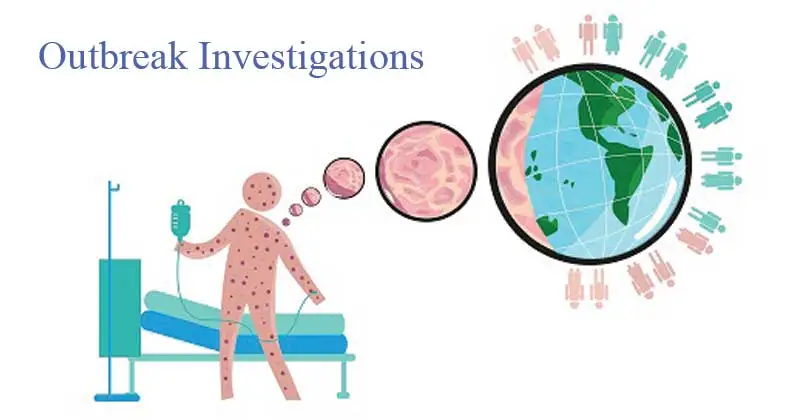
A disease outbreak investigation is a structured public health response to an unusual cluster of illness in a population. Its disease outbreak investigation purpose statement is clear: identify the source, stop transmission, treat those affected, and prevent future cases.
Every outbreak whether bacterial, viral, or toxin-related follows a similar investigative logic. The CDC outbreak investigation steps, taught in every outbreak investigation PPT used in public health training globally, provide a replicable, evidence-based framework. This framework also forms the core of most control of communicable diseases PDF manuals used by national health ministries around the world.
Understanding outbreak investigation steps is not just for epidemiologists. It is critical knowledge for public health officers, hospital administrators, journalists, and policymakers.
The 10 Steps of an Outbreak Investigation Fully Explained
The 10 steps of an outbreak investigation are the gold standard in disease outbreak investigation. They appear in every serious outbreak management PDF, every CDC outbreak investigation steps document, and every outbreak investigation PPT used in academic and field training.
Step 1 — Prepare for Field Work
Before investigators go into the field, they must gather supplies, review existing literature, and understand the local health system. This preparation phase is often skipped in rushed responses and that failure costs lives. A proper disease outbreak investigation starts with readiness, not reaction.
Step 2 — Establish the Existence of an Outbreak
Not every cluster of illness is an outbreak. Investigators must compare current disease rates to historical baselines. This step in CDC outbreak investigation steps is critical it prevents panic over normal seasonal variation and focuses resources on real emergencies.
Step 3 — Verify the Diagnosis
Outbreak investigation steps require that the clinical and laboratory diagnosis be confirmed before any intervention. In the Kent meningitis case, health authorities confirmed the outbreak was linked to Neisseria meningitidis serotype B a critical verification step that shaped the entire response.
Step 4 — Construct a Working Case Definition
A case definition tells investigators who counts as a case and who does not. This disease outbreak investigation step defines cases by person, place, and time. Every outbreak management PDF emphasizes that a flawed case definition leads to under- or over-counting, which derails the entire response.
Step 5 — Find and Count Cases
Once the case definition exists, investigators systematically search for all affected individuals. In the Bangladesh measles outbreak, health authorities tracked both confirmed cases and suspected cases across multiple districts a textbook example of this CDC outbreak investigation step in action.
Step 6 — Perform Descriptive Epidemiology
This is where data becomes insight. Investigators analyze cases by person (who got sick), place (where they got sick), and time (when they got sick). An epidemic curve a graph of cases over time is typically drawn at this stage. This step appears in every outbreak investigation PPT as one of the most visually powerful tools in disease outbreak investigation.
Step 7 — Develop Hypotheses
Based on descriptive epidemiology, investigators form hypotheses about the source and mode of transmission. This is the analytical engine of the 10 steps of an outbreak investigation. In nightclub-linked outbreaks like the Kent meningitis case, close contact via shared spaces forms the natural hypothesis basis.
Step 8 — Evaluate Hypotheses
Hypotheses must be tested through analytic epidemiology case-control studies or cohort studies. This step in CDC outbreak investigation steps separates speculation from science. Control of communicable diseases PDF guidelines note that skipping this step leads to wrong interventions targeting the wrong source.
Step 9 — Implement Control and Prevention Measures
This is the step that saves lives. Based on confirmed hypotheses, public health authorities implement containment. In the Bangladesh measles outbreak, emergency measles vaccination was launched across 30 upazilas a direct application of this outbreak investigation step. Control of communicable diseases PDF frameworks classify interventions as source control, transmission interruption, and host protection.
Step 10 — Communicate Findings
The final step of the 10 steps of an outbreak investigation is communication. Findings must be shared with health authorities, affected communities, and the global health community. Every outbreak management PDF and outbreak investigation PPT emphasizes that transparency at this stage prevents misinformation and builds public trust for future responses.
CDC Outbreak Investigation Steps vs WHO Framework Key Differences
The CDC outbreak investigation steps are the most widely cited framework globally, but the WHO also provides guidance that is especially relevant in low-resource settings. The CDC framework is more detailed and laboratory-focused, while WHO guidance under its control of communicable diseases PDF documents emphasizes community-level response and resource-limited adaptations.
Both frameworks agree on the disease outbreak investigation purpose statement: identify, control, and prevent. Both appear in standard outbreak investigation PPT materials used in medical schools, public health institutes, and field epidemiology training programs (FETP) worldwide.
The core 10 steps of an outbreak investigation remain consistent across both frameworks, though sequencing and emphasis may differ. Practitioners are advised to consult both the CDC outbreak investigation steps documentation and the WHO control of communicable diseases PDF for comprehensive preparation.
Outbreak Management PDF What These Documents Actually Cover
An outbreak management PDF is a reference document used by public health teams during an active disease outbreak investigation. These documents typically include the 10 steps of an outbreak investigation, sample case definition templates, epidemiological data collection forms, laboratory testing protocols, and communication templates.
The most commonly referenced outbreak management PDF documents come from the CDC, WHO, ECDC (European Centre for Disease Prevention and Control), and national health ministries. They are regularly updated after major outbreaks to incorporate lessons learned.
For the 2026 Kent meningitis outbreak, a superspreading event involving nearly 4,800 nightclub attendees required health authorities to rapidly scale their outbreak investigation steps exactly the scenario these documents prepare for.
Disease Outbreak Investigation Purpose Statement Why It Must Be Clear
Every disease outbreak investigation begins with a purpose statement. This is not bureaucratic formality it is the foundation of a focused, effective response. A clear disease outbreak investigation purpose statement defines the scope of the investigation, the populations being protected, and the outcomes being measured.
Without a clear disease outbreak investigation purpose statement, investigations drift. Resources are wasted. Political pressure fills the vacuum that scientific clarity should occupy. Every CDC outbreak investigation steps document and outbreak investigation PPT emphasizes that this statement must be written and agreed upon before field work begins.
A model disease outbreak investigation purpose statement reads: “To identify the source and mode of transmission of the reported cluster of illness, implement appropriate control measures, and prevent further cases.”
Global Impact What 2026 Outbreaks Teach Us
The simultaneous occurrence of the Kent meningitis cluster and the Bangladesh measles outbreak in early 2026 reveals two important global lessons. First, no country rich or poor is immune to disease outbreak investigation failures. Second, speed and scientific rigor in following the 10 steps of an outbreak investigation determines how many people live or die.
In Kent, the outbreak began on 11 March and within days reached France, requiring cross-border notification. This cross-border dimension is addressed in CDC outbreak investigation steps guidance and control of communicable diseases PDF international frameworks but only when health authorities are trained to look for it.
Outbreak investigation PPT materials used in field training must incorporate these real-world 2026 cases to prepare the next generation of epidemiologists for the speed and complexity of modern disease outbreak investigation.
Conclusion The 10 Steps Are a Living Framework
The 10 steps of an outbreak investigation are not a checklist to be ticked and forgotten. They are a living, adaptive framework that public health systems must practice continuously. The CDC outbreak investigation steps, the WHO control of communicable diseases PDF guidance, and every outbreak management PDF in circulation agree on one thing: preparation before an outbreak is the only reliable prevention.
Governments must train more field epidemiologists. Health systems must maintain updated outbreak investigation PPT training materials. And disease outbreak investigation purpose statements must be embedded in emergency response plans before the next crisis arrives not written during it.
The outbreaks of 2026 are a warning. The 10 steps of an outbreak investigation are the answer.
FAQs
What are 5 antiviral drugs?
Five widely used antiviral drugs include Oseltamivir (Tamiflu) for influenza, Remdesivir for COVID-19 and other RNA viruses, Acyclovir for herpes viruses, Ribavirin used in hepatitis C and certain hemorrhagic fevers, and Lopinavir/Ritonavir used in HIV management. In the context of disease outbreak investigation, identifying the correct antiviral early in the 10 steps of an outbreak investigation specifically during hypothesis evaluation determines whether antiviral treatment becomes part of the control strategy outlined in control of communicable diseases PDF protocols.
What are 7 ways to prevent infections?
Seven evidence-based ways to prevent infections are: regular handwashing with soap and water, vaccination against preventable diseases, safe food handling and clean water access, avoiding close contact with infected individuals, using personal protective equipment (PPE) in healthcare settings, proper wound care and hygiene, and following CDC outbreak investigation steps guidance during active outbreaks to interrupt transmission early. These prevention methods are standard content in outbreak management PDF documents and outbreak investigation PPT training materials used globally.
What are the 4 types of prevention?
The 4 types of prevention in public health are Primordial Prevention (addressing root social and environmental conditions), Primary Prevention (stopping disease before it occurs through vaccination and hygiene), Secondary Prevention (early detection and treatment to reduce severity), and Tertiary Prevention (managing existing illness to reduce complications and disability). All four types are relevant to disease outbreak investigation the 10 steps of an outbreak investigation span all four levels, from early case detection to long-term control. Control of communicable diseases PDF frameworks integrate all four prevention types into outbreak response planning.