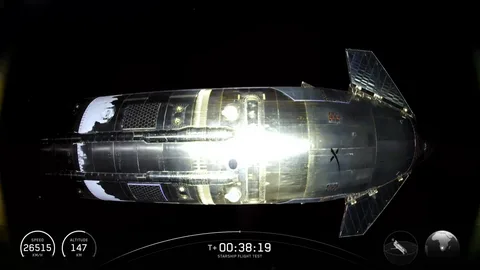
SpaceX successfully launched its brand-new Starship V3 rocket on Starship Flight 12 on Friday, May 22, 2026, marking the most powerful version of the megarocket ever to fly. The Starship launch lifted off at 6:30 p.m. EDT from a newly completed second pad at SpaceX’s Starbase facility in South Texas. While Ship 39 completed a controlled splashdown in the Indian Ocean, the Starship booster was lost after its recovery burn failed mid-flight.
Background: Why Starship Flight 12 Was So Anticipated
The gap between Starship Flight 12 and the previous test was the longest since the program began nearly seven months with no Starship launch since Starship Flight 11 in October 2025. SpaceX launched five Starship missions in 2025, but Flight 12 is the first of 2026. The delay was deliberate.
The gap between flight tests was because SpaceX was making crucial final preparations to a new version of Starship the iteration expected to embark on key missions in the years ahead, including lunar landings and eventually Mars. Engineers spent months redesigning core components to create Starship V3, a fundamentally upgraded vehicle from nose to engine bell.
SpaceX has a lot riding on this Starship V3 flight test. NASA has picked Starship to land its Artemis 4 astronauts on the moon in 2028. Beyond NASA, SpaceX is counting on Starship V3 to slash the cost of launching Starlink satellites and eventually support human missions beyond Earth orbit.
Details: What Happened During Starship Flight 12
Liftoff and Ascent
SpaceX launched its Starship V3 megarocket on Friday, May 22, from a recently completed second pad at its Starbase manufacturing and test facility in South Texas. Liftoff occurred at 6:30 p.m. EDT, sending the massive 408-foot-tall vehicle skyward on its 12th suborbital test flight.
One of the Super Heavy booster‘s 33 methane-fueled Raptor 3 engines shut down early during the climb out of the lower atmosphere, and additional engines failed to run properly during an attempt to fly the stage back to its planned splashdown point off the Texas Gulf Coast. Despite this, the rocket continued climbing and completed hot-stage separation cleanly.
Super Heavy Booster Lost
After stage separation, Super Heavy reoriented and attempted to perform a one-minute boostback burn toward Starbase. However, something went wrong and the burn didn’t go as planned. The massive Starship booster plummeted back to Earth and crashed into the Gulf, beaming live views of its fall from space until the screen went black.
On Starship Flight 12, SpaceX had already decided not to attempt a mechanical arm catch of the Starship booster at the tower. The company planned to return Super Heavy to a soft splashdown in the Gulf of Mexico rather than risk a recovery mishap that could damage the pad on the first flight of brand-new hardware. The crash into the Gulf, while not the intended outcome, did not damage any ground infrastructure.
Ship 39 Survives Reentry
SpaceX completed a largely successful test flight of its next-generation Starship rocket on Friday, deploying a clutch of mock satellites and executing a controlled splashdown in the Indian Ocean a high-stakes debut of the newly upgraded vehicle.
The Starship V3 upper stage did appear to survive reentry with no evidence of heat shield burnthrough, a stark contrast to earlier test flights. It executed a landing bank and flip maneuver, as well as a landing burn with just two of its three engines working.
Despite the issues, and only having two of its three engines lit for a landing burn, reentry and splashdown were smooth, and Starship made a controlled landing in the Indian Ocean before a fiery finish to the cheers of SpaceX employees.
The Scrub: What Delayed the Starship Launch
The Starship launch was originally planned for May 21 but did not happen as scheduled. SpaceX’s May 21, 2026 attempt to launch Starship Version 3 ended in a scrub due to a “hydraulic pin holding the tower arm in place did not retract,” according to Elon Musk’s social media post. Musk stated, “If that can be fixed tonight, there will be another launch attempt tomorrow at 5:30 CT.”
The scrub pushed Starship Flight 12 to May 22, where the Starship launch live coverage drew millions of viewers worldwide watching SpaceX’s first flight of the year.
Starship V3: What Makes It Different
Starship V3 is not simply an incremental update it is a ground-up redesign of the world’s largest rocket. The Starship V3 rocket stands 124.4 meters tall, measures 9 meters in diameter, and is capable of delivering up to 100,000 kg of payload to low Earth orbit. Its liftoff thrust reaches an extraordinary 80,800 kilonewtons.
The Starship launch tested more powerful Raptor 3 engines, enhanced control systems, and a host of other upgrades designed to streamline operations and improve safety and reliability. The Raptor 3 engines represent the third generation of SpaceX’s methane-fueled powerplant and are more efficient and simpler to manufacture than earlier versions.
The Starship V3 upper stage targeted multiple in-space and reentry objectives, including a payload deployment of 22 Starlink simulators similar in size to next-generation Starlink V3 satellites, plus two specially modified Starlink satellites. Those two modified satellites were designed to scan Starship’s heat shield during flight and transmit imagery to operators a critical data-gathering exercise for future missions.
Starship Flight 12: First Launch From New Pad 2
One frequently overlooked milestone of Starship Flight 12 is where it launched from. Starship Flight 12 was also the first Starship launch from the Second Pad at the Starbase launch and testing site. The addition of a second launch pad is a significant step toward SpaceX’s goal of flying Starship multiple times per week in future years, enabling a rapid-turnaround launch cadence essential for the economics of the program.
Quotes: Elon Musk and SpaceX React
Elon Musk praised the effort as “an epic first Starship V3 launch and landing!” on social media after the flight concluded.
SpaceX’s launch commentator noted during the Starship launch live broadcast that the Starship booster “didn’t complete its full boost back” after stage separation, setting expectations for a water impact rather than a controlled recovery.
A SpaceX team member present at the Indian Ocean splashdown zone described the moment: “It is one of the most magical feelings on Earth hearing the Starship crack down with its sonic booms, and watching it breeze through the sky.”
Impact: Why This Flight Matters Globally
The latest Starship launch achieved a key milestone for the vehicle following months of testing delays. The outcome could also boost investor confidence ahead of SpaceX’s initial public offering next month, expected to be the largest in history.The stakes extend far beyond investor sentiment. SpaceX is relying on the fully reusable Starship to dramatically lower launch costs for its human spaceflight projects, Starlink internet satellites, and plans for orbital data centers. A successful Starship V3 campaign is essential to keeping NASA’s Artemis lunar program on schedule.
SpaceX has already invested over $15 billion into Starship development, with $3 billion in R&D expenses for Starship reported in 2025 alone. The program is the most expensive and ambitious commercial rocket development effort in history, and Starship Flight 12 moves it meaningfully closer to operational readiness.
Conclusion: What Comes Next for Starship V3
Starship Flight 12 delivered a mixed but ultimately encouraging result. The Starship V3 upper stage proved it can survive reentry without heat shield burnthrough a major technical hurdle cleared. The loss of the Starship booster is a setback, but one that SpaceX anticipated by opting for a water splashdown rather than a pad catch on the first Starship V3 flight.
The road ahead for SpaceX includes pushing toward full orbital flight, in-orbit refueling demonstrations, and eventually crew-capable missions under the NASA Artemis program. Each Starship launch brings the program closer to the moment when Starship becomes not a test vehicle but a workhorse of deep space exploration.
The Starship V3 test campaign has begun and despite the Starship booster loss on Starship Flight 12, the program’s momentum is unmistakably pointing toward the moon, and beyond.
FAQs
What is the significance of the Starship V3 Ship 39 test campaign?
The Starship V3 Ship 39 test campaign beginning with Starship Flight 12 represents SpaceX’s push toward a fully operational, rapidly reusable heavy-lift rocket. Starship V3 is the baseline vehicle NASA requires for the Artemis 4 lunar landing mission in 2028. Ship 39’s successful reentry and Indian Ocean splashdown on May 22, 2026 validated key heat shield improvements, new Raptor 3 engine configurations, and the deployment mechanism for Starlink simulators. Each Starship launch in the V3 campaign builds the technical foundation for crewed lunar missions and eventually Mars transportation.
Does Elon Musk own 100% of SpaceX?
No, Elon Musk does not own 100% of SpaceX. He is the majority shareholder and CEO, but SpaceX has received significant investment from institutional and private investors over many funding rounds. As of early 2026, Musk holds an estimated 42–47% equity stake in the company, with the remainder held by investors, employees, and early backers. SpaceX recently filed IPO paperwork ahead of a public offering expected in mid-2026, which would further distribute ownership among public market shareholders. Even so, Musk retains effective control of SpaceX’s strategic direction through his ownership stake and leadership role.
How big is Starship V3?
Starship V3 is the largest and most powerful rocket ever built. When fully stacked with its Super Heavy booster, the vehicle stands approximately 124 meters (408 feet) tall taller than the Statue of Liberty with its pedestal. The rocket is 9 meters in diameter and generates a liftoff thrust of around 80,800 kilonewtons from its 33 Raptor 3 engines on the booster alone. Starship V3 is designed to carry up to 100,000 kilograms of payload to low Earth orbit in a fully reusable configuration roughly double the capacity of any other rocket currently in operation.