
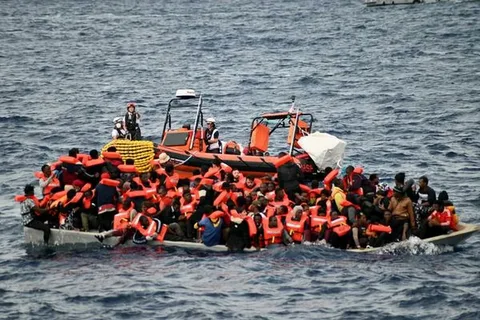
At least 144 refugees and migrants are dead or missing after a series of maritime incidents off the coast of Mauritania, the UN refugee agency confirmed this week. The tragedy adds to a growing list of the worst migrant boat disasters recorded on the increasingly deadly Atlantic route toward Europe.
Background
The Atlantic migration route running from West Africa toward Spain’s Canary Islands has become one of the most dangerous crossings in the world, alongside the Mediterranean refugee boat routes that have claimed thousands of lives in recent years. Long distances, unpredictable ocean conditions, and overcrowded, unseaworthy pirogues make survival difficult even when boats don’t sink outright.
Mauritania’s coastal waters, particularly the port cities of Nouadhibou and Nouakchott, have become key transit and rescue points along this corridor. According to UNHCR, 17 disembarkations have already been recorded in these two cities so far in 2026, with more than 2,100 people rescued and brought ashore.
This is not the first mass-casualty event in the region. In July 2024, a similar disaster near Nouakchott killed at least 15 people and left more than 190 missing after a pirogue carrying roughly 300 passengers capsized following seven days at sea. Migrant boat disasters off Mauritania have followed a grim, recurring pattern in recent summers.
Details
Between July 14 and July 18, Mauritanian authorities and UNHCR carried out three separate rescue and disembarkation operations in Nouadhibou, bringing 387 people safely ashore. But the operations also revealed the scale of a much larger tragedy.
The deadliest single incident involved a boat that left Bufaloto, Gambia, bound for Spain’s Canary Islands, roughly 1,677 kilometers away. The vessel drifted at sea for nearly 25 days after running out of fuel, leaving passengers without food or clean water and forcing many to drink seawater to survive. When the boat was finally reached on July 18, only 38 of the roughly 160 people on board were found alive.
UNHCR spokesperson Matt Saltmarsh told reporters in Geneva that two children among the survivors had lost their entire families during the journey and were recovering in hospital. He said it was not yet clear whether the deaths on board resulted from drowning, dehydration, hunger, or a combination of causes.
Separately, Mauritania’s Ministry of Fisheries reported that a boat carrying approximately 160 people that had departed from Gambia experienced its own crisis near Nouakchott, with 37 people rescued, one body recovered, and 122 others still listed as missing. Slightly different casualty figures reported by various sources reflect the chaotic, still-unfolding nature of rescue efforts along this stretch of coastline.
Overall, UNHCR said arrivals to Europe by sea across major routes have actually declined this year, with just over 40,000 recorded compared to more than 65,000 during the same period in 2025. Despite fewer crossings, the death toll on individual voyages remains devastatingly high.
Quotes
UNHCR said in a statement that it was “extremely saddened and concerned” by the reports coming out of Mauritania, describing the incidents as tragic maritime disasters that once again exposed the human cost of the Atlantic migration route.
The agency stressed that deaths and disappearances at sea continue at alarming levels, often occurring far from public attention, with entire boats sometimes vanishing without any trace or record of those on board.
UNHCR also called for governments to expand legal pathways for migration, urging “meaningful and quicker access to legal pathways through higher resettlement quotas, increased labour opportunities and education pathways” as safer alternatives to dangerous sea crossings.
Impact
The Mauritania tragedy underscores how the Atlantic route has increasingly rivaled the central Mediterranean as one of the world’s deadliest migration corridors. While the 2023 Pylos migrant boat disaster and the Adriana shipwreck drew global attention to the Mediterranean, disasters off West Africa often receive far less international coverage despite comparable death tolls.
For Mauritania, the repeated large-scale rescue operations place growing strain on local authorities, humanitarian partners, and coastal communities already stretched thin by previous incidents, including a 2024 disaster near the same coastline. The country has also received European Union funding aimed partly at curbing undocumented migration, a policy approach that critics argue does little to address why people continue attempting these dangerous voyages in the first place.
For the origin communities in Gambia, Senegal, and other West African nations, each mass-casualty event compounds an already devastating pattern of loss. Families frequently wait weeks or months without confirmation of whether relatives survived, a hardship mirrored in past Mediterranean refugee boat tragedies where bodies were never recovered.
Conclusion
With rescue operations in Mauritania ongoing and final casualty figures still being confirmed, humanitarian agencies say the disaster is unlikely to be the last of its kind this year. UNHCR has renewed calls for expanded legal migration pathways, warning that without them, people will continue risking their lives on overcrowded boats across both the Atlantic and Mediterranean routes.
As international attention shifts toward the latest tragedy, advocacy groups continue pushing for greater accountability and faster, more coordinated rescue capacity, lessons drawn directly from earlier disasters like the Adriana shipwreck, where delayed intervention was linked to a large number of deaths.
Frequently Asked Questions
What is a boat refugee?
A boat refugee, sometimes called a “boat person,” is someone who flees their home country by sea, usually aboard a small, overcrowded vessel, in search of safety or asylum elsewhere. The term dates back to the Vietnamese refugee crisis of the late 1970s and has since been applied to migrants and asylum seekers crossing dangerous waters worldwide, including the Mediterranean Sea and the Atlantic route between West Africa and Spain’s Canary Islands. Boat refugees are typically fleeing conflict, persecution, or severe economic hardship, and many depend on smuggling networks that charge significant fees for passage on vessels rarely built to carry the number of people packed on board.
Which country has the worst refugee crisis?
The answer depends on whether you’re measuring the number of people displaced, the number of refugees hosted, or the severity of humanitarian conditions on the ground. Syria, Afghanistan, and Ukraine have produced some of the largest refugee populations in recent history due to prolonged conflict, while countries such as Turkey, Iran, Pakistan, and Uganda host some of the highest refugee numbers globally relative to their own populations and resources. Along migration routes into Europe specifically, Libya, Tunisia, and increasingly Mauritania and Gambia have become major departure and transit points, making both the central Mediterranean and Atlantic corridors among the deadliest migration routes on the planet.
Is the boat people a true story?
“Boat people” is not a single story but a broad, well-documented term describing a real and ongoing global phenomenon spanning decades, from Vietnamese refugees fleeing by sea after the Vietnam War to today’s migrants crossing the Mediterranean and Atlantic Ocean. Various films, books, and documentaries have used the phrase as a title while dramatizing specific real events, but the underlying pattern of forced migration by sea is factual and continues today, as shown by recent tragedies including the Mauritania disaster and the 2023 Pylos migrant boat disaster, both of which resulted in significant loss of life.