
The Sahel crisis has entered a dangerous new phase after a deadly ambush near Anefis, northern Mali, killed at least 50 Malian soldiers on July 18, jointly claimed by a Tuareg separatist coalition and an al-Qaeda-linked group. The attack signals a troubling new level of coordination among armed groups across the wider Sahel region.
Background
The Sahel region has faced a worsening security crisis for more than a decade, driven by armed Islamist insurgencies, ethnic militia violence, and repeated military coups across Mali, Burkina Faso, and Niger. Foreign missions such as the UN’s MINUSMA and France’s Operation Barkhane both withdrew in recent years without fully suppressing the jihadist and separatist groups operating in the region.
Violent extremism in the Sahel has largely been driven by two major networks: Jama’at Nusrat al-Islam wal-Muslimin (JNIM), an al-Qaeda affiliate formed in 2017, and the Islamic State Sahel Province, formerly known as the Islamic State in the Greater Sahara. These two networks have often clashed with each other even as both fight government forces.
Since April 2026, fighting has escalated sharply across northern Mali, with Human Rights Watch documenting serious abuses committed by all warring parties. The UN recorded 2,640 conflict-related civilian deaths in the Central Sahel between January and March 2026 alone, underscoring the scale of the ongoing crisis.
Details
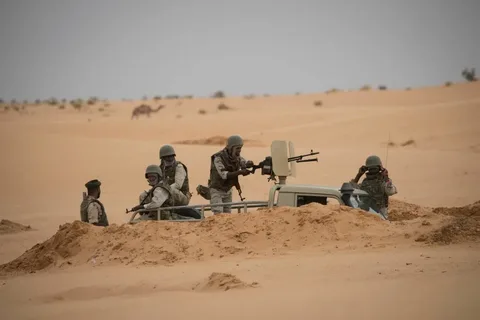
The July 18 ambush near Anefis struck a joint convoy of the Malian Armed Forces and Russia’s Africa Corps, the force that replaced the Wagner Group as Moscow’s military presence in the country. The attack was jointly claimed by the Azawad Liberation Front (FLA), a coalition of mostly Tuareg separatist groups, and JNIM.
What makes this alliance notable is that the two groups have historically pursued very different goals: the FLA seeks greater autonomy or independence for northern Mali’s Azawad region, while JNIM wants to establish governance based on its own interpretation of Islamic law across the wider Sahel. Héni Nsaibia, a senior West Africa analyst at the Armed Conflict Location and Event Data monitor, puts the cooperation down to a shared battlefield enemy rather than any shared ideology.
This is not an isolated incident. Since April, a series of coordinated operations across northern Mali have raised serious questions about whether Bamako’s security strategy, backed by growing Russian military support, is working at all. The Malian military confirmed the Anefis assault and said counter-operations had been launched, while Africa Corps released footage it said showed drone strikes targeting the fighters responsible.
Meanwhile, the Islamic State Sahel Province has continued operating largely independently in the tri-border area between Mali, Niger, and Burkina Faso, competing with JNIM for territory even as both groups put pressure on the region’s military governments. In response, Mali, Burkina Faso, and Niger, now governed under the Alliance of Sahel States (AES) after breaking from the West African bloc ECOWAS, have launched a joint military battalion aimed at fighting groups linked to both al-Qaeda and the Islamic State.
Quotes
Héni Nsaibia of ACLED explained the unusual battlefield cooperation directly, telling Al Jazeera that the Tuareg-led separatists and JNIM are currently fighting together because they share a common enemy in the Malian armed forces and their Russian partners from Africa Corps.
Burkina Faso’s interim leader, Captain Ibrahim Traoré, speaking at a recent AES summit in Bamako, announced plans for large-scale joint operations against armed groups in the coming days, though he offered few specifics on the timing or scope of the planned actions.
Mali’s President General Assimi Goïta struck a more optimistic tone at the same summit, reporting what he described as positive operational outcomes and claiming that several militant bases had been destroyed in recent operations, though these claims have not been independently verified.
Impact
The growing coordination between ideologically opposed armed groups has serious implications for regional stability. Analysts at the Stimson Center have warned that such alliances, even if temporary and built on convenience rather than shared goals, demonstrate a level of tactical sophistication that could further erode the authority of Mali’s ruling military junta.
The crisis also carries consequences beyond Mali’s borders. Fighting has increasingly spilled into neighboring Niger and Burkina Faso, and reports of similar insurgent violence have surfaced as far as northwestern Nigeria, where local officials have described recent attacks on farming communities as acts of terrorism.
For the millions of civilians living across the Sahel region, the human cost continues to mount. Displacement, food insecurity, and restricted humanitarian access have all worsened as fighting intensifies, while journalists, opposition figures, and human rights defenders in AES-governed states face growing restrictions, including arbitrary detention and enforced disappearances, according to rights monitors.
Conclusion
With JNIM, the Islamic State Sahel Province, and Tuareg separatist factions all operating across the same contested territory, often shifting between rivalry and convenience-based cooperation, the security outlook for the Sahel remains deeply uncertain. The coming weeks will likely test whether the AES joint battalion and continued Russian military support can meaningfully change the trajectory of a conflict that has already outlasted multiple foreign intervention efforts.
Analysts caution that military operations alone are unlikely to bring lasting stability unless the underlying political and governance grievances driving these alliances are addressed.
Frequently Asked Questions
What are the 5 countries in the Sahel?
The Sahel is often defined slightly differently depending on the source, but the core countries most commonly included are Mauritania, Mali, Burkina Faso, Niger, and Chad. Some broader definitions extend the region further to include parts of Senegal, Nigeria, Sudan, and Eritrea, since the Sahel is a geographic and climatic zone rather than a strictly political one, stretching as a semi-arid belt across the width of Africa between the Sahara Desert to the north and tropical savannas to the south. In terms of the current security crisis, most coverage focuses specifically on Mali, Burkina Faso, and Niger, the three states now governed under the Alliance of Sahel States.
What’s happening in Sahel?
The Sahel is currently experiencing one of the world’s most severe and complex security crises, driven by a combination of jihadist insurgencies, ethnic and communal violence, and political instability following a series of military coups in Mali, Burkina Faso, and Niger. Armed groups including JNIM and the Islamic State Sahel Province continue to contest territory with national militaries and each other, while recent developments have shown these groups occasionally cooperating with separatist factions like Mali’s Azawad Liberation Front when it serves a shared tactical purpose. The result has been rising civilian casualties, mass displacement, and a humanitarian emergency that continues to draw concern from international monitors and rights organizations.
What does Sahel stand for?
Sahel is not an acronym; it comes from the Arabic word “sāḥil,” meaning “shore” or “coast,” historically used to describe the region as the southern edge or shoreline of the Sahara Desert. The term reflects the area’s geography as a transitional zone between the arid Sahara to the north and the more fertile savanna regions of sub-Saharan Africa to the south. Over time, the name has come to refer not just to this physical landscape but also to the broader political and security region that spans multiple countries facing similar environmental, economic, and conflict-related challenges.