
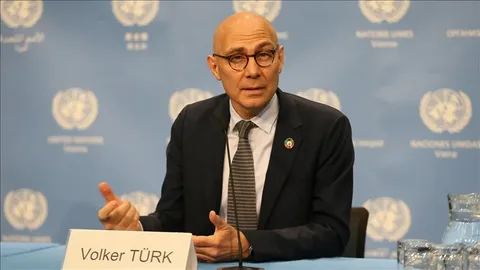
Volker Türk is an Austrian international lawyer and senior United Nations official who has served as the UN High Commissioner for Human Rights since October 17, 2022. He is the eighth person to hold this position, succeeding former Chilean President Michelle Bachelet. Born on August 27, 1965, in Linz, Austria, Türk has spent over three decades building one of the most distinguished careers in international human rights and refugee law.
He studied at the Khevenhüller Gymnasium in Linz before pursuing law at Johannes Kepler University Linz, where he earned his Master of Laws degree. He later completed his doctorate in international law at the University of Vienna, with his dissertation focused specifically on the mandate of the UN High Commissioner for Refugees. That academic foundation set the direction for his entire professional life.
Over the course of his career, Türk held key positions at UNHCR headquarters, serving as Director of the Division of International Protection from 2009 to 2015, Director of Organizational Development and Management from 2008 to 2009, and Chief of Section for Protection Policy and Legal Advice from 2000 to 2004. He also served UNHCR around the world, including as Representative in Malaysia, Assistant Chief of Mission in Kosovo and Bosnia and Herzegovina, and Regional Protection Coordinator in the Democratic Republic of the Congo.
Volker Türk Ethnicity and Nationality Is He Turkish?
One of the most commonly asked questions about Volker Türk is whether he is Turkish. The answer is no. Despite having the surname “Türk,” which means “Turk” in the German language, Volker Türk has no Turkish origin or connection to Turkey. Volker Türk was born on August 27, 1965, in Linz, Austria. He is Austrian by birth, nationality, and ethnicity. His family background is Central European, and he has spent most of his life working within European and international institutions.
The surname “Türk” is not uncommon in German-speaking countries, particularly in Austria and southern Germany, and does not indicate Turkish ancestry. Volker Türk’s Volker Türk ethnicity is clearly Austrian, and he has always represented Austria as his country of origin on the international stage. He speaks English, French, and German fluently, and has a working knowledge of Spanish all of which reflect his European academic and professional roots.
Volker Türk Parents and Early Life
Volker Türk was raised in Linz, one of Austria’s major cities, with a strong awareness of his country’s complicated 20th-century history. Like many of his generation, he was brought up keenly aware of Austria’s past and the atrocities committed during the Second World War. That historical consciousness appears to have deeply shaped his commitment to human rights and international law from an early age.
Detailed public information about Volker Türk parents their names, occupations, or backgrounds has not been disclosed by Türk himself or published in any official biographical sources. He has kept his immediate family life, including information about his parents, largely private throughout his career. What is known is that he grew up in a country where the memory of war crimes and human suffering remained a living national conversation, and that experience guided him toward a life of public service in humanitarian and human rights work.
Volker Türk Wife and Personal Life
Volker Türk is married, though he has largely kept the details of his family life out of the public sphere. What is known about his personal life comes from his own social media posts, where he has occasionally shared glimpses into his private world. In a notable post, Türk paid tribute to his father-in-law, Trần Văn Côn, who passed away at the age of 90. Türk described him as someone born in Vietnam who fled on a boat in the 1970s, lived in a refugee camp in Malaysia, was granted asylum in Switzerland, and rebuilt a new life with his family a symbol of kindness, resilience, and light.
This personal story carries significant professional weight. The fact that Türk’s own family has a direct connection to the refugee experience — through his Vietnamese father-in-law — adds a deeply personal dimension to the work he has dedicated his life to. His Volker Türk wife’s background is Vietnamese, and the connection to her father’s story as a refugee aligns in a remarkable way with Türk’s decades of professional work protecting refugees and stateless persons around the world.
Volker Türk Religion
Volker Türk has never publicly identified with any specific religion, and his Volker Türk religion remains a private matter that he has chosen not to discuss in public forums. He was raised in Austria, a predominantly Roman Catholic country, but there is no confirmed public statement or documentation indicating his personal religious affiliation or beliefs. His public statements and professional work reflect a broadly secular and humanistic worldview, centered on the universality of human rights regardless of religion, ethnicity, or nationality.
In interviews and speeches, Türk has often spoken about human dignity and rights in terms that are universal and inclusive rather than grounded in any particular religious doctrine. His professional mission, as he has described it himself, is rooted in the belief that human rights are the strongest tool we have to be a voice for those who do not have power, to speak truth to those who do, and to make sure they understand that there are limits to power.
The 2026 Vote: How Volker Türk Won His Second Term
The UN General Assembly on July 24, 2026, adopted a draft resolution to reappoint Volker Türk of Austria as the UN High Commissioner for Human Rights for a period of four years, beginning on October 12, 2026, and expiring on October 11, 2030.
The vote in the 193-member General Assembly to reappoint Türk was 144 to 10, with 13 abstentions. UN member nations rejected a US proposal to delay the vote until the end of the following week, as well as a Russian proposal to extend Türk’s term only until the end of the year.
The countries that voted against Türk’s reappointment included the United States, Israel, and Russia three powerful nations that have been subjects of criticism by Türk’s office during his first term. The opposition was vocal and sharp. The US State Department called the vote “another example of the UN’s inherent corruption and incompetence,” accusing Türk of turning “a blind eye to real atrocities” and instead pursuing a “radical ideological agenda.” Israel’s Foreign Ministry called the move a “moral failure” by Secretary-General Guterres.
Despite that pressure, the overwhelming majority of the international community backed Türk, reflecting broad support for the work his office has done and the importance of maintaining an independent human rights voice within the United Nations system.
Volker Türk Statement After Reappointment
Türk has consistently spoken in strong terms about the role of the UN rights office throughout his first term. After his reappointment was confirmed, the move was seen as a clear endorsement by the international community of the direction he has taken. During his tenure, he has issued statements on conflicts in Gaza, Ukraine, Sudan, Myanmar, and Afghanistan, frequently calling on governments to respect international humanitarian law and hold perpetrators of human rights violations accountable.
One of his defining Volker Türk statements on his vision for the role captures his philosophy clearly: “Human rights is the strongest tool that we have in our hands to be a voice of those who don’t have power and to speak truth to those who have the power and to make sure that they understand that yes, there are limits to power.”
UN spokesperson Stephane Dujarric said Secretary-General Guterres had followed UN rules and engaged in a very transparent manner in appointing Türk, including by holding prior consultations with member states and regional groups.
Volker Türk Salary and Net Worth
As UN High Commissioner for Human Rights, Volker Türk holds one of the most senior positions within the United Nations system. Senior UN officials at the Under-Secretary-General and High Commissioner level receive a salary that typically falls in the range of $220,000 to $250,000 per year, based on the UN’s publicly available pay scale for senior leadership positions. This compensation comes with additional benefits including housing allowances, education grants for children, medical coverage, and pension entitlements all standard for senior UN officials working internationally.
As for Volker Türk net worth, no verified public figure is available. His net worth is not officially disclosed, which is standard practice for UN officials. Estimates that circulate online are speculative and unverified, and should be treated with caution. Given his more than three decades of service within the UN system at senior levels, his accumulated compensation over time would place him comfortably in a financially secure position, though he is not known to be associated with any private wealth, business interests, or investment ventures.
Global Impact of Türk’s Second Term
The reappointment of Volker Türk carries significant implications for how the United Nations addresses human rights in an increasingly fractured global environment. His office has been outspoken on the conflict in Gaza, with Türk using the language of international humanitarian law to call attention to civilian casualties and humanitarian conditions in the territory. That position drew significant criticism from Israel and the United States, and their opposition to his reappointment is widely understood as a direct result of those statements.
His continued tenure means that the office will maintain its current direction on issues including climate change and human rights, digital rights, women’s rights, the rights of minorities, and accountability for atrocities. It also signals that despite political pressure from major powers, the broader international community remains committed to preserving an independent voice for human rights at the highest level of global governance.
Türk’s critics have said he could have done more to publicly follow up on a report issued by his predecessor, former Chilean President Michelle Bachelet, that said China’s detention of Uyghurs and other mostly Muslim ethnic groups in Xinjiang may amount to crimes against humanity. That tension with China is expected to continue into his second term.
Conclusion: What Comes Next?
Volker Türk begins his second term as UN High Commissioner for Human Rights in a world where the gap between human rights standards and political realities has never felt wider. From Gaza to Ukraine, from Myanmar to Sudan, the challenges facing his office are immense and the political headwinds are strong. The 144-10 vote in his favor, however, demonstrates that the vast majority of the world’s nations see value in having an assertive, independent human rights mechanism at the heart of the United Nations.
His personal story an Austrian lawyer raised with an awareness of his country’s darkest history, married into a family that lived the refugee experience firsthand gives him a connection to the issues he advocates for that goes beyond the professional. As he begins four more years in one of the most demanding and politically exposed roles in international diplomacy, the world will be watching closely whether that personal conviction translates into institutional impact.
Frequently Asked Questions (FAQs)
Who is the UN rights chief?
The current UN rights chief is Volker Türk, an Austrian international lawyer who has served as the United Nations High Commissioner for Human Rights since October 17, 2022. He was reappointed by Secretary-General António Guterres and confirmed by the UN General Assembly on July 24, 2026, with a vote of 144 to 10. His new term runs from October 12, 2026, to October 11, 2030. As the eighth person to hold this role, Türk leads the Office of the High Commissioner for Human Rights (OHCHR), which monitors human rights conditions worldwide, advises the Secretary-General, and engages with governments, civil society, and international bodies to promote and protect fundamental rights under international law.
Is Volker Türk a Turkish person?
No, Volker Türk is not Turkish and has no connection to Turkey or Turkish ethnicity. Despite his surname which means “Turk” in the German language and is found among German-speaking populations in Austria and Germany Volker Türk was born on August 27, 1965, in Linz, Austria, and is Austrian by birth, nationality, and ethnicity. The name is simply a German surname with no ethnic or national connection to the Republic of Turkey or to the Turkish people. This is one of the most frequently misunderstood facts about him, and it is worth clarifying that his Volker Türk ethnicity is fully Austrian and Central European.
What are Volker Türk’s beliefs?
Volker Türk’s core beliefs, as expressed consistently throughout his career and public statements, center on the universality, indivisibility, and interdependence of human rights. He believes that no government regardless of its size, power, or political system is above international human rights standards. Regarding Volker Türk religion, he has not publicly identified with any religious tradition, and his worldview appears to be broadly secular and humanistic. He has spoken extensively about the importance of human dignity, the protection of vulnerable populations including refugees and stateless persons, and the need for accountability when rights are violated. He has also made clear that he sees human rights not as a political ideology but as the foundational framework for peaceful, just, and stable societies.