
Thirty-Two Provinces Dream, Constitutional Storm, or Political Explosion
by Miyan Iftikhar Ahmed.
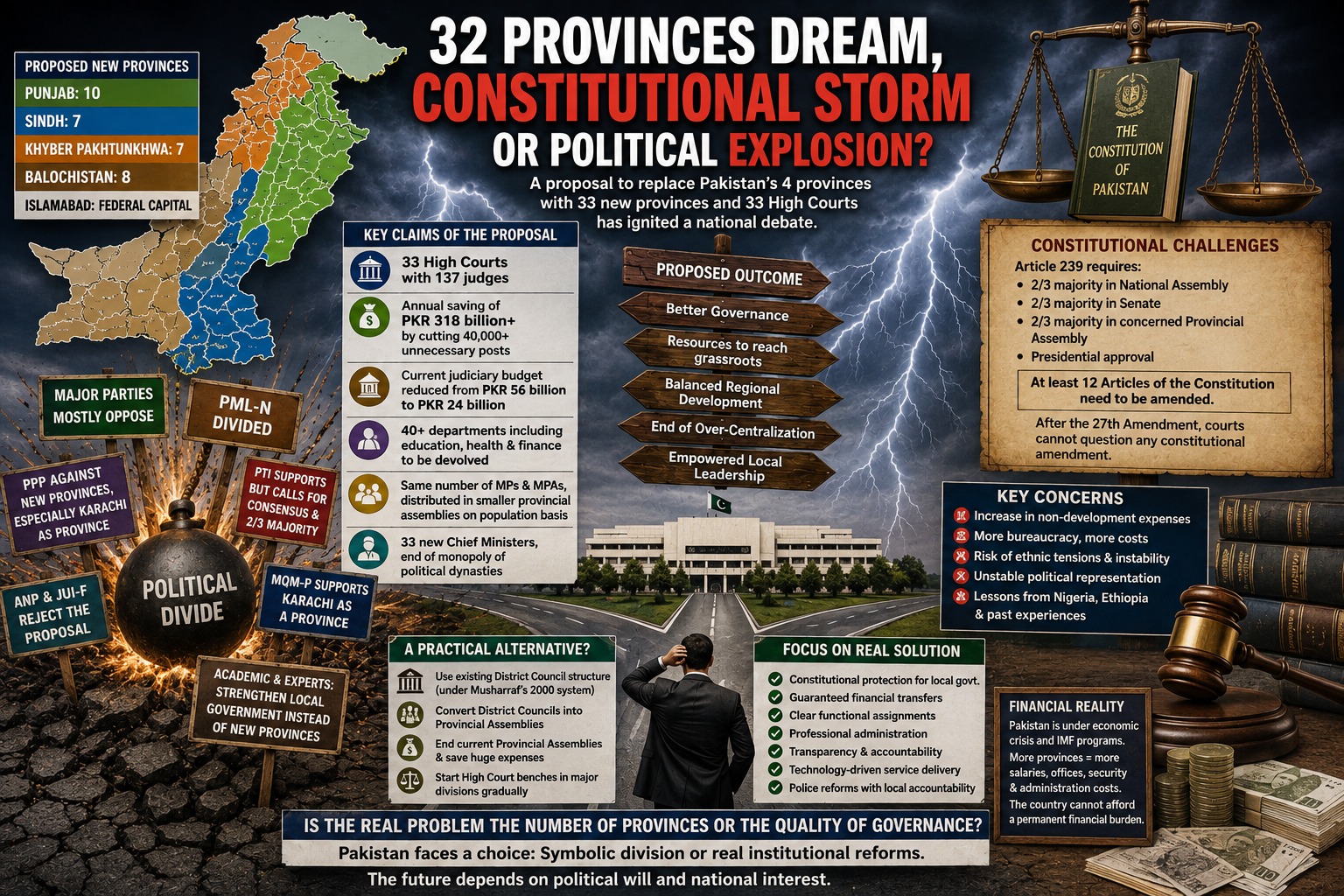
The proposal to create thirty-two new provinces and thirty-three high courts in Pakistan has revived an old constitutional and political debate that never reached its conclusion. This proposal, presented by Interior Minister Mohsin Naqvi during a speech at the Pakistan Economic Summit 2026, talks about abolishing the existing four provinces and replacing them with thirty-three new administrative units, with Islamabad remaining the federal capital while the current divisions of the four provinces are elevated to provincial status. Under the proposed scheme, Punjab would be divided into ten provinces, Sindh into seven, Khyber Pakhtunkhwa into seven, and Balochistan into eight, which would then require the establishment of thirty-three high courts across the country with a total of one hundred and thirty-seven judges to serve on them. According to the proposal, the elimination of over forty thousand unnecessary administrative positions would save the national exchequer three hundred and eighteen billion rupees annually, while the judiciary’s current budget of fifty-six billion rupees would be reduced to twenty-four billion rupees, and more than forty departments including education, health, and finance would be completely transferred to the new provinces. The total number of members of the national and provincial assemblies would remain the same, but they would be distributed among the smaller provincial assemblies according to population, and the creation of thirty-three new chief ministers would end the monopoly of a few specific political families while allowing new political leadership to emerge at the local level. The presentation argues that Pakistan’s current four provinces are larger in terms of population and area than many countries of the world, and even larger than the provinces of China and India, with twenty-five million children out of school, forty percent of children suffering from malnutrition, and Pakistan ranking one hundred and sixty-eighth out of one hundred and ninety-three on the Human Development Index, and that smaller administrative units would ensure resources reach the grassroots level and improve governance. This proposal is not merely an administrative plan but a political explosion that has divided the ruling coalition from within and created a strange restlessness in the opposition ranks as well. Mohsin Naqvi maintains that Pakistan’s current governance system has completely collapsed and is fundamentally incapable of solving the country’s problems and those new administrative units are the only solution. He called upon all political parties to sit together and resolve every important issue, including the creation of new provinces, and warned that if structural change does not come, the same debates will continue even ten years from now. But immediately after the announcement of this proposal, its effective endorsement came through a media briefing by the public relations wing, upon which senior Pakistan Bar Council member Salahuddin Ahmed wrote a two-page letter stating that this reveals a great deal about the source of the proposal and that he is surprised that some prominent members of the bar are suddenly issuing statements in support of it. He said he does not believe that the majority of lawyers support this proposal, nor does he think that the bar should play any role in establishing national debate or consensus on this issue, but rather that those who have formulated this proposal should themselves take responsibility for it. His most important point was that for years, the very voices that are now advocating for more provinces used to say that Pakistan’s biggest administrative problem was the excessive transfer of powers and resources to the provinces after the eighteenth amendment and the seventh National Finance Commission award, and now suddenly they are convincing us that the biggest administrative difficulty is that there are too few provinces, and he does not understand how anyone can debate the benefits of greater centralization and greater decentralization in the same breath. This proposal has also divided political parties into two opposing camps. Supreme Court Bar Association President Haroonur Rashid said during a full court reference held on the retirement of Justice Musarrat Hilali at the Supreme Court that the association supports the proposal for new provinces and considers it a step toward better governance through decentralization, fair administration at the grassroots level, equal opportunities for balanced economic development, and stronger political stability in the country. But the Pakistan Bar Council passed a resolution in its two hundred and fiftieth meeting stating that if the creation of new provinces is deemed necessary, it must be strictly carried out in accordance with the constitution, through parliamentary process and national consensus, and it authorized its vice chairman to convene a national seminar by inviting representatives of all parliamentary political parties and provincial bar councils to develop a broad-based national consensus. On the other hand, Pakistan Tehreek-e-Insaf chairman Barrister Gohar Ali Khan expressed support for new provinces by calling them a national necessity but emphasized a two-thirds majority and constitutional consensus, while Muttahida Qaumi Movement Pakistan supported the proposal by reiterating its old demand for making Karachi a province and called for a nationwide referendum. But in contrast, Pakistan Muslim League Nawaz is divided on this matter, where Prime Minister’s advisor Rana Sanaullah made it clear that this proposal is not part of the government’s agenda while Shahid Khaqan Abbasi supported it, and Pakistan Peoples Party has opposed the creation of new provinces in Sindh, particularly rejecting MQM’s proposal for making Karachi a province, and its Secretary General Nair Bukhari said that the constitution contains a complete procedure and neither new provinces nor any change in provincial boundaries is possible without a two-thirds majority in the relevant provincial assembly, the National Assembly, and the Senate. Sindh Chief Minister Syed Murad Ali Shah rejected the proposal, calling it an obsolete concept that his province’s people will never accept, and the National Party also unequivocally rejected the proposal and stated that further division of existing provinces is unacceptable. Notably, according to a report in Express Tribune, almost all major mainstream political parties including Pakistan Muslim League Nawaz, Pakistan Peoples Party, Pakistan Tehreek-e-Insaf, and Jamiat Ulema-e-Islam have opposed the creation of new provinces, while only Muttahida Qaumi Movement appears to support this proposal. In this surprising political scenario, participants at a one-day seminar organized by the Sustainable Development Policy Institute strongly emphasized that Pakistan does not suffer from a shortage of resources but rather public expenditure is failing to produce the desired impact because powers are concentrated in provincial capitals, and they supported strengthening the constitutionally guaranteed local government system instead of creating new provinces. PTI Secretary General Salman Akram Raja said that administrative units already exist and if the objective is service delivery to the people, the solution is to empower local government, and even dividing Punjab into three provinces would still leave approximately forty million people in each province, which would not provide the desired solution, and he dismissed the proposal for a national referendum on new provinces as absurd and said that the constitution already provides a procedure for this purpose. PPP leader Qamar Zaman Kaira warned that Pakistan is currently facing multiple challenges and debate on new provinces could further expose existing weaknesses, and the solution to narrow nationalism and terrorism is not sub-regional nationalism. Federal Parliamentary Secretary for Information Barrister Daniyal Chaudhry said that smaller provinces do not automatically mean better governance and the division of provinces would create more bureaucratic positions that would further complicate governance and become financially unsustainable. He said that governance reforms should aim to provide better, faster, and more accessible services to citizens at their doorstep, and any proposal for new provinces must be backed by a full financial impact assessment, and he called for a five to ten year financial evaluation. But the biggest challenge to this proposal is constitutional, and this is where the proposal resembles climbing a mountain. Under Article 239 of Pakistan’s constitution, any constitutional amendment must be passed by a two-thirds majority in both the National Assembly and the Senate, and more importantly, under clause four of Article 239, if a new province is to be created by altering the boundaries of an existing province, the amendment must also be passed by a two-thirds majority of the relevant provincial assembly, and the amendment cannot be presented to the President for assent unless it has been passed by at least a two-thirds majority of the total membership of the relevant provincial assembly. Constitutional experts say that a political announcement or resolution cannot automatically create a new province, and this process requires amendments to several articles of the constitution under Article 239, making the creation of a new province a far more complex process than a simple political announcement. PTI leader Farhatullah Babar said that the creation of new provinces would require amending at least twelve articles of the constitution, and he asked whether any province would currently agree to any change affecting its existing boundaries. Former Additional Attorney General Waqar Rana said that Pakistan’s constitution does not contain any clear provision for creating new provinces, whereas India’s constitution has clear provisions under Articles 2 and 3 for the establishment of new states, and clause four of Article 239 only addresses the limited issue of altering the boundaries of a province, and he said that the proper legal path is to first insert a clear provision in the constitution for creating new provinces and then proceed accordingly, which would require resolutions passed by a two-thirds majority from each provincial assembly. He warned that such important and far-reaching questions should not depend on the advisory opinion of the Federal Constitutional Court and that this issue is fundamentally political and courts should avoid entering the political arena. Pakistan Bar Council member Barrister Salahuddin Ahmed said that creating new provinces under Article 239 of the constitution would alter the boundaries of existing provinces, therefore a two-thirds majority would be required in the relevant provincial assembly as well as in the Senate and National Assembly, and those who are pushing this proposal could instead attempt to amend Article 239 itself through parliament to eliminate the requirement of provincial assembly approval. In this context, another important point is that after the twenty-seventh constitutional amendment, clause five of Article 239 now states that notwithstanding anything contained in the constitution or any judgment of any court, no court shall have any jurisdiction to question any constitutional amendment on any ground whatsoever. Political analysts have speculated that the government wants to introduce constitutional amendments to bypass the provincial assembly approval requirement, and then hold a referendum on new provinces through the Election Commission of Pakistan. But PPP Secretary General Nair Bukhari said that referendums are held on matters on which the constitution is silent, while a proper procedure for creating new provinces already exists in the constitution, and even in the case of a referendum, the proposal must first be approved by the federal cabinet and then presented to a joint session of parliament. He said that the government has not yet consulted their party on this matter and the Prime Minister and other political forces should first take political parties into confidence and consult their leaders. Jamiat Ulema-e-Islam Senator and legal expert Kamran Murtaza said that the government appears determined to create twenty-seven new provinces, and they could first secure constitutional amendments and then move toward a referendum through the Election Commission. Pakistan Institute of Legislative Development and Transparency President Ahmed Bilal Mehboob said that the government should first establish a commission to examine the financial, administrative, and political aspects of creating new provinces. Former Senator Mustafa Nawaz Khokhar said that a national debate on the necessity and benefits of new provinces is urgently needed, but when a government lacking public confidence and a non-representative assembly raises such a sensitive issue, conflict becomes inevitable, and he urged the government to hold free and fair elections and allow political parties to include their position on new provinces in their election manifestos. But the most interesting and important aspect of this proposal is its comparison with the local government system of the Musharraf era, and this is where an alternative and more practical path becomes visible. General Pervez Musharraf introduced a new local government system in August 2000 called the Devolution of Power Plan or district government system, under which a new government structure was established at the district, tehsil, and union council levels and a district council was created in each district headed by a district nazim. This system claimed to be transferring administrative and financial powers to the local level, but it was implemented despite opposition from political parties and was seen as a tactic to legitimize military rule. An important feature of this system was that it created a parallel government structure at the local level without abolishing provincial governments, while the current proposal for thirty-two new provinces talks about abolishing the provincial structure altogether and redistributing it anew. But an important question is whether the objective would be achieved and costs would also be saved if the existing structure of Musharraf’s district system is used to give them provincial status and the existing provincial assemblies are abolished. Under Musharraf’s 2000 system, district governments were established in one hundred and one districts and the structure of district councils still exists today, while the current proposal talks about making divisions into provinces, of which there are thirty-three, which is far fewer than one hundred and one districts. If the existing offices, staff, and infrastructure of district councils are converted into provincial assemblies, the costs of new buildings, secretariats, and staff could be avoided, and the savings from abolishing existing provincial assemblies could cover twenty-five percent of the required expenditures, which would eliminate free facilities, reduce the burden on the people, and leave only the National Assembly and Senate intact. This would not only achieve the objective but also save heavy costs because district councils already have seventy-five percent of the required structure, and many large divisions are demanding high court benches which could be started from larger divisions and gradually extended to every division. But this alternative path also faces constitutional and political obstacles, because abolishing provincial assemblies would require major constitutional amendments and existing provincial governments and political parties would strongly oppose it because their existence and powers would be eliminated, and Pakistan’s constitution is based on a two-tier system of federation and provinces, and abolishing provincial assemblies would amount to changing the very foundations of the constitution. However, this alternative path is important because it indicates that the objective of administrative improvement and fair distribution of resources cannot be achieved only by creating new provinces, but can also be achieved by making the existing structure more efficient and appropriate. The financial aspects of this proposal are also extremely important and cannot be ignored. According to a report by the Governance and Transparency Think Tank, the creation of new provinces would significantly increase non-development expenditures, including the costs of governor offices, cabinets, secretariats, high courts, and expanded bureaucracy, which would divert scarce resources from essential public services. Experts have warned that additional provinces could empower political and bureaucratic elites, promoting patronage networks rather than citizen-centered governance, as has been seen in countries like Nigeria and Ethiopia. Provincial division would also destabilize political representation because Pakistan’s Senate gives equal representation to each province, and adding new provinces would change this balance, potentially increasing inter-provincial tensions. Ethnic tension is another major risk because existing provinces have internal balances that moderate nationalist pressures, and redrawing boundaries on ethnic lines could intensify separatist or nationalist movements. Proposals for an Urdu-speaking majority province in Sindh could reignite debate over the controversial Jinnahpur project, and new provinces in Balochistan could fuel rather than resolve ethnic or tribal nationalism. Experts say that instead of territorial division, Pakistan should strengthen local government to effectively deliver services and restore public trust. Past experiences, including the devolution experiment from 2001 to 2009, proved that accountable local institutions can improve delivery of infrastructure, water, sanitation, and electricity services, and the failures of previous reforms were mostly due to provincial resistance, inadequate financial transfers, and political interference rather than design flaws. The GTTN report outlined eight key reforms to make local governance effective, including constitutional protection for local government, guaranteed transfers with genuine financial autonomy, clear functional assignments, an appropriately sized multi-tier system, professional administration with political accountability, robust transparency and oversight, technology-driven service delivery, and police reforms with local accountability. Experts say that these steps offer a sustainable path to better governance, citizen satisfaction, and strengthening trust in the state, and constitutional protection is necessary so that local government cannot be abolished for political convenience. Financial autonomy requires that at least thirty percent of provincial revenues be automatically transferred to local authorities, and a clear functional assignment would ensure that services like education, health, water, sanitation, and local roads are the responsibility of local councils. In this entire scenario, an important question is whether Pakistan can bear the permanent financial burden of such reorganization in its current financial state. Pakistan is currently going through one of the most difficult economic crises in its history and is dependent on successive International Monetary Fund programs, each of which comes with familiar conditions: widening the tax base, improving revenue collection, and most importantly, limiting non-development expenditures. Each new province requires its own elected assembly, chief minister, governor, cabinet, provincial services, and an expanded bureaucracy to keep the machinery of government running, and these are not one-time costs but salaries, pensions, official residences, transportation, security arrangements, and departmental establishments that continue year after year, and recurring expenditures would increase considerably at a time when the IMF is pressuring Pakistan to reduce governance costs rather than increase them. Therefore, the most important question raised by this proposal is whether Pakistan can bear the permanent financial burden of such reorganization in its current financial state. History also provides an important lesson in this regard. General Pervez Musharraf’s devolution plan was introduced with the declared objective of bringing government closer to the people, but instead of strengthening existing institutions, it attempted to replace an entire administrative framework in one stroke, resulting in the disappearance of deputy commissioners and commissioners and the emergence of a new district government system that collapsed within a decade or more. Another consequence that received little attention was that the old district administration was part of a long-established administrative and security framework, and when this structure was dismantled, important links of coordination and control weakened, and later rebuilding them proved far more complex than dismantling them. The major lesson is that institutions, political and institutional, do not develop in isolation but grow and develop with the society that creates them, over time, through continuity, and Pakistan’s constitutional journey has seen repeated disruptions and each disruption broke the continuity through which political institutions normally develop, and the deeper question is what effect these repeated disruptions have on the evolution of the state. In conclusion, this proposal for thirty-two new provinces is more of a political statement than an administrative reform, and its chances of becoming reality in the current political situation are almost negligible. It requires amendments to at least twelve articles of the constitution, a two-thirds majority in the National Assembly, Senate, and all four provincial assemblies, and then presidential assent, while all major mainstream political parties oppose it and the ruling coalition itself is divided on this matter. But this proposal has generated an important debate on whether Pakistan needs to change its administrative structure and if so, how. The alternative path of using the existing structure of Musharraf’s district system to abolish provincial assemblies and convert district councils into provincial assemblies, although constitutionally and politically difficult, indicates that there can be different paths to achieving the objective that avoid heavy costs and make the existing structure more efficient. But beyond that, this proposal raises a fundamental question: is Pakistan’s real problem the number of provinces or the quality of governance? Will creating new provinces improve education, health, and human development indicators, or is it merely an expensive and fruitless game of redrawing the political map? According to GTTN experts, Pakistan faces a dual choice: the symbolic, politically attractive path of new provinces, which risks further worsening governance and ethnic tensions, or the difficult but sustainable path of genuine institutional reform, and active decentralization offers tangible improvements in citizens’ lives while provincial division risks deepening profound ineffectiveness. In view of all these facts, it is not difficult to say that this proposal for thirty-two new provinces is indeed an explosion, but its explosion will remain silent until Pakistan’s political parties set aside their interests and find some concrete and practical path in the national interest, and until then this proposal will remain nothing more than an interesting debate and a reminder that Pakistan faces real governance problems whose solution will not come merely by redrawing the map.