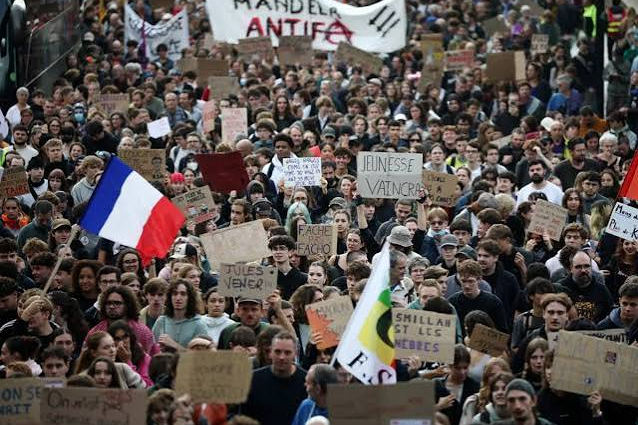

France youth protests have become one of the most closely watched social movements in Europe this year. High school and university students, later joined by unions, are demanding better schools and relief from rising prices. Tens of thousands of people still march in major cities every Saturday, according to an analysis published by Dawn.
Background: How the France Student Movement Began
The France student movement did not start in Paris. Dawn’s analysis by political scientist Laurent Gayer says it began in late August in Mayotte, an overseas department in the Indian Ocean. It then spread to poorer suburbs of Greater Paris such as Créteil and Saint Denis, where many students come from families with North African or Sub Saharan African roots.
In September 2026, students began calling for more teaching staff, renovated school buildings and the end of Parcoursup, the platform used to apply for first year university places. At the same time, calls against the high cost of living spread on social media, outside the control of traditional unions. A similar “block everything” attempt in September 2025 had failed, so intelligence agencies did not take the new call seriously.
Pressure on higher education explains part of the anger behind the France youth protests. In 1980, about 40 percent of an age group earned the baccalaureate, while today the figure is 80 percent. University funding has stayed flat, so places are limited. Students say Parcoursup is opaque, stressful and unfair, and you can find more explainers on education and youth politics on our site.
Details: What Happened During the France Youth Protests
The Day of 17 October
Between 550,000 and 800,000 people took to the streets on 17 October. Students were joined by cost of living protesters, supporters of the Yellow Vest movement and far left activists. Some attacked police and official buildings, while others looted shops. The town halls of Limoges and Marseille were damaged, and the government imposed curfews in several cities.
The mood changed from place to place. In parts of Paris, Marseille, Lyon, Nantes, Rennes and Bordeaux, clashes with police came close to an uprising. Elsewhere, crowds in costumes turned the streets into something closer to a carnival, with people of different ages, classes and backgrounds marching together.
A Movement Built Online
Unlike earlier waves of unrest, these France youth protests were organised mostly through social media and messaging apps such as Snapchat. Each morning, students gathered dustbins and building materials to block school entrances. On 1 October, around 200 students walked and ran through Saint Denis, visiting one school after another to recruit more participants.
Pop culture shaped the look of the movement. Placards mixed images from the 1789 Revolution with references to Mario, Star Wars, the Hunger Games and One Piece. Slogans first shared online were repeated at marches, which helped the France student movement build a shared identity. As one student explained, education works as a weapon against disinformation.
Government Concessions
On 28 October, the government led by Sébastien Lecornu offered a Parcoursup reform and 15,000 extra places in higher education. Students had asked for 200,000 new university posts, so many consider the offer too small. Gayer writes that budget limits make further concessions unlikely for now. Readers can follow related world news and analysis as the story develops.
Impact: Policing, Divisions and the Gen Z Pattern
The French Police Crackdown
The French police crackdown has been severe. As of 17 November, at least 155 people had suffered serious injuries from explosive weapons used by law enforcement. These include 11 eye losses, seven amputations and 18 fractured skulls. Between mid September and mid November, more than 12,000 protesters were taken into custody, most of them minors. During the Yellow Vest movement of 2018 and 2019, the number was 6,730.
Officials have taken a hard line. Interior Minister Laurent Nuñez urged officers to show no restraint, while Justice Minister Gérald Darmanin asked judges to be merciless with looters. Anger toward police has grown among young people, yet a Sciences Po CEVIPOF poll still shows 73 percent confidence in the police nationwide.
Parents, Far Right Groups and Divided Streets
The France youth protests have also exposed deep divisions. On 24 October, far right militants assaulted demonstrators in about a dozen cities, claiming to protect shopkeepers. Investigations followed after reports that police cooperated with some of these groups. Meanwhile, parents in several cities organised on WhatsApp to help police clear school blockades, which led to scuffles with students.
Hundreds of the country’s 3,700 high schools are still disrupted, although the Education Ministry reportedly plays down the figures. Large scale looting has not returned, but tension remains high around the cost of living protests in France and the school closures.
Part of a Wider Gen Z Wave
These Gen Z protests echo recent youth movements in Indonesia, Bangladesh, Nepal, Madagascar, Morocco and Peru, and more recently in Albania, Belgium, Italy and Germany. Young people share online tools, symbols and humour across borders. For readers following global youth movements, the French case shows how local grievances can take a worldwide cultural form.
Still, the comparison has limits. In Nepal and Madagascar, protesters toppled governments. In France, the Macron government and the Lecornu cabinet survived, and most students have not made resignation their main demand. Their criticism targets elites they see as too close to wealthy interests and the far right. Attention is now turning to the presidential election in April and May 2027.
Frequently Asked Questions
What are the France youth protests about?
The France youth protests combine several demands. Students want more teachers, repaired schools and a replacement for Parcoursup, while many protesters also object to the rising cost of living. A deeper fear of the far right gaining power in 2027 has helped unite young people from wealthy and poorer areas alike.
Who started the France student movement?
According to Dawn’s analysis, the France student movement began in late August in Mayotte. It then spread to poorer suburbs near Paris and later reached students at prestigious city centre schools. It was organised mainly through social media, not by traditional unions, although unions joined from October.
How serious is the French police crackdown?
Reported figures are significant. At least 155 serious injuries had been recorded by 17 November, and more than 12,000 people were detained between mid September and mid November. Many were minors. The government has defended order, and a poll still shows high public confidence in the police.
Are these Gen Z protests similar to those in Nepal or Madagascar?
They share features such as youth leadership, online organising and pop culture symbols. However, protesters in France have not tried to topple the government, and their criticism focuses on elites rather than family favouritism. The government has also remained in office despite the unrest.
Has the government responded to the Parcoursup reform demand?
On 28 October, the government announced a Parcoursup reform and 15,000 extra higher education places. Students called this too limited compared with their demand for 200,000 new university posts. Further concessions look uncertain because of budget pressure, so protests may continue into the 2027 election season.