
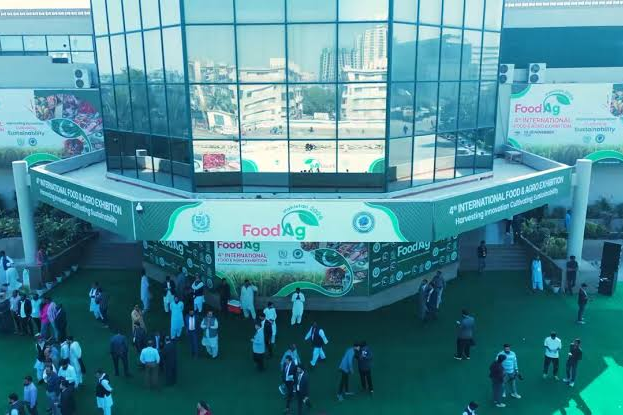

Commerce Minister Jam Kamal has said that FoodAg Pakistan recorded a significant rise in international delegates this year, despite regional tensions and concerns over disruptions around the Strait of Hormuz. He inaugurated the 4th International Food and Agro Exhibition at the Expo Centre Karachi on Monday. The four day event runs from November 23 to 26 and is seen as a major platform for Pakistan food exports.
Background: Why FoodAg Pakistan Matters
FoodAg Pakistan has grown into one of the country’s most visible trade events for farmers, processors and exporters. Over the past four years, the exhibition has given the agro food sector a direct route to foreign buyers and investors. For a country that depends heavily on agriculture, such a platform carries real commercial weight.
The event is organised by the Trade Development Authority of Pakistan (TDAP), which works to expand the country’s exports in global markets. This year’s edition arrives at a sensitive time. Rising crude oil prices, higher freight costs and regional uncertainty have made international trade harder for many exporters.
Even so, organisers say interest in FoodAg Pakistan has not weakened. The minister said new international markets send representatives every year, which he described as a sign of growing global curiosity about Pakistan’s agricultural and food products.
Details: What the Exhibition Offers
Scale of Participation
According to the information shared at the inauguration, the TDAP exhibition in Karachi brings together 400 Pakistani exhibitors and 820 international delegates from 72 countries. That is a wide international reach for a trade show still in its fourth year. The numbers suggest that overseas buyers continue to see value in travelling to Karachi.
The ceremony was attended by dignitaries, international delegates, senior government officials, representatives of regulatory authorities and members of the business community. Their presence reflects the importance attached to the agro food sector in Pakistan’s wider economic plans.
Sectors on Display
The exhibition covers a broad range of products. Participating sectors include rice, fruits and vegetables, fruit pulp and beverages, and meat, poultry, dairy and fisheries. Seafood, cereals, spices, salt, honey and food ingredients are also on show.
Processed foods form another large segment. Visitors can find biscuits, confectionery, sweets, pasta, snacks, ketchups, sauces and jams. Food related services are also part of the exhibition, which gives the event a full value chain focus rather than a narrow product display.
Business to Business Meetings
The minister highlighted the importance of business to business meetings at FoodAg Pakistan. These sessions allow Pakistani companies to speak directly with international buyers, discuss pricing and negotiate supply terms. For small and medium exporters, such access can be hard to arrange on their own.
Direct meetings also help Pakistani suppliers understand buyer requirements, including packaging, quality standards and delivery timelines. Many exporters say this kind of feedback is as valuable as the orders themselves.
Quotes and Statements from the Minister
Speaking to the media after the inauguration, Jam Kamal said FoodAg had become a highly encouraging initiative for Karachi and for Pakistan. He said it offered agricultural producers, exporters and businesses valuable opportunities to connect with foreign buyers and investors.
The minister acknowledged that rising crude oil and freight costs had created challenges for international trade. He added, however, that Pakistan’s economic indicators remained positive. He also said that, for the first time, Pakistan’s services exports crossed the $1bn mark, while agriculture, IT and textiles played a significant role in exports over the last eight months despite an uncertain global situation.
On wheat, he clarified that procurement and supply requirements are determined by provincial governments and fulfilled by the federal government. Regulating flour prices in Karachi, he said, falls within the provincial and administrative domain. He urged the provinces to prepare accurate data on stocks, demand and supply, and the production of wheat and sugar.
Jam Kamal also spoke about trade with neighbours. He said a number of Chinese companies operate in Pakistan and that talks are underway to sell Pakistani products to China. He noted that annual imports from China hover between $17 billion and $18 billion, while exports stand at around $3 billion.
On Afghanistan, he said trade had been hit, but that national security is necessary. He added that Pakistan has urged Afghan authorities to take strict action against elements using Afghan soil against Pakistan.
The minister further said that the powers and resources given to provinces under the 18th Amendment and the National Finance Commission should extend to district levels. He said consumers need access to local administrations to resolve their issues, and that the administrative structure should be decided by mutual consensus. For more business coverage like this, readers can visit South Asian Chronicle.
Impact: What It Means for Pakistan’s Economy
The strong turnout at FoodAg Pakistan points to steady foreign interest in Pakistani rice, seafood, fruits, spices and processed foods. If even a share of the meetings turn into confirmed orders, exporters could see better earnings in the months ahead. That would also help the wider effort to widen Pakistan’s export base beyond textiles.
Karachi stands to gain as well. As the country’s main commercial hub and port city, it benefits when exporters, logistics firms, packaging suppliers and service providers all see more business. Trade shows of this size also raise the city’s profile among international buyers.
Regionally, the event shows that Pakistan wants to remain visible in global food supply chains even when shipping routes and energy prices are under pressure. Analysts often note that reliable freight and stable energy costs are essential for the agro food sector. Readers interested in wider economic trends can explore the business and economy section on our website.
There are still hurdles. Higher freight costs can squeeze profit margins, and trade with some neighbours remains disrupted. Exporters will need consistent quality, timely deliveries and clear data from provinces to turn goodwill into long term contracts.
Conclusion: What Comes Next
FoodAg Pakistan 2026 has reinforced the idea that the country’s agro food sector has real export potential. With 400 exhibitors, 820 delegates and 72 countries involved, the exhibition is doing what it was built to do, which is to connect Pakistani producers with the world.
The next test lies in follow up. Business meetings must become signed agreements, and agreements must become shipments. If that happens, FoodAg Pakistan could keep growing as a reliable platform for Pakistan food exports. Stay with South Asian Chronicle for further updates on trade, exports and the economy.
Frequently Asked Questions About FoodAg Pakistan
What is FoodAg Pakistan?
FoodAg Pakistan is the International Food and Agro Exhibition held in Karachi. It is organised by the Trade Development Authority of Pakistan and is designed to connect Pakistani producers, processors and exporters with foreign buyers and investors. The 2026 edition is the fourth, and it covers a wide range of food and agricultural products.
When and where is FoodAg Pakistan 2026 being held?
The exhibition takes place at the Expo Centre Karachi from November 23 to 26, 2026. It was inaugurated on Monday by Commerce Minister Jam Kamal. The four day schedule gives exhibitors and visitors enough time for product displays, networking and scheduled business meetings.
How many exhibitors and delegates are taking part?
The exhibition brings together 400 Pakistani exhibitors and 820 international delegates from 72 countries. The minister said the event saw a significant increase in delegates this year, even though concerns about regional tensions and disruptions around the Strait of Hormuz could have affected participation.
Which products and sectors are featured?
Visitors can see rice, fruits and vegetables, fruit pulp and beverages, meat, poultry, dairy, fisheries and seafood. Processed foods such as biscuits, confectionery, sweets, pasta, snacks, ketchups, sauces and jams are also featured. Cereals, spices, salt, honey, food ingredients and food related services complete the list.
How does FoodAg Pakistan help the country’s exports?
The exhibition lets Pakistani businesses meet international buyers face to face, which can speed up negotiations and build trust. Business to business meetings are a key feature. Over time, such contacts can lead to new export contracts, wider market access and stronger earnings for the agro food sector.