
The Ink that Ousted Chains: How Enslaved African Muslims Used Faith and Literacy to Resist
When historians estimate that somewhere between one in ten and one in three Africans forced into American slavery practiced Islam, it reframes a piece of history most people never learn in school. These were not converts encountering a foreign religion in the New World. They arrived already literate in Arabic, already trained in Quranic recitation and Islamic law, carrying an intellectual and spiritual tradition that slaveholders had no framework for understanding. That gap between what enslavers assumed about the people they bought and who those people actually were became, for a number of remarkable individuals, a narrow but real space for resistance.
A Faith Slaveholders Could Not Read
The plantations of the antebellum South were not built to accommodate literate captives, let alone captives literate in a language their masters couldn’t read. Many enslaved Muslims came from regions of West Africa, including Futa Toro, Futa Jallon, and the Niger Bend, where Quranic schooling was widespread and a command of Arabic functioned as both religious devotion and practical skill. Slaveholders frequently mistook Arabic writing for a curiosity or a parlor trick. They had no way to verify what was actually being written, and that blind spot is exactly where some of the most striking acts of quiet defiance took place: enslaved scribes asked to copy out a Bible verse or the Lord’s Prayer for an enslaver’s amusement would instead write passages from the Quran, genealogies of their own families, or pleas to be allowed to return home.
Sylviane Diouf, whose 1998 book Servants of Allah: African Muslims Enslaved in the Americas remains the most thorough scholarly treatment of this history, has argued that literacy was one of the most distinguishing marks separating enslaved Muslims from the broader enslaved population, and from many of their captors as well. Arabic became a covert channel. Bilali Mohammad and Salih Bilali, two prominent enslaved Muslims on neighboring Georgia sea islands, were known to correspond as “intimate friends.” Omar ibn Said exchanged letters with Lamine Kebe. None of it could be policed by people who couldn’t read a word of it.
Omar ibn Said and the Only Surviving Arabic Slave Narrative
The best-documented case is also the most haunting. Omar ibn Said was born around 1770 in Futa Toro, in what is now Senegal, to a family with the means to give him roughly 25 years of Islamic education: Quranic study, Arabic, theology, law. He had already married, had children, and made the pilgrimage to Mecca by the time an invading army captured him and sold him into the transatlantic trade. He arrived in Charleston around 1807, just before the legal close of the international slave trade, and was bought by a man he later described, in his own words, as small and lacking in either kindness or faith.
Ibn Said escaped. He was caught in Fayetteville, North Carolina, and thrown in jail, where he did something that would define the rest of his life: he began writing on the walls of his cell in Arabic. Word spread of an enslaved man producing elegant, incomprehensible script, and General James Owen came to see for himself, then bought him. Ibn Said spent the remainder of his life, more than fifty years, enslaved in the Owen household, where his literacy made him a minor local celebrity and, by most accounts, spared him the harsher physical labor faced by enslaved people without his particular value as a curiosity.
In 1831, at the request of associates intrigued by his story, ibn Said wrote a fifteen-page autobiography in Arabic. It remains the only known autobiography written by an enslaved person in the United States in their native written language. Owen’s household pushed him toward Christianity, supplying him with an Arabic translation of the Bible and eventually claiming his conversion. Ibn Said was baptized and joined a Fayetteville Presbyterian church. But scholars who have studied his surviving writings, including the recent translations and analysis by Mbaye Lo and Carl Ernst, point out that he opened his autobiography with a Quranic verse asserting Allah’s sovereignty over the world, and his fourteen known Arabic manuscripts continued to draw on Islamic texts and invoke Allah for the rest of his life. Whether his Christianity was genuine, performed, or some unresolved blend of both is a question his own writing leaves permanently open, which may itself have been the point: in a system designed to strip away every form of self-determination, ambiguity about his inner life was one of the few things ibn Said could still control.
Bilali Mohammad’s Manuscript and the Sapelo Island Community
On Sapelo Island, off the Georgia coast, a different kind of resistance took shape: not individual concealment but organized community. Bilali Mohammad, born around 1770 in Timbo, in the Futa Jallon region of present-day Guinea, was enslaved first in the Bahamas and then sold to Georgia planter Thomas Spalding around 1802. His literacy and evident leadership qualities led Spalding to make him head driver over a plantation population sometimes numbering in the hundreds, an unusual position of authority for an enslaved man, won largely because his owner came to trust him.
Bilali used that trust to sustain an openly practicing Muslim community. He served as imam to as many as eighty enslaved men on the island, leading them in prayer five times a day, observing Ramadan, and reportedly organizing them, with his master’s blessing, to help defend against a British landing during the War of 1812. When Bilali died around 1857, his family found a thirteen-page manuscript he had written in Arabic. For decades it was assumed to be a personal diary. Closer scholarly analysis eventually identified it as something more significant: a transcription, apparently from memory, of a North African Islamic legal treatise, the kind of text used to teach Muslim jurisprudence. Bilali had, in other words, reconstructed a piece of his religious curriculum from memory on a Georgia plantation, almost certainly to keep teaching it to others. His friend and fellow Fula scholar Salih Bilali held a similar position of trust on neighboring St. Simons Island, and the two men’s correspondence, along with the persistence of Arabic literacy and Islamic practice among their descendants well into the twentieth century, recorded by Works Progress Administration interviewers in the 1930s, suggests a Muslim community on the Georgia sea islands that endured for generations under conditions designed to erase it.
Ayuba Suleiman Diallo: Faith as Leverage
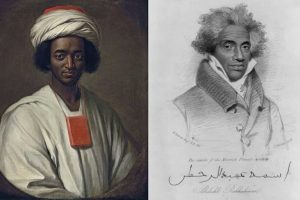
Not every story ended in lifelong bondage. Ayuba Suleiman Diallo, who became known to his enslavers as Job ben Solomon, was captured in the Senegal River region and enslaved in Maryland in the 1730s. He had memorized the entire Quran by age fifteen, and according to Thomas Bluett, the British minister who later wrote what is considered the first biography of an African American, Diallo’s memory and devotion to the faith were extraordinary even by the standards of the era’s curious observers. He continued his five daily prayers in bondage, slipping away to the woods to pray even as white children followed him there to mock him and throw dirt in his face.
After a year of enslavement, following one of those confrontations, Diallo ran. He was caught and jailed, and it was in jail that he met Bluett, who became fascinated with him and eventually helped arrange his return to Africa. Diallo’s case is unusual because his visible, unwavering piety became something his enslaver and, eventually, British society found compelling rather than threatening. He was freed, sailed to England, where he received what amounted to a celebrity welcome, and eventually made it home. Most enslaved Muslims who held fast to their faith were not rewarded for it. Diallo’s outcome was the exception that proved how rare the exception was, and it depended on a confluence of sympathetic strangers that the overwhelming majority of enslaved Africans never encountered.
A Resistance That Often Left No Name Behind
For every Omar ibn Said or Bilali Mohammad whose writing survived, accident of fate, an interested collector, an institution willing to preserve a curiosity, historians widely agree there were many more enslaved Muslims whose Arabic literacy, prayers, and resistance left no trace at all beyond a bill of sale or a runaway notice. Lamine Kebe reportedly feigned conversion to Christianity specifically to secure passage home through the American Colonization Society, then vanished into Sierra Leone still practicing his faith once he was free of the people he’d needed to deceive. Diouf’s research suggests the practiced Islam of the enslaved South did not survive as a continuous tradition into the twentieth century in any organized form. But its fragments did: in Gullah language patterns, in family names, in the few precious manuscripts that scholars are still translating and re-translating today, finding layers of meaning that nineteenth-century missionaries and curiosity-seekers missed entirely because they were never equipped to read what was actually in front of them.
That, in the end, may be the throughline across all these stories. The literacy that slaveholders treated as a novelty was, for the enslaved people who possessed it, one of vanishingly few tools available to preserve an identity, a faith, and a sense of self that the institution of slavery was built to destroy.
Sources consulted: Sylviane A. Diouf, “Servants of Allah: African Muslims Enslaved in the Americas” (NYU Press, 1998); Mbaye Lo and Carl W. Ernst, “I Cannot Write My Life: Islam, Arabic, and Slavery in Omar ibn Said’s America” (University of North Carolina Press, 2023); Ala Alryyes, ed., “A Muslim American Slave: The Life of Omar Ibn Said” (University of Wisconsin Press); the 1925 American Historical Review publication of Omar ibn Said’s 1831 autobiography, edited by J. Franklin Jameson; the National Museum of African American History and Culture’s “African Muslims in Early America”; the Lowcountry Digital History Initiative’s “Enslaved and Freed African Muslims: Spiritual Wayfarers in the South and Lowcountry”; the New Georgia Encyclopedia entry on Bilali Mohammed; and Thomas Bluett’s 1734 “Some Memoirs of the Life of Job Ben Solomon.”
Share