
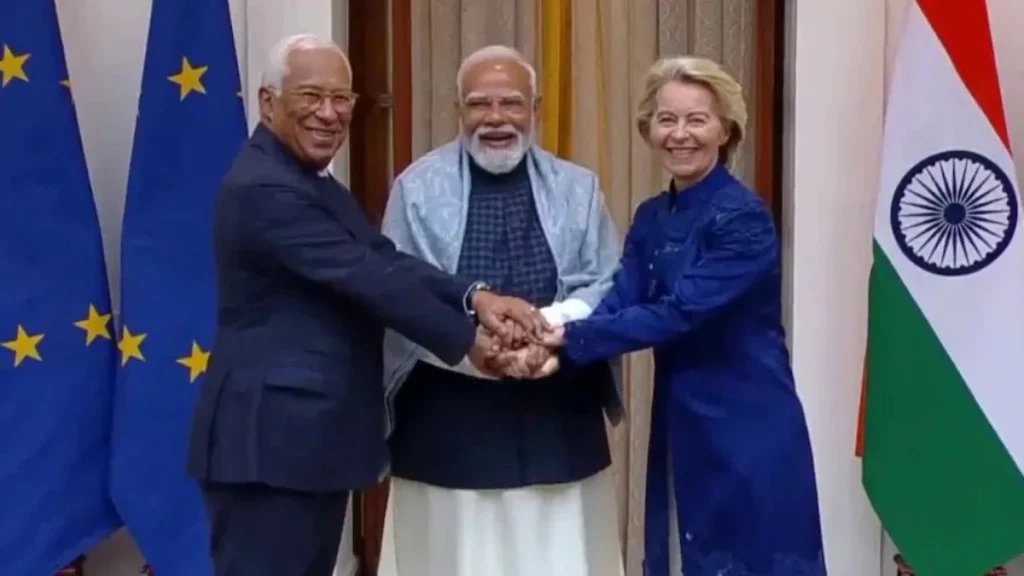
The European Union and India have moved closer to whin
at officials are calling a “mother of all deals,” marking one of the most significant trade and strategic partnerships in recent years. The agreement, widely referred to in media discussions as an “EU India landmark deal,” is expected to reshape global trade dynamics. At the same time, Pakistan’s GSP Plus status of Pakistan remains under scrutiny, raising concerns over its future trade benefits with Europe.
Meanwhile, the United States has issued a renewed U.S. Travel advisory Pakistan, urging citizens to reconsider travel due to ongoing security risks. These parallel developments highlight shifting geopolitical and economic alignments across Asia and Europe.
Background
The European Union has been actively expanding its trade partnerships in Asia as part of a broader strategy to reduce dependency on traditional markets. India, with its rapidly growing economy, has become a key partner in this transformation. The proposed EU India deal is being described as one of the most ambitious frameworks in recent years.
On the other hand, Pakistan has benefited from the EU’s GSP+ scheme, which provides preferential trade access. However, the GSP Plus status of Pakistan is periodically reviewed based on human rights, governance, and compliance standards. This has created uncertainty in Islamabad regarding long-term access.
Details of the EU–India Deal
The India EU landmark deal includes discussions on trade liberalization, investment cooperation, and technology exchange. European officials have referred to it as a “mother of all deals EU India” due to its scale and strategic importance.
Key expected areas of cooperation include:
- Expanded trade in goods and services
- Green energy partnerships
- Digital and technological collaboration
- Supply chain integration between Europe and India
This agreement also reflects Europe’s effort to diversify its economic dependencies amid global uncertainty.
Pakistan’s GSP+ Status Under Pressure
Pakistan’s GSP Plus status of Pakistan remains a critical economic lifeline, allowing duty-free access to European markets for many exports. However, analysts warn that increasing scrutiny from EU institutions could affect future renewals.
The uncertainty has raised concerns in Pakistan’s export sector, especially textiles, which heavily rely on European markets. Any change in GSP Pakistan benefits could significantly impact trade revenues and employment.
US Travel Advisory for Pakistan
The United States has once again updated its U.S. Travel advisory Pakistan, urging citizens to reconsider travel due to security conditions. The advisory highlights risks linked to terrorism, regional instability, and unpredictable security situations in certain areas.
While such advisories are not new, repeated warnings may affect tourism, business travel, and international perception of stability in Pakistan.
Global and Regional Impact
The combination of the EU India deal, Pakistan’s uncertain GSP Plus status, and rising travel advisories reflects a broader shift in global geopolitics.
Key impacts include:
- Strengthening of India–EU economic ties
- Potential pressure on Pakistan’s export competitiveness
- Shifting investment flows in South Asia
- Increased focus on security in international travel decisions
- Realignment of global trade partnerships
Experts suggest that these developments could reshape regional influence in Asia over the next decade.
Expert Opinions
Trade analysts argue that the EU India landmark deal represents a long-term strategic shift rather than a short-term agreement. According to policy experts, Europe is prioritizing stable, large-scale markets like India.
Meanwhile, economic observers in Pakistan warn that maintaining GSP Pakistan benefits will require consistent diplomatic engagement and reforms. Security analysts also note that travel advisories like the U.S. Travel advisory Pakistan often reflect broader geopolitical risk perceptions rather than isolated incidents.
Conclusion
The emerging “mother of all deals EU India” signals a major shift in global trade architecture, strengthening India’s position in international markets. At the same time, Pakistan faces challenges linked to its GSP Plus status of Pakistan and external security perceptions highlighted by the latest U.S. Travel advisory Pakistan.
Future developments will depend on diplomatic negotiations, security improvements, and evolving global economic priorities.
FAQs
What are the threats to the EU?
The European Union faces several interconnected challenges including economic instability, migration pressures, energy security concerns, and geopolitical tensions with major global powers. In addition, cybersecurity risks and internal political divisions among member states also pose significant threats. These factors collectively influence EU foreign policy decisions and its approach toward major trade partners like India and strategic regions like South Asia.
Which country is the best friend of Pakistan?
Pakistan maintains strong diplomatic and strategic relations with several countries, but China is widely considered its closest and most consistent partner. The relationship spans defense cooperation, infrastructure development, and economic investment under initiatives like CPEC. Pakistan also maintains important ties with Turkey, Saudi Arabia, and other regional allies, but China remains the most significant “all-weather friend” in international relations.
Could Israel join the EU?
Israel is not currently a member of the European Union, although it has strong trade and scientific cooperation agreements with the bloc. Full membership is highly unlikely in the near future due to geographic, political, and institutional criteria required for EU accession. However, Israel continues to engage closely with EU countries in areas such as technology, defense cooperation, and research partnerships.