
Eurovision 2026 is just days away but the spotlight is not only on the music. Five countries Iceland, Ireland, the Netherlands, Slovenia, and Spain have opted not to participate in protest at Israel’s inclusion, marking the largest number of boycotting countries in the contest’s history since 1970. The debate over Israel’s place in the competition has turned this year’s event into one of the most politically charged editions in the contest’s 70-year history.
Background Why Is Israel in Eurovision?
Many viewers ask: why is a Middle Eastern nation competing in a European song contest? The answer lies in broadcasting membership, not geography.
Israel’s public broadcaster has been part of the EBU since 1957 and has participated in Eurovision for over 50 years. Its eligibility is based entirely on that membership, just like every other participating country.
Eurovision does not base eligibility on geography it is tied to whether a country’s national broadcaster is a member of the European Broadcasting Union. The EBU includes nations within and around Europe’s broadcasting area, which explains the participation of countries such as Armenia, Georgia, Azerbaijan, and even Australia.
So technically, Israel meets all the rules. The EBU has consistently maintained this position, even as political pressure has grown in recent years.
The EBU Vote What Actually Happened?
The central question going into late 2025 was whether the EBU would hold a direct vote to exclude Israel. It chose not to.
Israel was cleared to compete in Eurovision 2026 after an overwhelming vote by EBU members to adopt a series of reforms, rather than force a referendum on whether to remove the country amid anger over the war in Gaza.
There were 738 votes in favour of adopting the new rules, 264 votes against, and 120 blank votes. The EBU framed this as a vote on rule reforms, not on Israel’s participation directly a distinction that angered several broadcasters who wanted a clear yes or no on Israel.
The EBU declined to put the exclusion of Israel to a vote in its December meeting. In response, five countries announced they were withdrawing from the 2026 Eurovision contest in Vienna.
Which Countries Are Boycotting Eurovision 2026?
The Eurovision boycott by five nations is historic in scale. Each broadcaster gave a clear reason for its withdrawal.
Ireland cited “the appalling loss of lives in Gaza and humanitarian crisis” as the reason for its boycott. The Dutch broadcaster AVROTROS said that “under the current circumstances, participation cannot be reconciled with the public values that are fundamental to our organisation.” Slovenia’s national broadcaster said its move came “on behalf of the 20,000 children who died in Gaza.” Spain’s public broadcaster RTVE also announced it would not participate in the Vienna event.
Iceland’s broadcaster RÚV announced it would not participate due to Israel’s inclusion, after its board voted to recommend Israel’s exclusion in late November 2025.
These five withdrawals make this the biggest boycott in Eurovision history in modern times, and the contest will proceed with 35 participating countries its smallest lineup since 2003.
Why Are People Boycotting Eurovision?
The Eurovision boycott movement goes beyond just these five national broadcasters. Artists and musicians worldwide have added their voices.
More than 1,100 musicians and cultural workers have called for a boycott of the 70th edition of Eurovision over its inclusion of Israel, amid growing pressure to ban the country. The open letter was co-signed by artists including Macklemore, Paloma Faith, Kneecap, Massive Attack, and former winners of the Eurovision contest.
The letter argued: critics say the EBU applied different standards to Russia in 2022 when it was swiftly banned after the invasion of Ukraine versus its approach to Israel.
The letter stated: “The EBU’s hypocritical responses to Russia’s and Israel’s crimes have removed any illusion of Eurovision’s claimed neutrality. In 2022, the EBU said that Russia’s presence would ‘bring the competition into disrepute.
The EBU, however, has drawn a clear distinction. In the case of Russia, the Russian broadcasters were suspended from the EBU due to persistent breaches of membership obligations and the violation of public service values which is fundamentally different from Israel’s situation.
Israeli Government Involvement A Vote Controversy
One major flashpoint in the Eurovision Israel controversy is allegations of government interference in the televoting process.
Israeli government officials ran advertising campaigns to boost public votes and encourage support for their country’s entries in 2024 and 2025. The Israeli Ministry of Foreign Affairs confirmed the existence of such campaigns for the 2024 entry, and similar campaigns for the 2025 entry received over 68 million total impressions.
Several participating broadcasters called for a rework of the televoting system and an independent audit of individual countries’ televoting results following the 2025 final.
In response, the EBU introduced reforms for 2026: votes per person are now capped at 10 (down from 20), and governments are discouraged from running public campaigns for their entrants. Professional juries have also been reintroduced for the semi-final stage.
Eurovision 2026 Rankings and Odds Where Does Israel Stand?
Despite the political storm, Israel remains a strong contender on the Eurovision 2026 odds markets.
Finland’s Linda Lampenius and Pete Parkkonen lead as the clear frontrunner with “Liekinheitin” at a 48% market-implied probability, with their violin-infused pop entry generating broad appeal through positive rehearsal buzz.
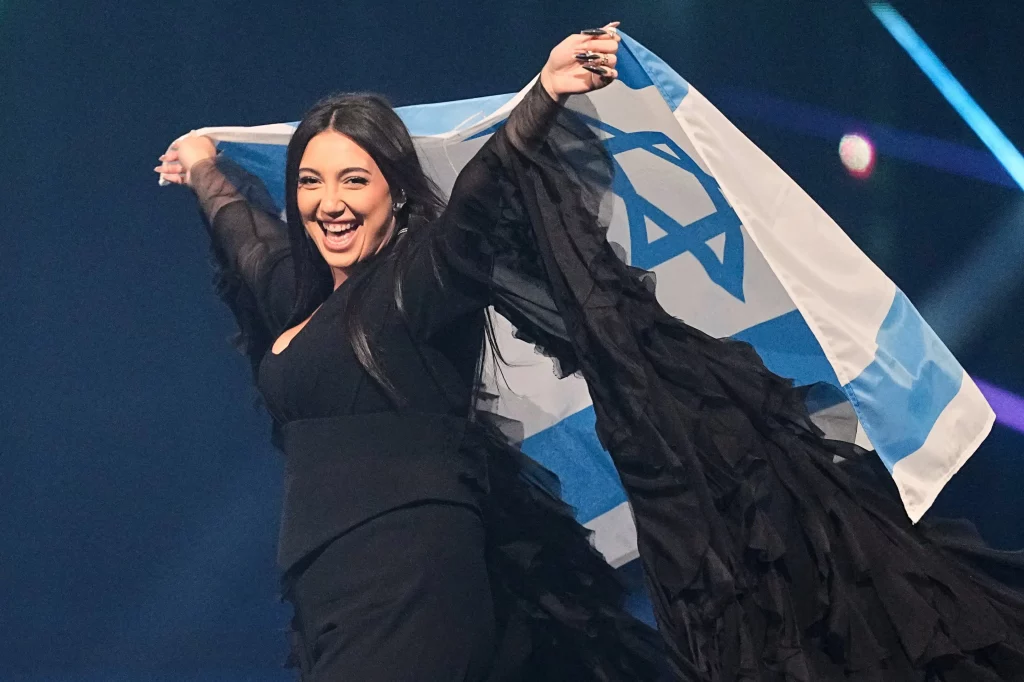
Israel’s Noam Bettan is currently ranked 6th in the betting odds, being traded between 13.00 and 21.00, with the gap between the top 5 and the rest of the field widening.
However, Israel’s strength lies specifically in the public televote. According to William Hill’s betting market for the Eurovision 2026 televote winner, Israel is the big favourite to win the public vote, with a 26% implied chance of victory. Greece sits in second place, and Finland is closely behind in third.
Israel topped the public vote last year, finishing second after all jury scores were included. The televote rules have been changed this year, with just 10 votes per fan permitted down from 20 which should help avoid accusations of mass block voting that dogged the 2025 contest.
Eurovision 2026 Semi Final 1 What to Expect
The Eurovision Song Contest 2026 is scheduled to consist of two semi-finals on 12 and 14 May, and a Grand Final on 16 May 2026, held at Wiener Stadthalle in Vienna, Austria.
Israel competes directly in the Grand Final as a returning semi-final qualifier and does not need to go through Semi Final 1. Greece, one of the main challengers to Finland, enters Semi Final 1 with significant momentum. Bookmakers have identified Finland, Israel, and Greece as the most likely top-10 finishers.
Greece’s Akylas with “Ferto” and Denmark’s Søren Torpegaard Lund trail at 12% each in prediction markets, buoyed by strong national final momentum and fan favourite status, with Vienna rehearsals currently underway.
Quotes From Key Voices
Israeli President Isaac Herzog, who was personally involved in efforts to ensure Israel remained in the contest, said: “Israel deserves to be represented on every stage around the world, a cause to which I am fully and actively committed. I hope that the competition will remain one that champions culture, music, friendship between nations, and cross-border connections.”
Nemo, who won Eurovision for Switzerland in 2024, returned their trophy to the EBU in protest at Israel’s clearance to compete in 2026. Charlie McGettigan, who won for Ireland in 1994, later said he would return his trophy as well.
Global Impact What This Means for Eurovision’s Future
The Israel Eurovision vote controversy has exposed deep fault lines within the EBU and among European public broadcasters. The contest, long marketed as a politically neutral celebration of music, is now facing questions about whether true neutrality is even possible.
Israeli President Herzog reportedly put together a team to push for Israel’s participation, with some direct lobbying of EBU members, aiming to prevent an assembly vote that Israel feared it might lose.
With five countries gone, the contest enters Vienna in a weakened but intensely watched state. The absence of Spain, Ireland, the Netherlands, Slovenia, and Iceland leaves notable gaps — but also keeps the focus squarely on whether Eurovision can survive as a unifying platform in an era of global conflict.
The rule changes introduced for 2026 reduced televotes, stricter campaign rules, jury reintroduction may be seen as either a meaningful reform or an insufficient compromise, depending on one’s perspective.
Conclusion What Comes Next?
Eurovision 2026 kicks off with Semi Final 1 on 12 May, followed by Semi Final 2 on 14 May, and the Grand Final on 16 May in Vienna. Finland remains the overwhelming favourite to win the overall contest, with Israel holding an edge in the public televote.
The bigger question, however, is what happens after Vienna. Will more countries join the boycott in 2027? Will the EBU be forced to revisit Israel’s membership directly? The contest has survived crises before but the scale of the current Eurovision boycott, combined with mass artist protests, suggests that the debate is far from over.
FAQs
How many countries are boycotting Israel in Eurovision?
Five countries are boycotting Eurovision 2026 over Israel’s inclusion: Iceland, Ireland, the Netherlands, Slovenia, and Spain. This is the largest group of boycotting nations in the contest’s history since 1970.
Who is boycotting Eurovision 2026?
The national broadcasters of Iceland (RÚV), Ireland (RTÉ), the Netherlands (AVROTROS), Slovenia (RTVSLO), and Spain (RTVE) have all announced they will not participate in the 2026 contest in Vienna due to Israel’s continued inclusion.
Why are people boycotting Eurovision?
The boycott stems from opposition to Israel’s participation amid the ongoing war in Gaza. Critics argue the EBU is applying double standards compared to its swift ban of Russia in 2022. Additionally, concerns have been raised about alleged Israeli government interference in the televoting process through large-scale advertising campaigns.