
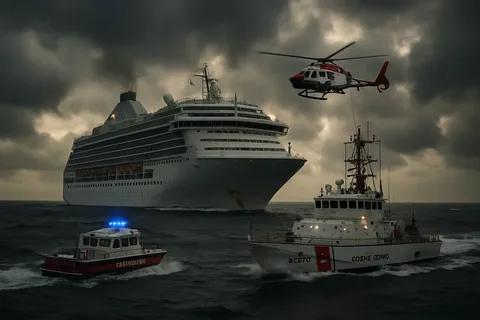
A deadly hantavirus outbreak on the cruise ship MV Hondius has shaken the global travel community. Three passengers have died, and Spain has finally agreed to let the hantavirus cruise ship dock in the Canary Islands after days of uncertainty at sea.
What Is the Hantavirus Cruise Ship?
The hantavirus cruise ship at the center of this global health alarm is the MV Hondius, a luxury expedition vessel operated by Oceanwide Expeditions, a Dutch cruise line company. The MV Hondius is a Dutch-flagged ship operated by Oceanwide Expeditions, carrying 88 passengers and 59 crew members from 23 countries on board.
The hantavirus cruise ship departed on what was meant to be an extraordinary adventure voyage. According to the WHO, the cruise ship set sail from Ushuaia, Argentina, on April 1 for Cape Verde. The voyage took passengers through some of the world’s most remote and breathtaking destinations. The cruise visited the Antarctic Peninsula, South Georgia, and Tristan da Cunha some of the remotest islands on the planet.
This was no ordinary holiday. The voyage was marketed as an Antarctic nature expedition, with berth prices ranging from 14,000 to 22,000 euros ($16,000 to $25,000). Passengers on this hantavirus cruise ship had paid a premium for the experience of a lifetime but they got a nightmare instead.
Where Is the Hantavirus Cruise Ship Now?
The question on everyone’s mind is: where is the cruise ship with hantavirus? After weeks of being stranded at sea and denied entry by several ports, the hantavirus cruise ship location has finally been confirmed.
Spain has granted permission for the luxury cruise ship hit by a deadly hantavirus outbreak and anchored off the coast of Cape Verde to sail to the Canary Islands. This came after significant diplomatic pressure and humanitarian appeals from multiple governments.
Spain’s Ministry of Health said in a statement that the WHO had explained that Cape Verde in West Africa was unable to receive the 147 crew and passengers of the MV Hondius. The ministry added that “The Canary Islands are the closest location with the necessary capabilities,” and confirmed that Spain had both a moral and legal obligation to assist those on board.
Oceanwide Expeditions said the journey to the Canary Islands will take three days of sailing and that the MV Hondius will dock in either Gran Canaria or Tenerife. The hantavirus cruise ship docking at a Canary Islands port marks a major development in this weeks-long health crisis.
Hantavirus Cruise Ship Deaths: What Happened?
The hantavirus cruise ship deaths have been at the center of international concern. A Dutch couple and a German national have died of the rare disease, which is usually spread from infected rodents through urine, droppings, and saliva, on board the ship in early April.
The timeline of the hantavirus cruise ship deaths paints a tragic picture. The first stricken passenger, the Dutch man, died on April 11. His body remained on board until April 24, when it “was disembarked on St Helena, with his wife accompanying the repatriation.
The tragedy did not stop there. His wife had gastrointestinal symptoms when she was disembarked, and deteriorated during a flight to Johannesburg. She died upon arrival at the emergency department on April 26.
Additionally, a British national who was evacuated from the ship is in intensive care in South Africa. South African authorities have confirmed that the British patient, being treated in a Johannesburg hospital, tested positive for hantavirus.
Hantavirus Cruise Ship Company: Who Is Oceanwide Expeditions?
The hantavirus cruise ship company, Oceanwide Expeditions, is a well-known Dutch operator that specializes in polar and expedition cruising. The company runs small, premium ships to remote destinations including Antarctica, the Arctic, and the South Atlantic.
Two crew members require urgent medical care, according to the Dutch-flagged ship’s operator, Oceanwide Expeditions. Another person on board with a suspected case has only reported a mild fever.
The company has been coordinating with WHO, European health authorities, and multiple governments as the situation aboard the hantavirus cruise ship continues to unfold.
Where Did the Hantavirus Come From?
Experts and WHO officials have traced where this hantavirus cruise ship outbreak originated. The typical incubation period for hantavirus is between one and six weeks, leading the WHO to believe that the Dutch couple, who had been travelling in Argentina before boarding the cruise, “were infected off the ship.”
Other passengers may also have been exposed during shore excursions. Other cases may also have been infected while on bird-watching trips to islands where birds and rodents live — such trips are part of the cruise.
Investigators have noted a specific strain at the center of this outbreak. A limited spread among close contacts has been observed in some previous outbreaks of the Andes strain of the virus, which spreads in South America, including Argentina. The Andes strain is the only hantavirus strain known to show any human-to-human transmission, making this hantavirus cruise ship case especially alarming.
Human-to-Human Transmission Suspected on Board
One of the most alarming developments in the hantavirus cruise ship story is the possibility of rare human-to-human transmission. A WHO official said that she suspected some rare human-to-human transmission had occurred between close contacts on board the ship.
WHO’s Maria Van Kerkhove, Director of Epidemic and Pandemic Preparedness and Prevention, was direct in her concern: “We do believe that there may be some human-to-human transmission that’s happening among the really close contacts, the husband and wife, people who have shared cabins,” she told reporters in Geneva.
However, the WHO also reassured the public. The WHO reiterated that the risk to the wider public was low, adding that it had been told that “there are no rats on board” the ship.
Van Kerkhove also sent a message directly to those stranded aboard the hantavirus cruise ship: “We just want you to know we are working with the ship’s operators. We are working with the countries where you are from. We hear you. We know that you are scared.”
Hantavirus Cruise Ship Docking: What Happens Next?
With the hantavirus cruise ship docking now approved for the Canary Islands, the focus shifts to repatriation and medical care. The Spanish Health Ministry said the MV Hondius will journey on to the Canary Islands once those who need evacuation are taken off the ship.
When the rest of the crew and passengers arrive in the Canary Islands, they will be examined, treated, and repatriated to their respective countries, Spain’s Health Ministry said, in coordination with the European Centre for Disease Prevention and Control and the WHO.
Spain also confirmed that strict safety protocols will be in place. All necessary safety measures would be taken, with medical care and transportation provided in special facilities and vehicles to avoid contact with the local population and protect health workers.
The Dutch government has also been actively involved in the response. The ministry said it would receive a medical flight carrying the ship’s doctor, a Dutch national who was gravely ill, following a formal request from the Dutch government.
Hinglaj Mata Temple Recently Seen in News: Where Is It Located?
Separately, the Hinglaj Mata Temple has also recently made headlines. Hinglaj Mata is a Hindu temple located in Hinglaj, a town on the Makran coast in the Lasbela district of Balochistan, Pakistan, lying in the middle of Hingol National Park.
The three-day annual festival at the historic Hinglaj Mata Temple was held in April 2026, drawing around 300,000 pilgrims and is regarded as the third-largest Hindu religious congregation after similar festivals in India and Nepal.
Senator Daanesh Kumar, who attended the festival, described it as proof of interfaith harmony, saying the event “sends a clear message to the world that Pakistan respects and protects the rights of minorities.”
Global Impact and Public Health Concern
The hantavirus cruise ship outbreak has triggered a broader conversation about health safety aboard expedition vessels. Cruise lines that operate in remote, wildlife-rich areas are now under scrutiny regarding rodent control protocols and passenger safety during shore excursions.
The hantavirus cruise ship deaths have put international spotlight on a disease that is rare but deadly. Public health agencies across Europe and the Americas are now monitoring the situation closely, particularly given the multi-national passenger list on the MV Hondius.
The WHO’s involvement signals how seriously the international community is treating this event. Authorities are urging calm while emphasizing that the risk to the broader public remains low.
FAQs
Which countries have hantavirus?
Hantavirus is found across the world. In the Americas, it is particularly prevalent in South America (especially Argentina, Chile, and Brazil) and parts of the United States. In Europe and Asia, different strains of hantavirus are also found. The Andes strain, linked to this cruise ship outbreak, is found primarily in South America.
Can hantavirus spread from human to human?
Generally, hantavirus does not spread from person to person. However, the Andes strain the one suspected in the MV Hondius outbreak has shown limited human-to-human transmission in some cases, particularly between very close contacts such as family members or cabin-mates. The WHO has noted this possibility in the cruise ship case.
What does “washy washy” mean on a cruise ship?
“Washy washy” is a playful phrase used by cruise ship crew members, particularly at the entrance to buffet restaurants and dining areas, to encourage passengers to sanitize their hands. Crew members often say “washy washy, happy happy” while gesturing toward hand sanitizer dispensers. It is part of routine hygiene enforcement on cruise ships worldwide.