
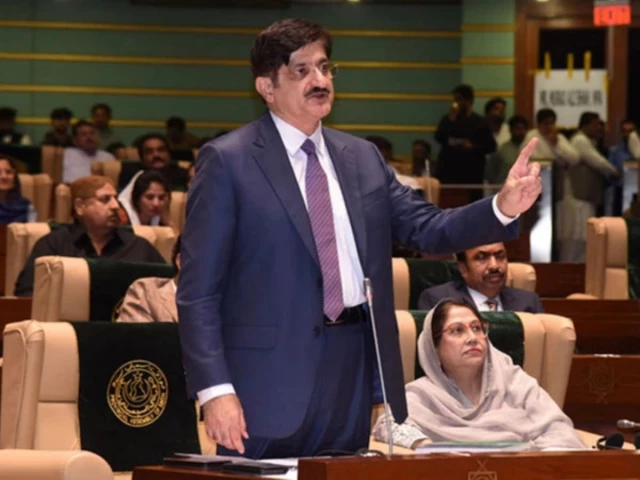

The Sindh Assembly opened a debate on Monday over the creation of new provinces in the country, with Sindh itself at the centre of the discussion. What made the session notable was the mood in the house. Treasury and opposition benches kept an unusual level of decorum on a subject that normally triggers loud protest.
The debate came through an adjournment motion, a parliamentary tool that allows lawmakers to pause regular business and take up a matter of urgent public importance. Given how sensitive the Sindh division issue is, the motion drew attention from every party represented in the assembly.
Background: Why This Debate Started
Talk of carving new provinces out of Sindh and Punjab resurfaced after Interior Minister Mohsin Naqvi suggested that smaller administrative units deserved serious consideration to improve governance in Pakistan’s two largest provinces. He did not name Sindh directly, but the comment was immediately read as targeting the existing Sindh division list.
Sindh has a long history with this argument. The provincial assembly has passed resolutions rejecting the province’s division multiple times, including in 1948, 2000, 2014, 2019, and again in 2026. Each time, the outcome has been the same: no support for splitting up the current Sindh division in Pakistan.
What Happened in the Assembly
PPP Sindh President Nisar Ahmed Khuhro moved the adjournment motion against dividing Sindh. Chief Minister Syed Murad Ali Shah responded directly from the floor, telling members that any decision about the province’s future rests solely with elected representatives sitting in that house.
He reminded the assembly that a new province can only be created through a constitutional process, which requires a two-thirds majority vote from the relevant provincial assembly. Businessmen, television panels, or public rallies, he said, have no authority to redraw the Sindh division districts.
Speaker Awais Qadir Shah allowed the debate to run its full course. He told lawmakers they were free to argue the issue at length, while making clear that any final call on Sindh’s boundaries belonged to the house alone.
Quotes From the Floor
Chief Minister Murad Ali Shah did not mince words on the floor of the house. He insisted that only elected members of the Sindh Assembly, not businessmen, courts, or television panels, have any say over the province’s future, declaring flatly that “Sindh will never be divided.”
He was equally direct about where such matters belong. Any decision on splitting the province, he argued, has to be made inside the assembly chamber itself, since that is the constitutionally proper forum for the discussion rather than a public rally or a talk show.
On the opposition side, MQM-P’s Taha Ahmed struck a different note, calling the chance to formally debate new provinces a “major political success” for his party, even while stopping short of backing an actual split.
Impact: What This Means for Sindh and Pakistan
For now, the practical impact is limited. No resolution to divide Sindh was tabled, and none of the mainstream Sindh-based parties, including the PPP, JI, JUI-F, and PML-N chapters in the province, support breaking up the current six divisions of Sindh.
The wider political impact is harder to dismiss. The Naqvi remark has reopened a conversation that touches Punjab as much as Sindh, and it has pulled parties like PTI into public statements linking the idea to a referendum or a constitutional amendment. That keeps the Sindh division debate alive at the federal level even while the provincial assembly rejects it.
There is also an economic angle worth watching. Any serious push toward new provinces would eventually touch resource distribution, NFC award shares, and administrative control over cities like Karachi, which alone accounts for a large share of the province’s population and revenue.
Conclusion: What Comes Next
Chief Minister Murad Ali Shah has left the door open, narrowly, for a formal vote if the opposition wants one. He pointed out that any resolution on the Sindh division districts would need support from at least 34 assembly members, a threshold he does not expect anyone to cross anytime soon.
Given the province’s history of unanimous resolutions against splitting up, the debate is likely to stay exactly that: a debate. Political observers expect the issue to resurface periodically, tied to whatever the federal government says next about administrative reform, but a real change to the Sindh division list appears unlikely in the near term.
FAQs
What are the divisions of Sindh?
Sindh is currently made up of six administrative divisions rather than seven, a common point of confusion in searches about the Sindh division list. These are Karachi, Hyderabad, Sukkur, Larkana, Mirpurkhas, and Shaheed Benazirabad divisions. Together, they contain roughly 30 districts, which are further broken down into talukas and union councils for local administration.
Which is the biggest division in Sindh?
It depends on whether you measure by area or by population. Hyderabad division covers the largest geographic area in Sindh, spreading across several districts in the province’s centre. Karachi division, on the other hand, is the smallest by land area but by far the largest by population, since it holds the entire city of Karachi and its more than 20 million residents.
What are the new divisions of Sindh?
The most recent addition to the Sindh division list is Shaheed Benazirabad division, created in 2014 and named after former Prime Minister Benazir Bhutto. Karachi division has also changed shape in recent years, after its original district was split into separate districts including Korangi and Kemari, alongside Malir, Gulshan, Orangi, and the central Karachi district. No new province has been created, and none appears likely given the assembly’s repeated rejections of the idea.