
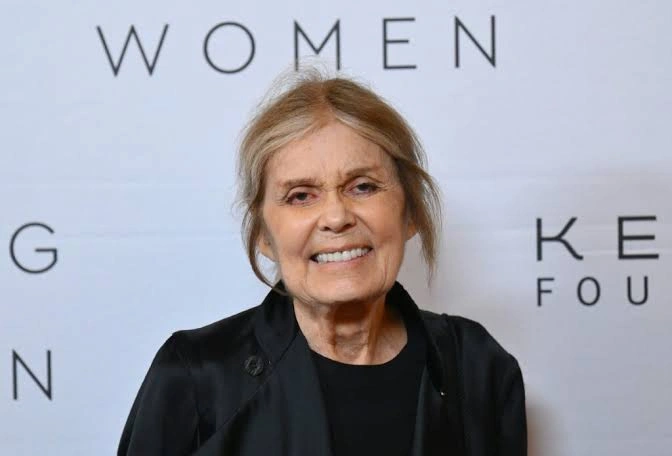
NEW YORK: Gloria Steinem, the pioneering writer, journalist and prominent leader of the US women’s liberation movement, has died at the age of 92.
Steinem’s foundation announced that she “passed away peacefully” at her home in New York City on Wednesday, surrounded by people who loved her.
A leading voice for women’s equality for more than five decades, Steinem co-founded the Women’s Action Alliance, an organisation focused on challenging sexism. She later became one of the most recognisable figures in the American feminist movement.
Gloria Steinem Built a Legacy Through Women’s Rights Activism
Gloria Steinem began her professional career as a journalist in New York before becoming a freelance writer and columnist. Her breakthrough came after she published an investigation into the working conditions of Playboy Bunnies.
She later became a columnist for New York Magazine and, in 1972, co-founded Ms. magazine, which became an influential publication focused on women’s issues beyond traditional subjects such as housekeeping and beauty.
During the 1970s, Steinem became a prominent campaigner for women’s reproductive rights. She publicly supported abortion rights and later celebrated the US Supreme Court’s 1973 Roe v. Wade ruling, which recognised a constitutional right to abortion at the time.
Steinem also revealed that she had obtained an illegal abortion in London at the age of 22. Decades later, she witnessed the reversal of Roe v. Wade, as the US Supreme Court overturned the landmark decision in 2022.
Gloria Steinem Championed Equality and Social Justice
Throughout her career, Gloria Steinem advocated for a wide range of social justice causes.
She campaigned for equal rights and equal pay for women and supported the legalisation of same-sex marriage. She also spoke out against the death penalty and female genital mutilation.
Her activism was shaped in part by experiences early in her life. Born on March 25, 1934, in Toledo, Ohio, Steinem experienced a difficult childhood and did not attend school full-time until she was 12.
After graduating from university in the late 1950s, she travelled to India on a research scholarship. During her two years there, she took part in several activities, including helping village women organise non-violent protests against government policies.
The experience helped strengthen her interest in grassroots activism before she returned to the United States and moved to New York City in the early 1960s.
In 2013, then-President Barack Obama awarded Steinem the Presidential Medal of Freedom, the highest civilian honour in the United States.
Gloria Steinem Remembered by Meghan Markle and Hillary Clinton
Tributes poured in following Gloria Steinem’s death, with writers, activists and feminists remembering her influence and decades of work.
Her foundation said Steinem continued working for equality until the end of her life. It described her ability to listen to people and make them feel seen and heard as one of her greatest gifts.
The foundation also said Steinem spent her final years writing and welcoming people into her home for “Talking Circles”, a tradition it said would continue.
Meghan Markle paid tribute to Steinem as a friend and mentor, sharing photographs of the two together. Markle said Steinem had helped shape the world for women and people more broadly, while describing her privately as even more remarkable than her public achievements suggested.
Markle recalled Steinem spending Thanksgiving with her family, offering advice during difficult periods and showing affection for her children. She also said she proudly wears a bracelet Steinem gave her bearing the words “we are linked, not ranked.”
Former US Secretary of State Hillary Clinton also remembered Steinem as one of the architects of women’s equality.
Clinton said Steinem was fundamentally an optimist whose activism was rooted in optimism and described that outlook as a moral choice she made throughout her life.
Steinem’s foundation said her commitment to turning her home into a centre for social justice movements and her forthcoming book, An Unexpected Life, were among the lasting contributions she hoped would influence future generations.