
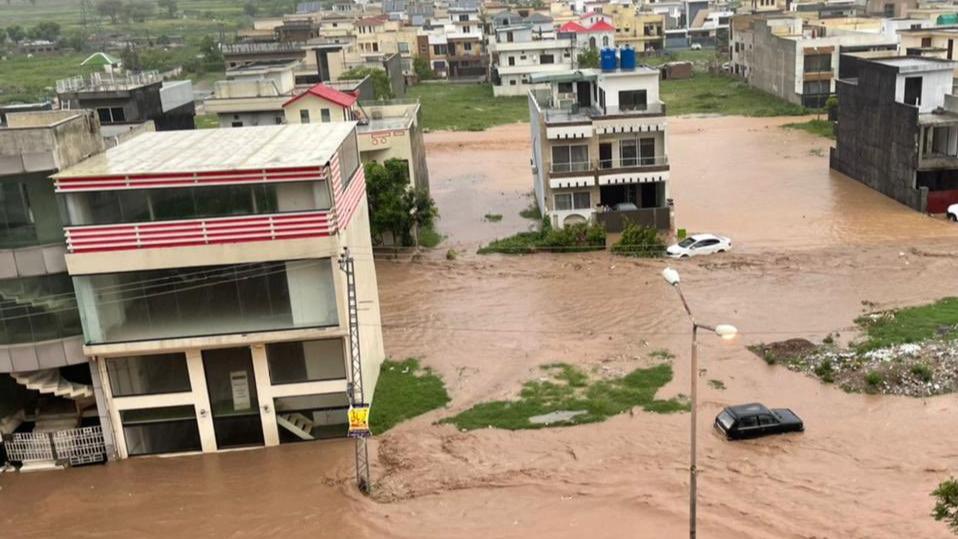

A single spell of monsoon rain was enough to shut down parts of Islamabad and Rawalpindi this week, flood basements that had already been sealed against exactly this risk, and force the Rawal Dam to open its spillways. The rainfall itself was heavy, but how the twin cities’ drainage network handled it, or failed to, is what turned a storm into a crisis.
Background
Islamabad and Rawalpindi share a drainage system built around natural nullahs that carry rainwater off the Margalla Hills and through both cities before it reaches the Soan River. That system was designed decades ago for a much smaller urban footprint. As both cities have grown, housing societies, illegal construction and everyday debris have narrowed or blocked stretches of these channels, leaving them unable to handle sudden, heavy downpours.
September sits at the tail end of Pakistan’s monsoon season, when the Margallas can still produce short, intense bursts of rain even as the broader pattern winds down. This week’s storm was one of those bursts, and it landed directly on a drainage network already running at reduced capacity.
Details: How the Flooding Unfolded
The Pakistan Meteorological Department recorded the heaviest rainfall Islamabad and Rawalpindi had seen in three years, concentrated over just a few hours on September 1. Sector E-11 bore the worst of it, with roughly 150mm falling in a short window, according to the district administration, enough to send water from an overflowing nullah straight onto roads and into building basements.
Where the Flooding Hit Hardest
Beyond E-11, flooding was reported along Park Road near Comsats University and in Ghauri Town Phase II, where officials later said residents had blocked a drainage channel with concrete slabs. A protective wall collapsed in D-12/2 during the storm, triggering a rescue response, though no injuries were reported there.
In Rawalpindi, the Nullah Lai stream rose to about 29.5 feet at Kattarian and 20 feet at Gawalmandi, both well above levels the district administration considers safe. That prompted an immediate holiday declaration for schools and colleges in Rawalpindi for the day.
Rising Water at Rawal Dam
The same rainfall pushed the Rawal Dam’s water level up to 1,751.90 feet, close enough to its operating limits that authorities opened the spillways to release pressure. Downstream communities and low-lying roads near the dam were placed on alert while the release was underway.
Quotes and Official Statements
Islamabad’s deputy commissioner said record rainfall in E-11 had caused drains to overflow and enter previously sealed illegal basements, and confirmed that residents of Ghauri Town Phase 2 had blocked a drain with concrete slabs. He ordered action against those responsible and told sanitation teams to intensify dewatering efforts.
CDA Chairman Sohail Ashraf, who toured the affected sectors alongside district officials, said the authority would build four new check dams at the foothills of the Margallas and lay a new nullah in E-11 to move rainwater through the sector more safely.
Impact: How the Response Played Out
Rescue 1122 evacuated dozens of residents from vulnerable stretches along Nullah Lai in Rawalpindi, while CDA crews and sanitation staff worked through the night and into the next day clearing blocked channels in Islamabad. Dewatering pumps were stationed at underpasses, interchanges and other flood-prone points across the capital as part of a coordinated operation launched the following morning.
Traffic slowed to a crawl on the Islamabad Expressway and several other main roads while standing water was cleared, and commuters were repeatedly warned to avoid low-lying underpasses. For residents in E-11 whose basements flooded despite being sealed in advance, the response raised an uncomfortable question about how much protection sealing alone can actually offer against a nullah this constrained.
The broader economic and social cost is harder to pin down so soon after the event, but past flooding in the same sectors, including a 2021 incident in E-11 that killed a mother and child, suggests the damage tends to extend well past the day the water recedes.
Conclusion
Emergency crews brought this week’s flooding under control within roughly 48 hours, but the underlying drainage bottlenecks that turned heavy rain into an emergency are still there. The CDA’s promised check dams and the new E-11 nullah would address some of that capacity gap if they get built on schedule. Until then, Islamabad and Rawalpindi remain exposed every time the Margallas produce another sudden downpour, which, this late in the monsoon, is still very much on the table.
Frequently Asked Questions
What is a flash flood?
A flash flood is a rapid rise in water levels caused by intense rainfall over a short period, typically developing within minutes to a few hours rather than the days it takes a river flood to build. Because there is so little warning time, flash floods are especially dangerous in urban areas like Islamabad, where narrowed or blocked drainage channels cannot carry the sudden volume of water away fast enough. They commonly affect low-lying roads, underpasses and basements first, since water naturally collects in the lowest available points before authorities can respond.
What is the biggest flood in Pakistan’s history?
By sheer geographic scale, the 2010 floods remain the largest in Pakistan’s recorded history, submerging around a fifth of the country’s total land area and affecting close to 20 million people along the length of the Indus River. The 2022 floods are usually described as the most destructive in terms of lives lost and financial damage, with more than 1,700 deaths and losses exceeding $30 billion after record monsoon rains combined with rapid glacial melt in the northern mountains. Officials and disaster-management experts frequently cite both events when arguing for stronger flood infrastructure.
What is the current situation in Islamabad?
The immediate danger from this week’s flooding has passed, with the CDA and district administration reporting that dewatering operations across E-11, Ghauri Town and other affected sectors were largely complete within a couple of days. Rescue 1122 and sanitation crews remain on standby given the possibility of further late-season rain, and the CDA has begun work to remove the concrete obstruction blocking the Ghauri Town drainage channel. Longer-term fixes, including the proposed check dams and the new E-11 nullah, are still at the planning stage and have not yet broken ground.