
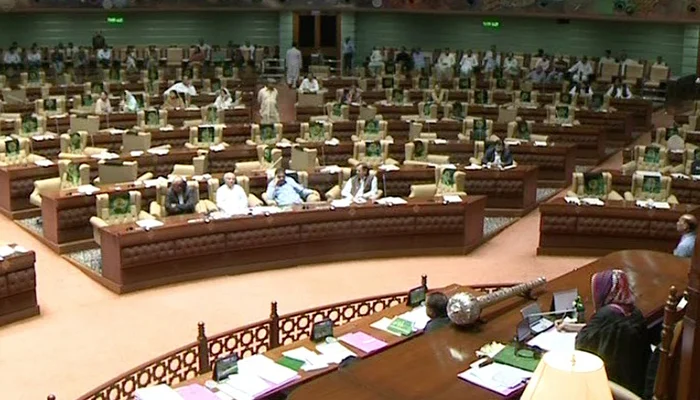

KARACHI: The Sindh Assembly Secretariat has formally forwarded the PA resolution against Sindh division to the federal government, sending letters to the principal secretaries of the president and the prime minister, as well as to the Senate and the National Assembly. The move places Sindh’s stated opposition to any redrawing of its boundaries directly on record with the country’s top constitutional offices.
Background
The step follows the Sindh Assembly’s session earlier this month, where lawmakers passed a resolution rejecting any move to divide the province or carve new administrative units out of it. That sitting itself came after days of debate on an adjournment motion about new provinces, an issue that has been circulating in Pakistani politics for weeks.
Sending a copy of a Sindh Assembly resolution to federal bodies is a fairly standard procedural step, but it carries real weight here. It means Sindh’s position on its own territorial integrity is no longer just a matter of assembly debate; it is now part of the official correspondence between the province and the centre.
Details
What the Letters Say
According to the Sindh Assembly Secretariat, the letters convey the full text of the resolution that rejected any proposal to divide the province. The document calls on the federal government, parliament, all political parties and state institutions to respect the democratic will of the people of Sindh and their elected provincial assembly.
It also asks these bodies to avoid initiating, supporting or even entertaining any proposal that would alter Sindh’s existing territorial limits. That phrasing is fairly broad on purpose. It’s not aimed at one specific plan; it covers any scheme, current or future, that touches Sindh’s boundaries.
Where the Resolution Was Sent
The letters went out to four distinct recipients: the Principal Secretary to the President, the Principal Secretary to the Prime Minister, the Senate Secretariat and the National Assembly Secretariat. Routing it through all four ensures the resolution is registered with both the executive and both houses of parliament, rather than sitting with just one office.
The Resolution Behind the Letters
The original Sindh Assembly resolution was moved by PPP lawmaker Nisar Ahmed Khuhro after a lengthy debate and was passed amid a walkout by MQM-P and JI lawmakers. It declared Sindh an indivisible province, drawing on a long list of similar resolutions the assembly has passed since 1948, most recently in 2012, 2013, 2014, 2019 and February of this year.
Quotes
The resolution itself, as conveyed in the Sindh Assembly Secretariat’s letters, states that it calls upon “the Federal Government, the Parliament, all political parties and all state institutions to respect the democratic will of the people of Sindh.”
Chief Minister Syed Murad Ali Shah, who led the debate before the resolution was passed, had earlier told the house that any decision on Sindh’s future rested with its own elected representatives and not with outside voices. Senior Minister Sharjeel Inam Memon added that province-level constitutional questions like this one belong squarely with the provincial assembly, not with television debates.
Impact
This step turns a provincial-level political statement into a formal piece of correspondence with national institutions. Practically speaking, the resolution has no power to block legislation on its own since creating a new province requires a constitutional amendment under Article 239, which needs a two-thirds majority in the relevant provincial assembly. But politically, it puts every federal office on notice about where Sindh’s elected house stands.
It also raises the stakes for the ongoing national conversation around new provinces. With Sindh’s position now formally logged with the president, the PM and both houses of parliament, any federal move touching the province’s boundaries would have to reckon with this resolution as part of the public record.
Conclusion
Whether this changes the trajectory of the broader new-provinces debate in Islamabad remains to be seen. For now, the Sindh Assembly Secretariat has done what it can procedurally: put the province’s rejection of any division of Sindh in writing, in front of the people who would actually have to act on any constitutional change. Given how frequently this issue has resurfaced in Pakistani politics, further statements from federal leaders and other provincial assemblies are likely in the coming weeks.
Frequently Asked Questions
Who supported the Pakistan resolution from Sindh?
The resolution against dividing Sindh was backed by the PPP-led treasury benches in the Sindh Assembly, with Chief Minister Murad Ali Shah and Senior Minister Sharjeel Inam Memon speaking in its favour during the debate. MQM-P and JI had walked out over a separate procedural disagreement before the vote took place, so they were not present when it passed, and PTI lawmakers were absent from the house altogether that day.
What are the new divisions of Sindh?
No new divisions have actually been created in Sindh. The resolution that was sent to federal authorities explicitly rejects proposals to divide the province, detach any district or region from it, or place any part of Sindh under a separate administrative setup. At this stage, the idea of new provinces or administrative units remains a political proposal under discussion, not an implemented change.
Did the Sindh Assembly pass the Pakistan Resolution?
No, this should not be confused with the 1940 Pakistan Resolution, which is a separate historical document. What the Sindh Assembly Secretariat sent to the federal government is a contemporary resolution opposing the division of Sindh, one that briefly recalls the province’s historic support for joining Pakistan as background context. The assembly has passed similar resolutions defending Sindh’s unity on several occasions over the decades.