

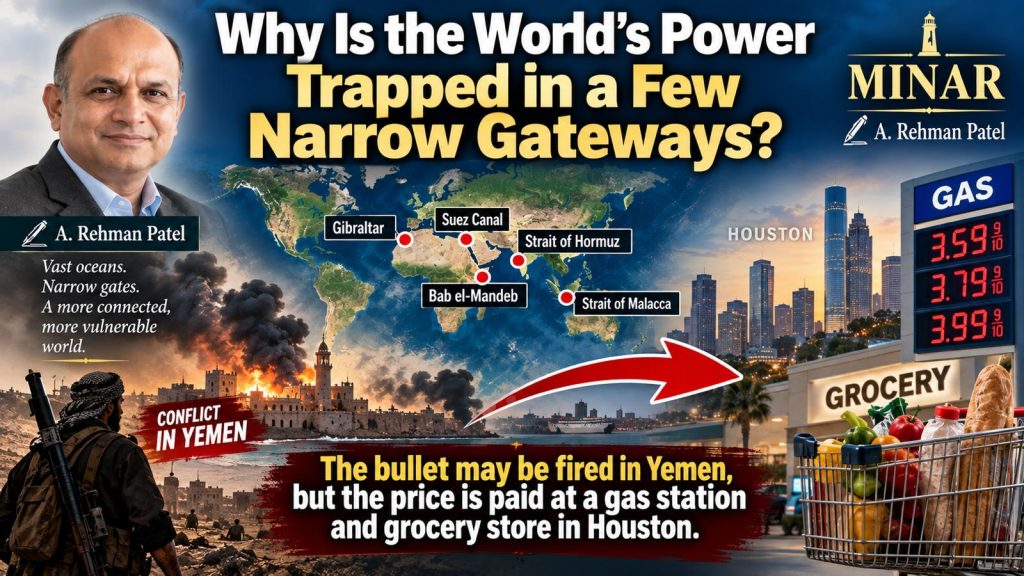

Why Is the World’s Power Trapped in a Few Narrow Gateways?
MINAR
A. Rehman Patel
On a map, the oceans appear immense.
The Indian Ocean, the Pacific, the Atlantic, the Arabian Sea and the Red Sea are such vast bodies of water that human beings seem insignificant beside them.
Yet history teaches us a curious lesson:
The world’s oceans may be vast, but global power has often been concentrated in a handful of narrow gateways.
Today, one of those gateways is once again at the center of world attention: Bab el-Mandeb.
In Yemen, the Houthis, also known as Ansar Allah, have advanced along the Red Sea coast toward strategically important areas near the entrance to Bab el-Mandeb. At the same time, the Strait of Hormuz is also under considerable pressure.
At first glance, this appears to be a story about Yemen, Saudi Arabia, Iran and the Middle East.
In reality, it is a story about the geographical vulnerability of the entire world.
In the nineteenth century, American naval strategist Alfred Thayer Mahan argued in his famous book The Influence of Sea Power upon History that a powerful army alone was not enough to make a nation a great power. Commerce, naval strength, ports and access to maritime routes were also fundamental elements of national power.
But centuries before Mahan wrote about sea power, the Portuguese, Spanish, Dutch, French and British empires had already learned this lesson in practice.
They did not reach distant parts of the world primarily by land.
They arrived by sea.
The Portuguese sailed around Africa into the Indian Ocean. European powers established influence over ports and commercial routes. Britain was a relatively small island nation, yet its command of the seas helped extend its power to distant corners of the world.
That is why Suez is more than a canal, Gibraltar more than a rock, Malacca more than a passage of water, and Hormuz and Bab el-Mandeb more than names on a map.
They are gateways to the global economy.
Throughout history, empires have not always fought simply to conquer land.
Sometimes they sought control of the routes through which the wealth of others had to pass.
Today, sailing ships have been replaced by container ships and oil tankers, while cannons have given way to missiles and drones.
But geography remains exactly where it was.
That is one of the great paradoxes of the twenty-first century.
We can observe the Earth through satellites. Artificial Intelligence can process millions of pages in seconds. Money can travel electronically from New York to Singapore almost instantly.
Yet millions of barrels of oil still have to physically sail through Hormuz, Bab el-Mandeb or Malacca.
Technology has conquered time.
It has not conquered geography.
This is where the conflict in Yemen becomes a global story.
If Hormuz becomes unsafe, the world searches for alternative routes. If Bab el-Mandeb also becomes insecure, the alternative itself comes into question.
And if pressure builds simultaneously at both gateways, the world can begin receiving the bill even before it fully hears the sound of war.
Oil becomes more expensive. Shipping insurance and freight costs rise. Transportation becomes costlier, eventually affecting food and the prices of everyday goods.
Then an extraordinary connection becomes visible:
The bullet may be fired in Yemen, but its cost can be paid at a gas station or grocery store in Houston.
And perhaps this can also be considered our prediction for this week:
If instability around Hormuz and Bab el-Mandeb continues, its impact in the coming months will not remain confined to oil. Transportation costs, food prices, inflation and ultimately the monthly household budget may all begin paying the price.
The great illusion of wars is that, in the beginning, they appear local.
Economics makes them global.
And that brings us to Pakistan.
For Pakistan, the situation is particularly complicated.
It has historic, economic and defense ties with Saudi Arabia. Iran is its neighbor. Millions of Pakistanis are connected to employment across the Gulf, while Pakistan’s energy requirements are deeply tied to the same region.
Therefore, the only question Pakistan should ask is not:
Whose side are we on?
A wiser question would be:
Where does Pakistan’s national interest lie?
Friendship does not require participation in every war.
And neutrality does not mean remaining indifferent to every threat.
Pakistan has an interest in Saudi Arabia’s security, in maintaining workable relations with Iran, in keeping maritime trade routes open, and in ensuring that a regional conflict does not pull it into a battlefield that may be easy to enter but extremely difficult to leave.
For Islamabad, therefore, the greater test in the coming days may not be whether to pick up a weapon.
It may be how to maintain the balance.
There is another lesson emerging from this crisis.
Small powers are no longer necessarily small.
If a relatively limited group sits close to a critical maritime chokepoint, possesses drones and missiles, and has the capacity to disrupt international shipping, its power cannot be measured simply by the number of soldiers under its command.
In the twenty-first century, a new measure of power is emerging from the combination of geography, technology and the ability to disrupt.
That may prove to be one of the defining lessons of the world ahead.
Not every future conflict will be fought between great nations. Sometimes a small island, a port or a strait only a few miles wide may be capable of shaking the global economy.
We often say that globalization has connected the world.
That is true.
But that same interconnectedness has created a new vulnerability.
A crisis at one small gateway can now alter a household budget thousands of miles away.
Centuries ago, sailing ships carried empires across these same waters.
Today, oil tankers, container ships and the global economy travel through them.
The ships have changed.
The empires have changed.
The weapons have changed.
But geography has not.
And perhaps that is the lesson of history we repeatedly forget:
Look at a map and the oceans appear vast. Yet the destiny of the world has often been written not by the oceans themselves, but by their few narrow gateways.