

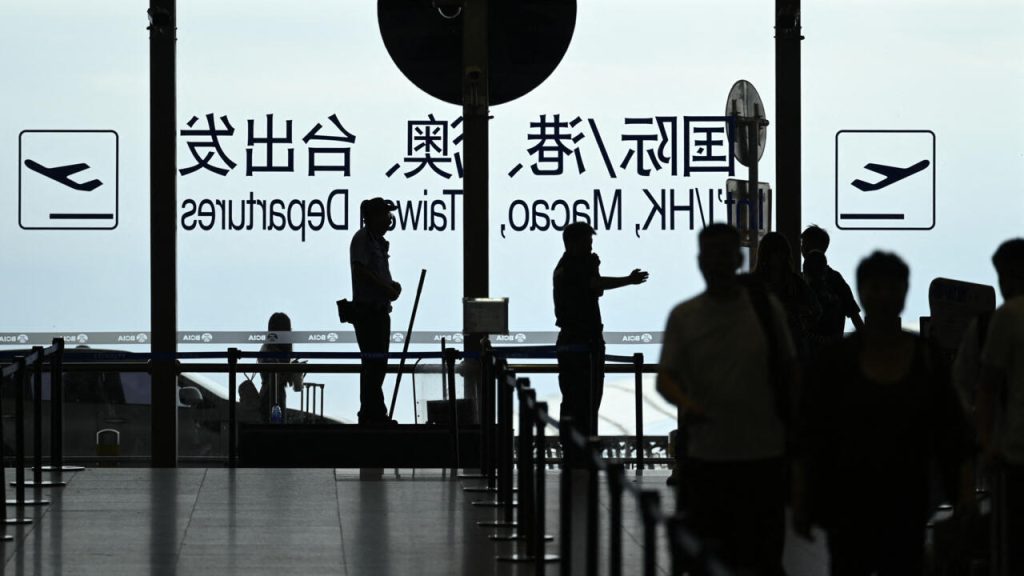

China’s exit-and-entry rules changed on Tuesday. Citizens can now be stopped from leaving the country if authorities decide they pose a risk to what Beijing calls “industrial or technological security.” The rules were first announced in July, but they only became enforceable this week.
The State Council framed the move as necessary to protect “national sovereignty, security, and development interests.” In practice, it hands officials a new legal basis for blocking departures, on top of powers they already had.
Background
China has never fully closed its borders the way it did during parts of the Cold War era, and ordinary citizens travel abroad in large numbers every year. Still, the government has kept a long-standing habit of watching who leaves, particularly officials and executives with access to sensitive information.
Exit bans themselves are not new. What changed on Tuesday is the scope. The updated rules bring technology and industrial security into a category that can trigger a travel block, an area that used to sit outside the usual exit-ban framework.
The timing lines up with a broader pattern. China and the United States have spent much of this year trading accusations over AI development, with each side claiming the other has tried to copy or steal advances in locally built models. That rivalry appears to have shaped how the new rules were written.
Details
Under the new framework, citizens who violate technology import and export regulations can be barred from leaving China. The rules single out cases where such violations are judged to endanger the country’s industrial or technological security, a fairly broad category that leaves room for interpretation.
There is also a separate provision for people who commit illegal or criminal acts abroad that harm national security or China’s broader interests. Anyone in that situation faces a possible exit ban ranging from six months to three years, counted from the date they return to Chinese territory.
Foreign nationals are affected too, though differently. Under the updated system, they can be denied entry into China for one to five years if they are found to have made false statements on a visa application.
None of this applies to everyone equally. Senior government officials and executives at state-linked firms have already lived under tighter travel scrutiny for years, so the new rules extend an existing practice rather than starting one from scratch.
Quotes
Analysts who study Chinese law point to one problem with the new rules: the language is loose enough to be read in different ways. Chong Ja Ian, who researches Chinese politics at the National University of Singapore, told AFP that security and criminal-activity definitions in China “can be vaguely defined and easily adjusted.”
Chong also raised the case of Min Zin, a US citizen and Myanmar analyst who was taken into custody in Yunnan province in June. Washington has said he was held improperly; Beijing has said he is suspected of breaking Chinese law. Chong argued that case shows how wide the net could stretch once the new rules are applied in practice.
Dylan Loh, an associate professor at Nanyang Technological University in Singapore, offered a similar read on the intent behind the policy, saying the restrictions are meant to send a signal that Beijing will act to stop what it sees as security leaks.
Impact
For ordinary travelers, the immediate effect is likely to be small. Most Chinese citizens are not involved in technology import or export work and will not come close to the categories the new rules target.
The bigger impact falls on people working in sensitive sectors: engineers, researchers, and executives tied to semiconductors, AI, and other technologies caught up in the US-China rivalry. For that group, an overseas trip now carries a new layer of legal risk that did not exist last month.
Foreign businesses operating in China are watching closely as well. Broad, loosely defined rules tend to make companies nervous, since it becomes harder to predict which activities might draw scrutiny. Taiwan’s government has already told its citizens to be cautious when visiting the mainland, given that Beijing treats people from Taiwan as Chinese nationals under its own law.
Conclusion
For now, much of how the new rules will actually work in practice remains unclear. Analysts say the real test will come once the first cases are made public, which is usually how the boundaries of vague Chinese security laws get defined over time.
Until then, expect continued friction between Beijing and Washington over technology, and more attention on how China applies exit bans to both its own citizens and foreign nationals living or working there.
FAQs
What is the “0.1% rule” in China?
There is no official Chinese government policy known as the “0.1% rule,” and it is not part of the exit-and-entry regulations that took effect this week. The confusion may stem from separate data published by the rights group Safeguard Defenders and cited by the BBC, which found that the share of civil court verdicts in China involving exit bans rose from roughly 0.23 percent in 2019 to about 7.3 percent by 2025. That trend reflects a broader rise in exit-ban cases over recent years, but it is not a named “rule” and is not specific to the new technology and national-security provisions covered in this article.
What is the national security of China?
China’s concept of national security is deliberately broad. Under the National Security Law passed in 2015, it covers political stability, economic security, military defense, cybersecurity, technology, culture, and social order, among other areas. Rather than focusing narrowly on external military threats, Chinese law treats national security as something that touches nearly every part of public and economic life, which is part of why critics argue the definition leaves room for wide discretion when applied to individual cases, including exit bans like the ones announced this week.
Why is 2027 important to China?
2027 marks the 100th anniversary of the founding of the People’s Liberation Army, and Chinese leadership has set it as a deadline for a separate military milestone known as the “centennial military building goal.” That goal calls for the PLA to make major progress on mechanization, informatization, and the integration of artificial intelligence into military operations. It is a distinct policy target from the travel and exit-ban rules covered in this article, though both reflect the same broader push by Beijing to tighten control over strategically sensitive technology as competition with the United States continues.